


Robinhood found a meaningful fee engine within two months of launching a chain. Whether that engine becomes durable earnings is a different question.
The market has focused on the headline: Bernstein kept an Outperform rating on Robinhood Markets and a $160 price target for HOOD. The more useful story is underneath it. A young chain built for tokenized stocks has so far been driven largely by memecoins, launchpads, and speculative pools. Those activities have generated real fees at a scale that caught Wall Street’s attention.
But “chain fees,” “chain revenue,” and “Robinhood earnings” are not interchangeable. The gap between them is where the real investment debate begins.
TL;DR
- Bernstein maintained an Outperform rating on HOOD with a $160 target, roughly 31% above Robinhood’s $122.11 close on September 4, according to The Block’s report on Bernstein’s note.
- Robinhood Chain generated roughly $39 million in cumulative fees from its July 1 public-mainnet launch through early September. About $33 million came in the 15 days to September 8, ahead of Solana and BNB Chain over the same period.
- Tokenized-stock value on the chain reportedly grew from roughly $10 million to $140 million in two months. That growth matters, but some reported stock-token volume is still attached to memecoin pools.
- Bernstein’s 2028 estimate of about $160 million in annual chain fees is far below the annualised rate implied by the early-September fee spike. The difference reflects a normalised forecast, not necessarily a contradiction.
- The key test is whether activity remains after incentives fade and whether users come for tokenized equities themselves rather than for speculative pairs.
Why Can a Two-Month-Old Chain Support a $160 HOOD Target?
Bernstein’s call matters less because of the target itself than because of the change it describes. Robinhood has historically monetised customer activity through its brokerage platform. Robinhood Chain adds another possible source of economics: transaction fees generated where that activity happens onchain.
The analyst case rests on a visible fee stream. As reported by The Block, the chain collected around $39 million in fees after its July 1 launch, with an unusually large share arriving in the first half of September. The same reporting cited fees of roughly $33 million over 15 days, compared with about $11 million for Solana and $9 million for BNB Chain during that window.

The Block’s September 8, 2026 report. It shows the reported $160 HOOD price target, about $39M in cumulative chain fees, and the $160M annual-fee estimate for 2028.
The source document behind the story describes this as a “chain is now earnings” thesis. The wording is directionally useful, but readers should keep the accounting layers separate:
- Chain fees are the gas charges users pay.
- Chain revenue is what the network retains after settlement and infrastructure costs.
- Robinhood’s reported revenue is what ultimately reaches its financial statements after the relevant commercial arrangements and costs.
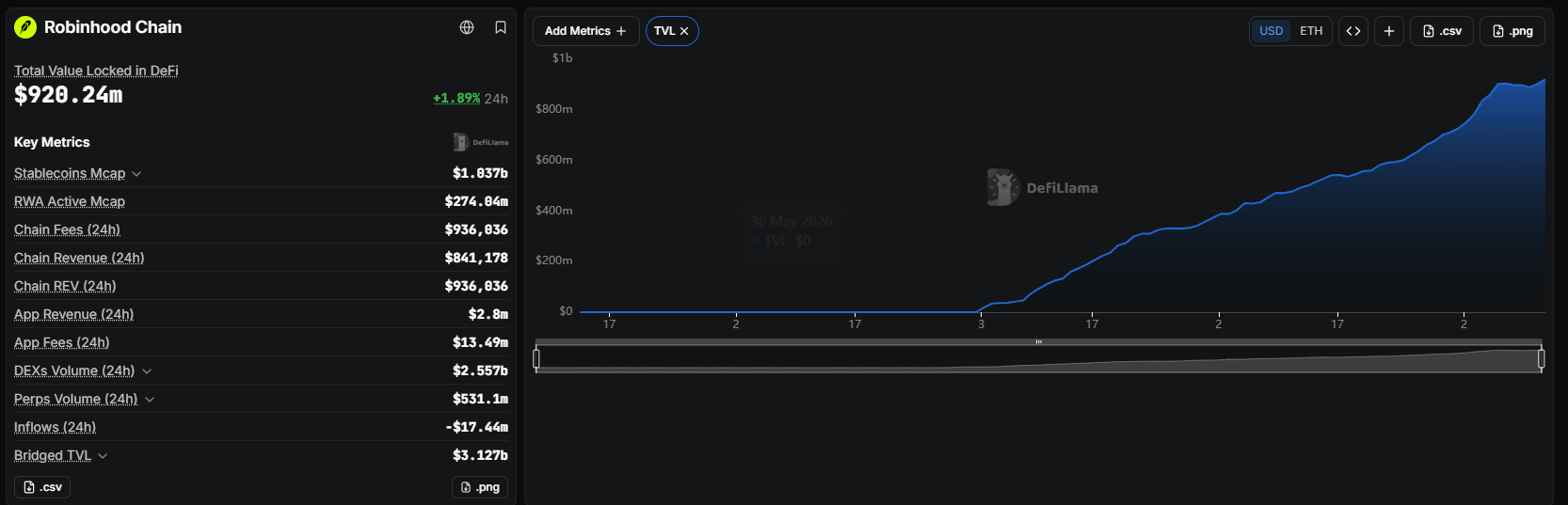
On September 4, DefiLlama recorded approximately $6.04 million in chain fees and $5.44 million in chain revenue for Robinhood Chain. Those numbers demonstrate demand, but neither one is a published Robinhood Markets revenue line. A fee dashboard is not an earnings release.

Where the Fees Are Actually Coming From
Robinhood Chain was designed to bring tokenized equities and other real-world assets onchain. Its early fee surge came from a less traditional starting point: memecoins and launchpads.
That is not automatically a flaw. New chains often attract the fastest-moving capital first, and speculative flows can help a network build liquidity, users, and infrastructure. Whales Market’s guide to Robinhood Chain projects shows why Pons, Long.xyz, and other early venues have mattered: launchpads, stock-backed pools, and DEXs can create a feedback loop between new tokens and tokenized stocks.
That is a powerful growth chart. It is also a warning about concentration. A chain can look like a recurring earnings platform while a launch event, a hot token, or a fee-sponsored campaign is doing much of the work.
Tokenized stocks are the part of the narrative Bernstein expects to last. Their value on the chain reportedly rose from roughly $10 million to $140 million in two months. Stablecoin supply rose from about $241 million to roughly $1 billion. Tokenised-stock pairs also reached around 27% of trading volume, while native memecoin pairs fell to roughly 36% from almost all volume at launch.
The mix is moving in the direction Bernstein wants. interpretation needs care.
A tokenized-stock pool can create stock-token volume even when the trader’s real view is on a memecoin. If a memecoin trades against a tokenised NVIDIA or AMC token, every swap can increase volume in the stock side of the pair. That does not mean each participant has developed independent demand for the underlying equity.
The point is not that the 27% figure is misleading. It measures something real. It just does not by itself prove that the chain has graduated from speculation to sustainable tokenized-equity use.
Whales Market’s xStocks guide is useful context here. Tokenized stocks can be valuable because they make traditional assets more composable, but users still need to understand what the token represents, how backing and redemption work, and which rights do or do not travel with the token.

Why the Run Rate and Bernstein’s Forecast Look So Different
The most interesting number in the story is not the $160 target. It is the distance between Bernstein’s 2028 estimate and the early-September run rate.
Bernstein expects Robinhood Chain to generate around $160 million in annual fees by 2028. At the same time, DefiLlama showed roughly $20.33 million in chain revenue over a recent seven-day period. Annualised mechanically, that is close to $1.06 billion.
The two figures are not designed to match. One is a long-term analyst estimate. The other is a short observation window during an exceptional burst of activity. Treating the annualised dashboard number as a forecast would be as careless as treating a single high-fee day as normal operations.
That is sensible modelling discipline. A sell-side analyst should not take a two-month memecoin cycle and extend it in a straight line to 2028. But the gap should change how readers interpret the headlines. Bernstein is bullish on the potential economics of Robinhood Chain. Bernstein is not claiming that the current fee peak is a steady state.
The important question is what has to stay after the spike ends. The answer probably includes a few things:
- Tokenized-stock liquidity that remains useful outside meme pairings.
- Stablecoin balances that stay on the network once the most aggressive incentives end.
- Venues with recurring trading rather than one-off launch events.
- Transparent operating history during normal and stressed conditions.
- A clear route from network revenue to Robinhood’s reported economics.
Defillama coverage of the $13 million daily-fee record is therefore best read as an observation, not an earnings forecast. The record proves that the chain can monetise attention. It does not prove the level of attention that will remain.
The Economics Are Attractive, but the Risks Are Concentrated
The most bullish feature of the model is the reported fee split. The source material cites an estimated 90% of chain fees retained by Robinhood, with roughly 10% directed to Arbitrum through the Orbit arrangement and less than 1% paid to Ethereum for data. If that structure proves durable, it gives Robinhood an unusually direct claim on activity happening on its own chain.
That is the good version of the story. The risk is that the activity, the operating model, and the regulatory exposure are all still early.
First, some of the fee spike occurred while Robinhood was subsidising gas in its wallet. The source material says the minimum gas-sponsorship threshold was lowered from $5 to $0.50 through September 29. Sponsoring fees can be an effective way to make a new chain easier to try. It also means the market has not yet seen exactly how much activity remains once users bear the full cost.
Second, Robinhood Chain experienced a roughly 13 to 14 minute interruption in block production on September 4, according to BeInCrypto’s incident report. Third, tokenized stocks add legal and market-structure questions that do not disappear because a token trades 24/7. The AMC episode in the source material makes the point. A stock-backed token can gain a premium in a thin or emotionally charged market, yet the ability to mint and redeem against the underlying asset can expand supply and remove that premium. The token’s mechanics are a feature, not a guarantee that a speculative move will last.
The lesson for traders is simple. A pair can look liquid on a chart while the other side of the market is thin, volatile, or structurally different from the asset it references. Before trading stock-backed memecoins or new pools, check the price impact, pool depth, and redemption structure. Whales Market’s slippage explainer covers why a large order can receive a very different execution price from the quote a trader saw before submitting it.

What Would Validate the Bernstein Thesis?
The first test is fee quality. Watch whether revenue remains meaningful after fee subsidies and launchpad mania cool. A declining daily fee number is not automatically bearish if activity becomes more diverse and more predictable. The question is whether the remaining users still pay for something the chain does better than alternatives.
The second test is independent tokenized-stock demand. Track how much volume comes from users who actually want exposure to stock tokens, liquidity provision, collateral, or 24/7 settlement. That is more durable than a memecoin paired with a stock token because the pair happens to be fashionable.
The third test is transparency. For a chain used around regulated financial assets, users should be able to assess uptime, incident response, sequencer controls, contract upgrade permissions, and the terms behind tokenised assets. A maturing network should make these things easier to verify, not harder.
The fourth test is accounting clarity. Investors do not need every chain fee to appear on Robinhood’s income statement. They do need a credible bridge between gross network activity, costs, Robinhood’s retained share, and the economics that matter to HOOD shareholders.
For an ecosystem view, read Whales Market’s analysis of the top Robinhood Chain projects. It separates the launchpads that attract attention from the DEXs, reserve protocols, and brokerage experiments that have to prove they can keep users when the easy volume leaves.
Conclusion
Bernstein’s optimism has a real foundation. Robinhood Chain has shown that a company can create meaningful onchain fee activity quickly, and the reported retention economics are attractive. Tokenized stocks are a plausible path to a more durable use case than a launchpad cycle alone.
But the strongest conclusion is not that a few high-fee weeks guarantee a $160 share price. It is that Robinhood now has a new economic experiment worth watching.
The fee surge proves that the chain can monetise demand. The next phase must prove which demand stays. If tokenized stocks, stable liquidity, and recurring users remain after the memecoin cycle fades, Bernstein’s thesis becomes much easier to defend. If activity contracts back to a handful of speculative venues, the early fee record will look more like a successful launch event than a durable earnings stream.
For traders evaluating early opportunities before a public token or broader market has fully priced them, Whales Market pre-market can help surface price discovery. Treat that price as an agreement about expected value, not a prediction of where an asset will trade after launch.
FAQs
Does Robinhood Chain have a native token?
No. Robinhood Chain does not have a native gas or governance token. Tokens associated with launchpads or projects on the network are third-party assets and do not represent ownership in Robinhood Markets.
Are Robinhood Chain fees the same as Robinhood revenue?
No. Fees are what users pay. Chain revenue is what the network keeps after some costs. Robinhood’s reported revenue is a further accounting question that depends on the commercial structure and costs that reach the company’s financial statements.
Why is Bernstein’s 2028 estimate lower than the current annualised run rate?
Because they describe different periods. The early-September annualised figure captures a peak during intense memecoin and launchpad activity. Bernstein’s 2028 number assumes a more normal, sustainable level rather than extending the peak unchanged.
Do tokenized-stock pairs mean users are buying stocks onchain?
Not necessarily. A memecoin swap through a pool paired with a tokenized stock can create volume in the stock token without the trader taking a deliberate view on the underlying equity. Volume should be read with the pool design in mind.