

Robinhood Chain is being built to bring stocks and real-world assets onchain. In its early stage, however, most of the attention has come from memecoins, launchpads, and new tokens paired with tokenized stocks.
High volume does not automatically translate into durable value. A protocol can look strong while incentives or a newly launched token are driving activity, then lose users just as quickly once attention fades. The more useful question is which projects already have a working product, verifiable usage data, and a mechanism that routes value back to the protocol or its token.
This article selects five projects across five layers: launchpads, stock-backed memecoins, reserve protocols, dynamic-fee DEXs, and onchain brokerage. This is not a recommendation to buy any token.
What Kind of Ecosystem Is Robinhood Chain Building?
According to the Robinhood Chain dashboard on DefiLlama, the ecosystem had approximately $890 million in TVL, a $1 billion stablecoin market cap, and $266 million in active RWA market cap at the time of writing. DEX trading volume reached roughly $1.8 billion over 24 hours, while seven-day volume exceeded $10.7 billion.
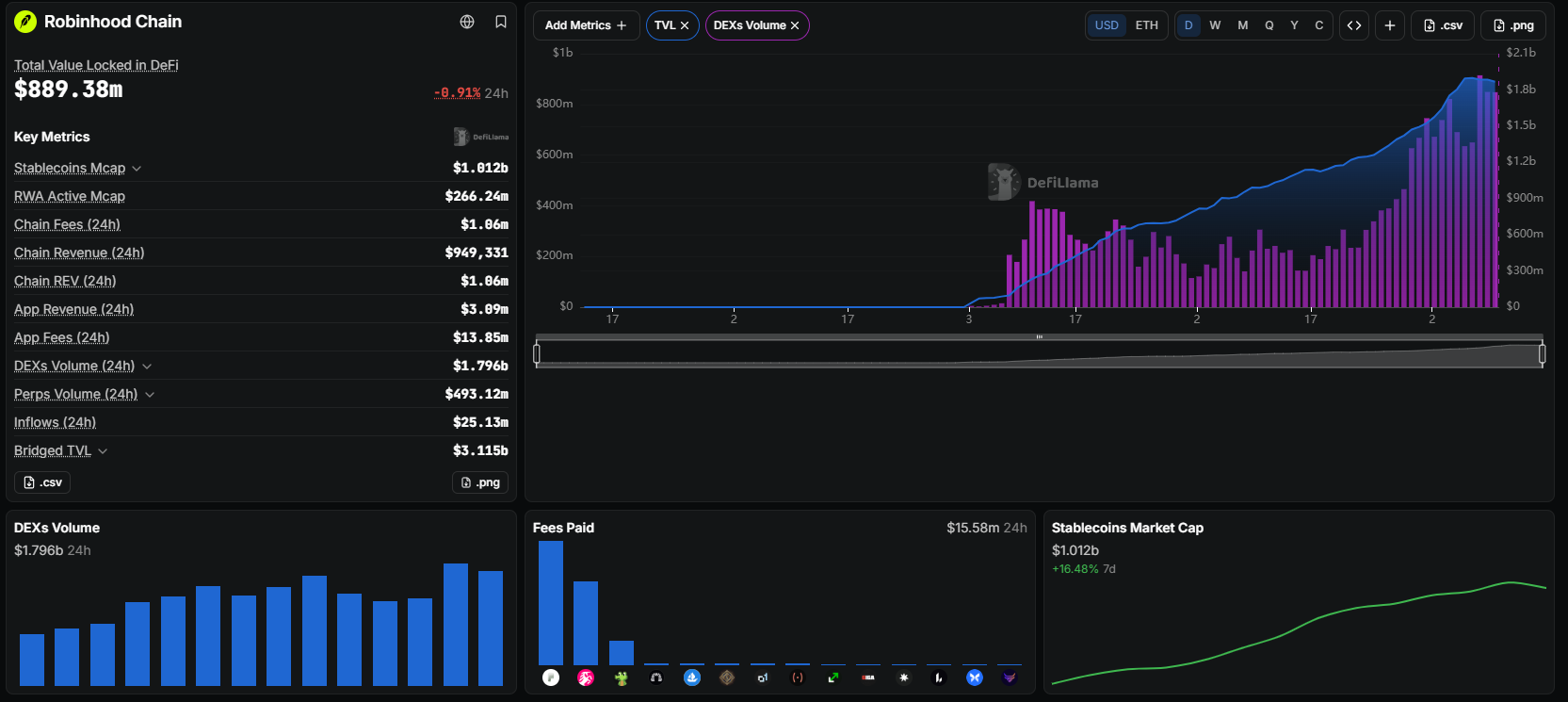
These figures show that meaningful capital and trading activity have already reached the network. The composition of that activity, however, remains highly speculative. Launchpads and memecoins can generate volume very quickly, while lending, liquidity management, and tokenized-stock DEXs need more time to prove that users will stay.
The biggest differentiator is the role of stock tokens. Projects can use tokenized equities as collateral, liquidity pairs, or rewards. Whales Market's xStocks guide explains how stocks are brought onchain, while Whales Market's Multipli analysis looks at the next step: turning RWAs into yield-bearing, composable DeFi assets.
Top 5 Robinhood Chain Projects to Watch
Below are the TOP 5 Robinhood Chain projects to watch
Pons: The Launchpad Leading Liquidity
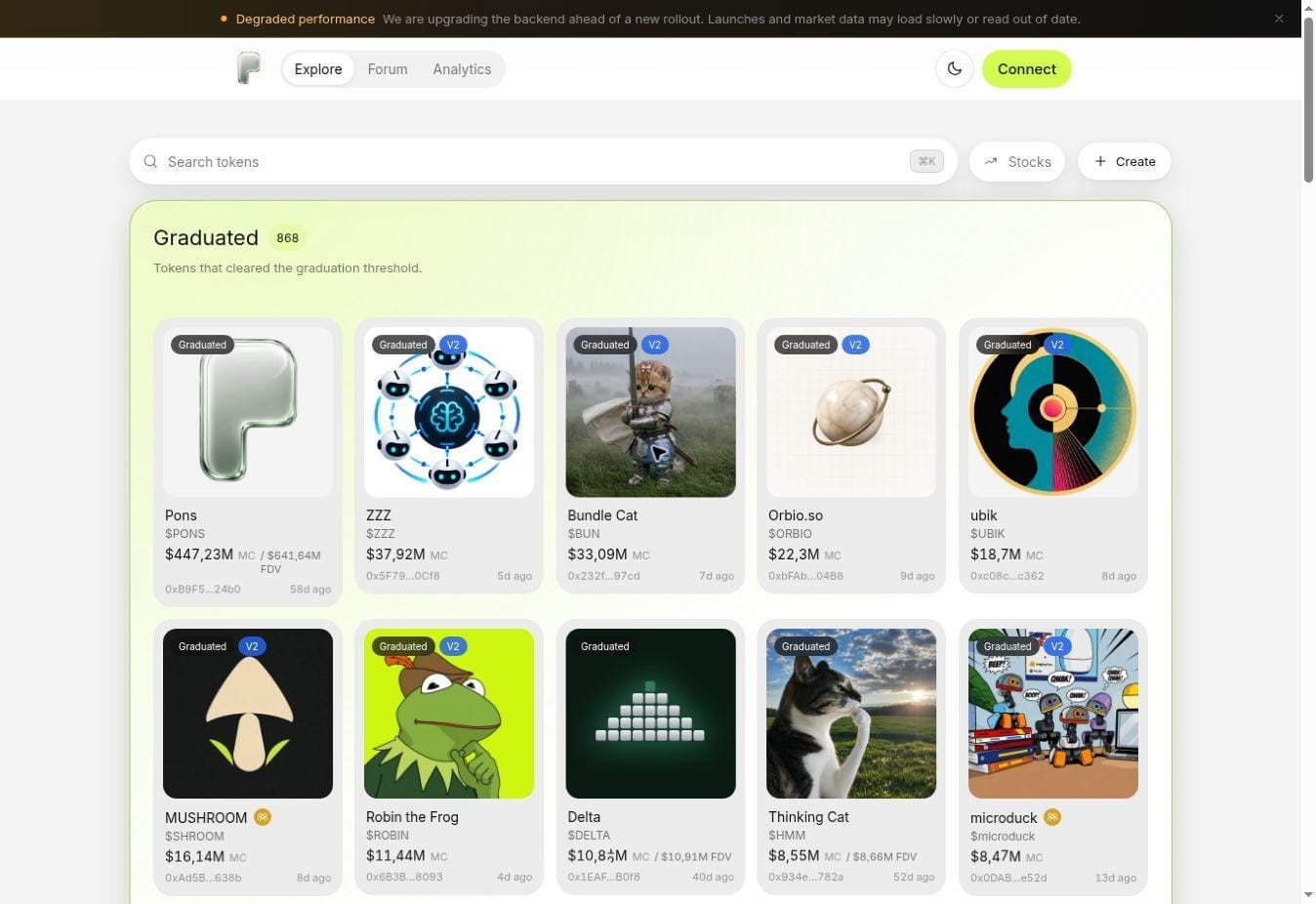
Pons is difficult to ignore when discussing Robinhood Chain. It is a launchpad that lets users create and trade fixed-supply tokens. New tokens move through an initial price-discovery and liquidity phase before graduating into a trading pool.
Pons ranks at the top of this list for more than narrative alone. According to the Pons dashboard on DefiLlama, the protocol recorded approximately $1.57 billion in DEX volume over 30 days. Over the same period, total fees reached roughly $97.1 million, protocol revenue was close to $17.9 million, and holders revenue was around $7.3 million.
The PONS token also has a relatively direct link to product activity. DefiLlama's methodology indicates that around 80% of revenue from Pons V1 is used to buy back and burn PONS. Higher volume therefore gives the protocol more resources for buybacks and burns. That reduces supply, but it is not a guarantee that the token price will rise.
The main risk is dependence on the memecoin cycle. If attention drops, both volume and revenue can fall quickly. Investors should track revenue across multiple weeks, the number of graduated tokens that retain durable liquidity, and the share of volume coming from larger pools rather than focusing on a single breakout day.
Long.xyz: Pairing Memecoins With Tokenized Stocks
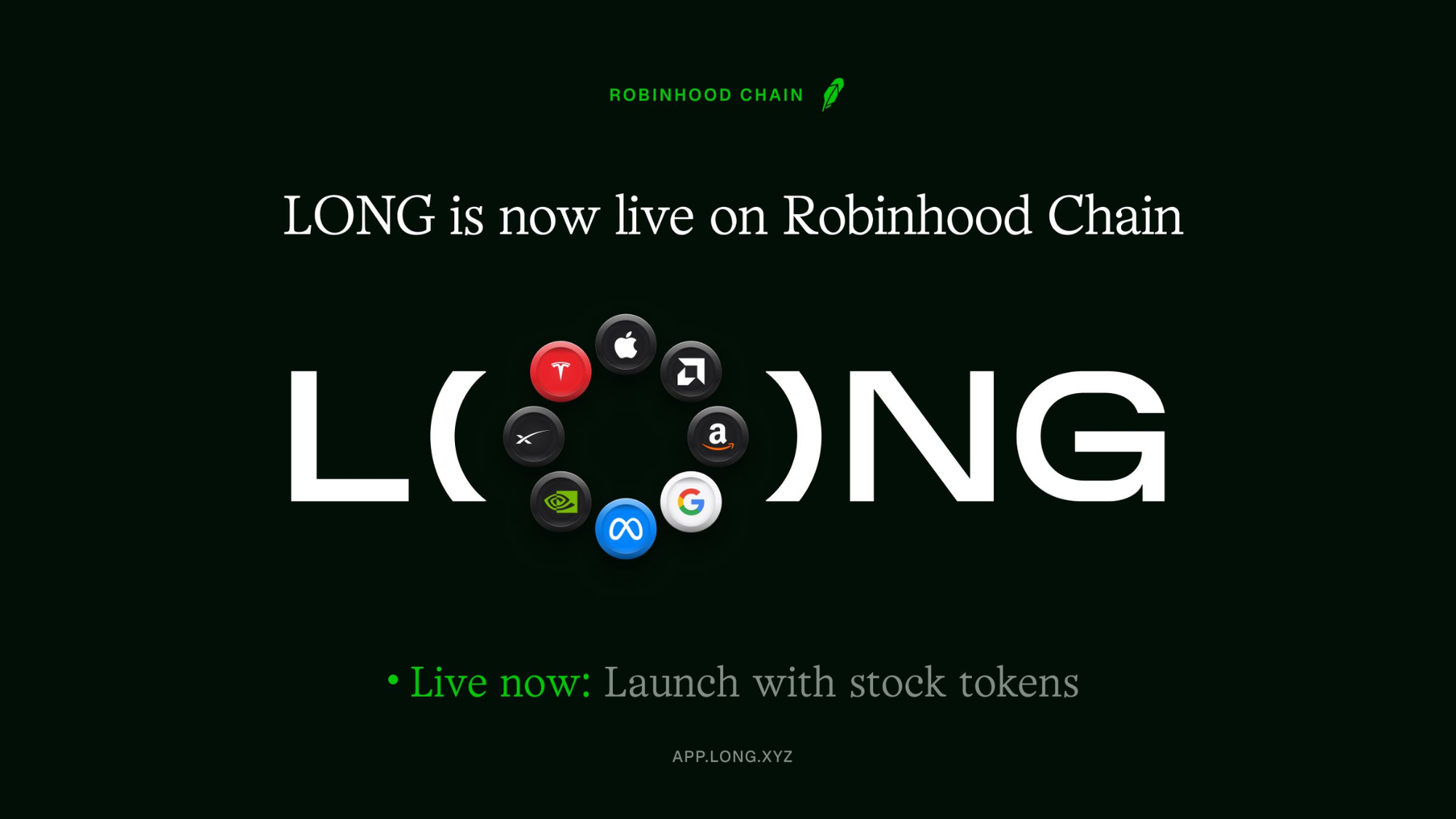
If Pons represents the launchpad wave, Long.xyz captures a narrative that is more specific to Robinhood Chain. The project lets creators pair a new token with a stock token instead of relying only on a stablecoin or native asset as the liquidity pair.
That design creates attention-grabbing pairs such as AI/NVDA, BONER/HIMS, and MEME/AMC. When users trade, the new token also creates an additional use case for the stock token inside the pool. Long.xyz turns tokenized equities from assets that are simply held into part of the network's liquidity infrastructure.
That is what makes Long.xyz a more natural fit for Robinhood Chain than a standard launchpad. It uses the asset class that differentiates the ecosystem from other L2s. The Long.xyz website also describes the product as a way for projects to launch alongside stock tokens.
Long.xyz carries a two-sided volatility risk. Users are exposed to memecoin volatility while also depending on the depth of the stock-token side of the pair. In a thin pool, a large order can create significant slippage. Long.xyz still needs to show that these pairs can retain liquidity after the initial attention fades.
NetNet: A Reserve-Asset Experiment Between DeFi and GameFi
NetNet can be viewed as an updated variation of the reserve-currency model that became popular during the Olympus DAO era.
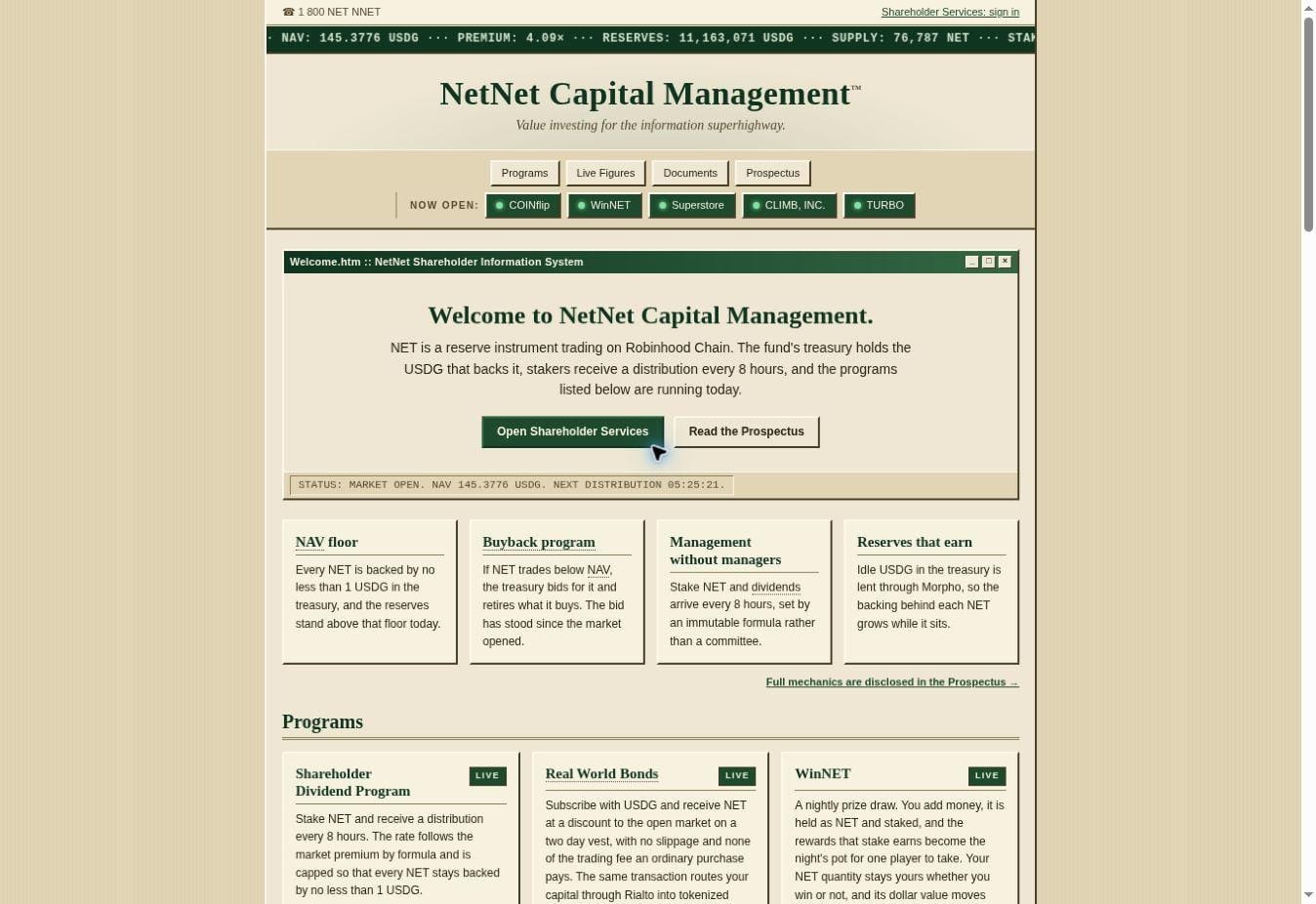
NetNet is the only entity with the authority to mint NET. Users buy discounted NET through USDG bonds. USDG flows into the treasury, which tracks RFV - the portion of value treated as relatively secure - and NAV, the backing value per token.
According to NetNet's introductory materials, part of the idle USDG is deployed to Morpho to generate yield, while the remainder is reserved for bond payouts and buybacks. Games that use stock tokens add an RW-play layer designed to attract users and generate revenue.
NetNet is also a useful example of how market cap can be misleading. According to CoinGecko, NET had a circulating market cap of approximately $2.9 million but an FDV of nearly $45.7 million. Around 4,824 NET were counted as circulating against a total supply of roughly 76,290 NET. On circulating market cap alone, the token looks very small; on FDV, the valuation is many times higher.
CoinGecko also displays a GoPlus warning that the contract creator may be able to modify certain token functions, including fees, minting, or transfers. An automated warning does not mean those permissions will be abused, but users should still review admin permissions, multisig controls, and timelocks before participating.
For NetNet, the metrics to watch are the onchain treasury, backing per NET, token vesting, and the gap between circulating market cap and FDV. 'Treasury-backed' should not be read as a guarantee of safety.
Fables: A Dynamic-Fee DEX for Tokenized Stocks
Fables addresses a less flashy problem than launchpads, but one that matters more for long-term liquidity: a fixed fee is not always the right design for tokenized equities.
Stock tokens behave differently from standard crypto assets. Price and volume can change sharply around market open, market close, or company-specific news. If a DEX always charges the same fee, LPs may be undercompensated precisely when adverse-selection risk is highest.
Fables is built on Uniswap V4 and uses dynamic fees. According to the Fables website and DefiLlama, stock-token pools adjust fees based on schedule, while crypto pools adjust them based on volatility. Fees can rise when adverse selection increases to compensate LPs, then fall again when market conditions are calmer.
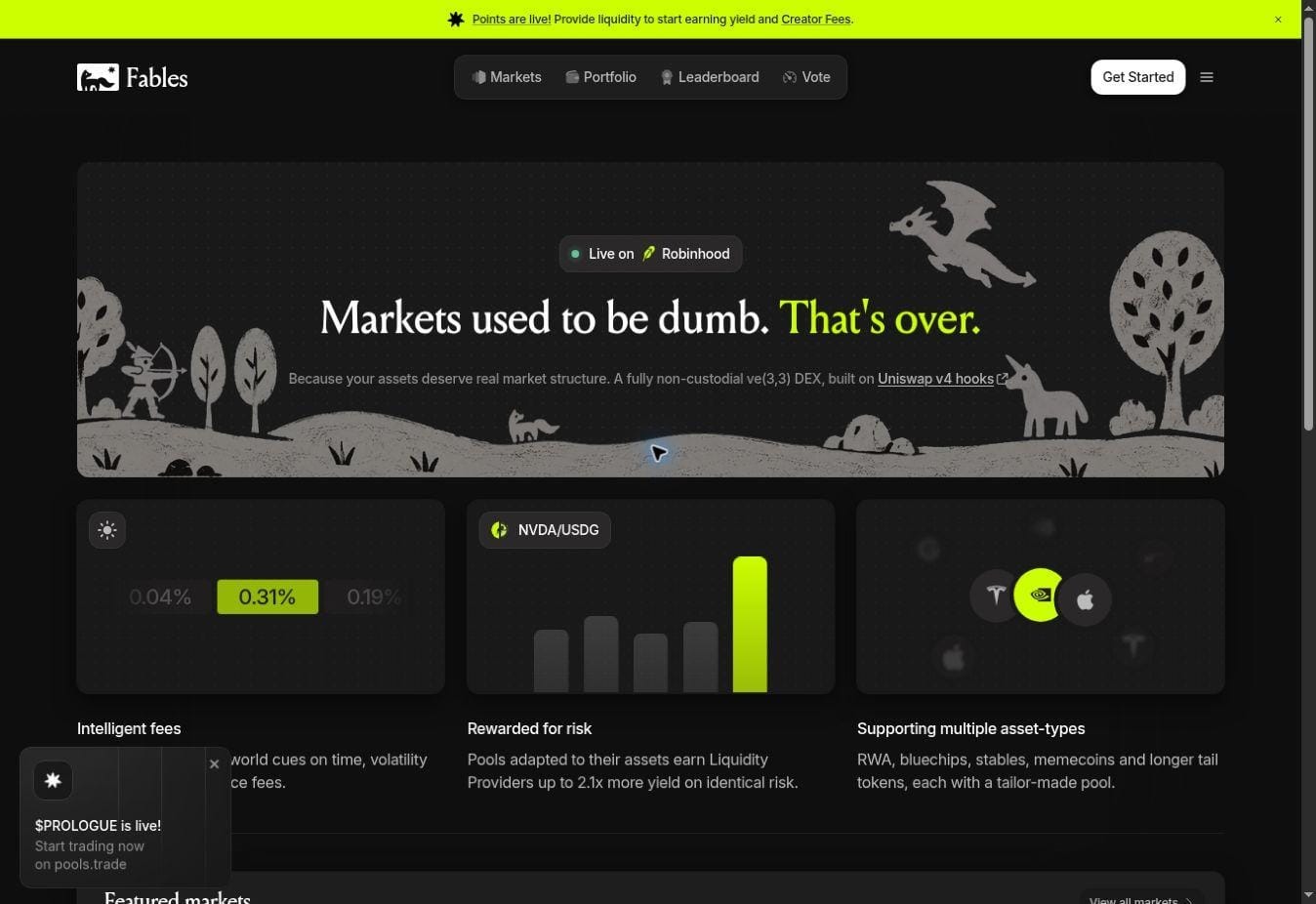
Early data suggests the product has found demand. The Fables dashboard on DefiLlama shows approximately $17.1 million in TVL and nearly $357.9 million in DEX volume over 30 days. Total fees over the same period were around $342,000.
One metric needs to be read carefully: DefiLlama currently reports protocol revenue at zero. Fees paid by traders do not mean the protocol captures all of that value. 'Fees' and 'revenue' should not be used interchangeably.
Fables previously introduced PROLOGUE ahead of its governance token. Any 1:1 conversion claim should only be used if official documentation still confirms it. DefiLlama also lists Fables as unaudited. Users should separate trading volume, LP fees, and protocol revenue when evaluating the protocol.
StonkBrokers: NFT Brokerage Accounts and a Mini DeFi Ecosystem
StonkBrokers has the most distinctive product model in the Top 5. At the center of the ecosystem are 4,444 ERC-6551 NFTs. Each NFT owns a token-bound account with its own onchain wallet.
According to the StonkBrokers website, each broker is randomly seeded with a stock token at mint. The owner can withdraw that asset or activate the broker to receive additional stock-token distributions from the project's reward program. Activation is paid in STONKBROKER, and 50% of the activation fee is burned.
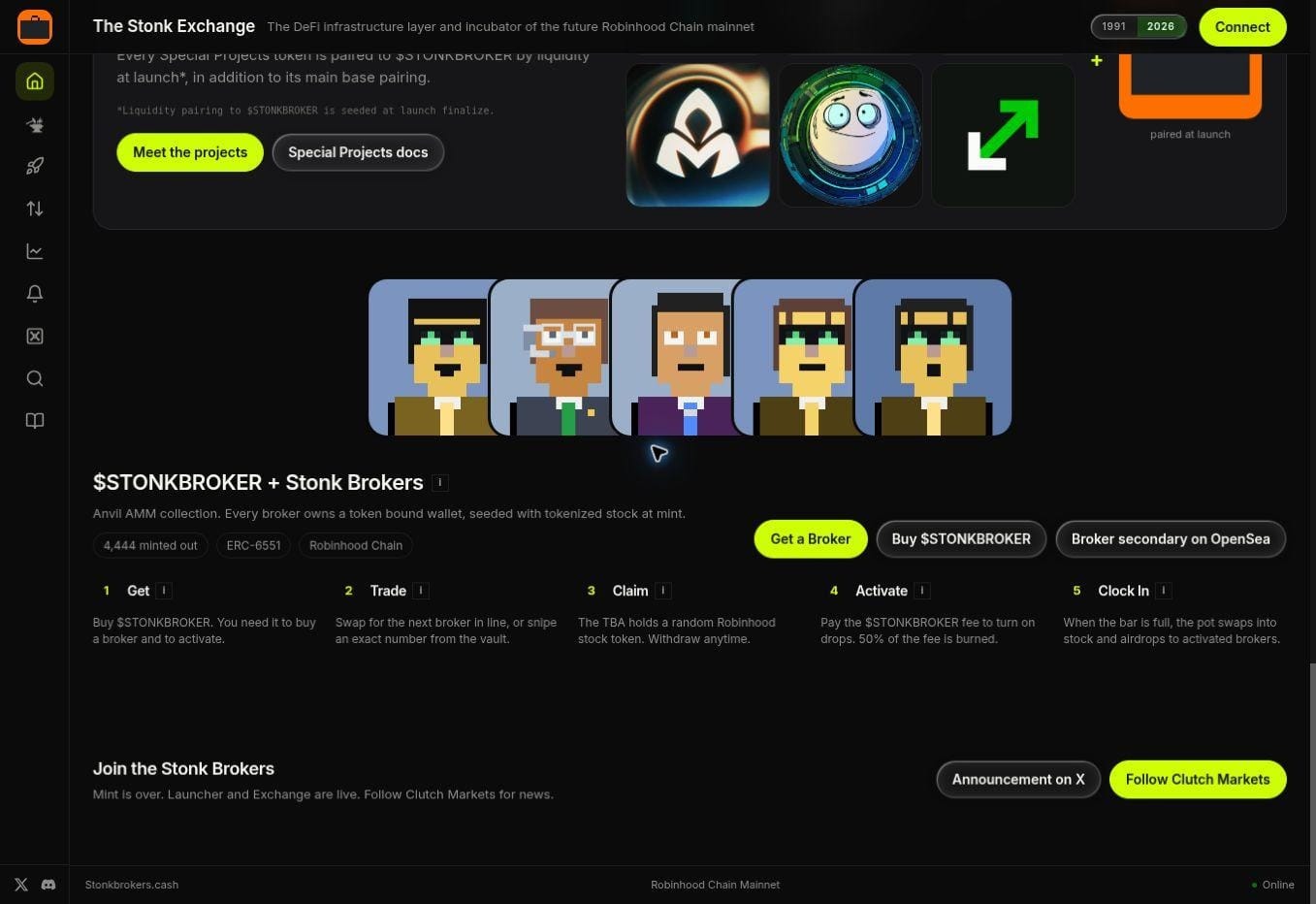
The mechanism creates a clear loop: users need the token to buy or activate a broker, part of the token is burned, and activated brokers can receive reward drops. If the NFT is transferred to another wallet, the activation status is cleared and the new owner has to activate it again.
The token has a direct use case, but demand may depend on new broker buyers, the frequency of NFT transfers, and the appeal of the reward program. If the secondary market slows, the activation loop can weaken as well.
The ecosystem also includes Anvil, Broker Box, Locker, a launchpad, and Stonk Exchange. The Launcher and Exchange are already live, while leverage is positioned as the next step.
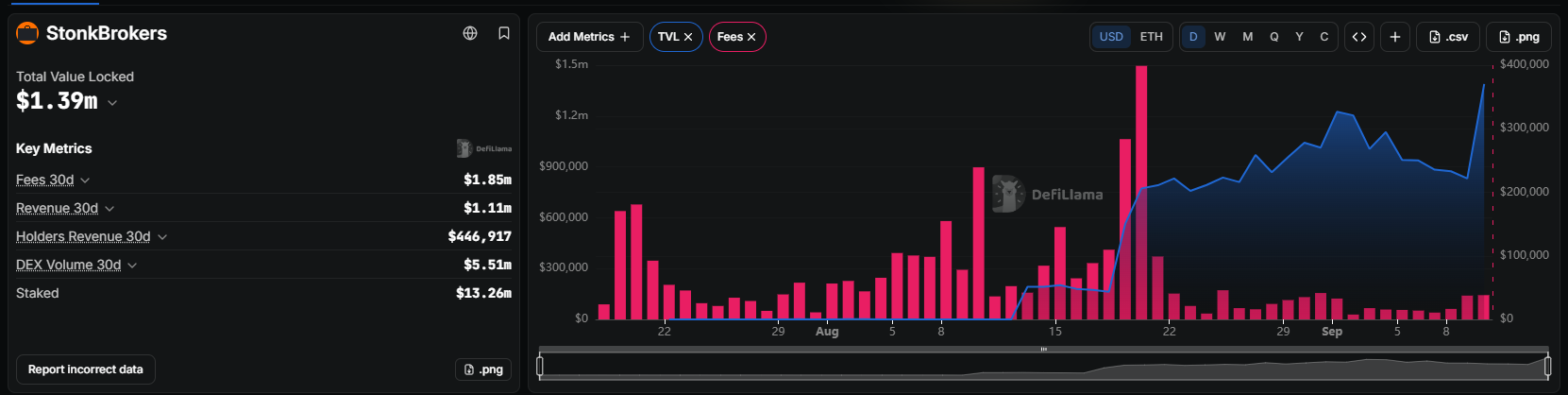
On the data side, the StonkBrokers dashboard on DefiLlama shows approximately $1.37 million in TVL, $1.85 million in fees, and $1.11 million in protocol revenue over 30 days. Holders revenue over the same period was around $446,000, while the value of staked tokens was close to $13 million.
TVL is relatively small compared with fees, so revenue from activation, NFT trading, the launchpad, and other products needs to be separated. This ratio should not be compared directly with a lending protocol.
The main risk is complexity. NFTs, token-bound wallets, stock rewards, an AMM, a launchpad, and leverage create many points of interaction, which also expands the smart-contract attack surface. Each Special Project introduces its own token and its own risk profile.
Quick Comparison of 5 Robinhood Chain Projects
The five projects should not be compared on market cap alone. For a launchpad, the key metrics are volume and how many tokens retain liquidity. For a DEX, TVL, LP fees, and protocol revenue matter more. For a reserve protocol, treasury backing and supply are more important. For StonkBrokers, activation revenue and usage across the broader product suite are the metrics to watch.
Common Risks That Should Not Be Overlooked
Early-Stage Metrics Can Be Inflated
TVL or volume can rise quickly because of incentives and airdrop expectations. A strong number in one week does not guarantee users will remain once rewards decline. Compare multiple timeframes instead of relying on a single snapshot.
Market Cap Does Not Tell the Full Story
A low circulating supply can make circulating market cap look small while FDV is many times higher. Before calling a project 'low cap,' check total supply, vesting, treasury-held tokens, and actual market liquidity.
Thin Liquidity Increases Slippage
Stock-backed memecoins can lack depth on both sides of the pair. When a large order moves through a small pool, the execution price can deviate sharply from the quote shown before the swap. Whales Market's slippage explainer covers how to evaluate price impact and tolerance in more detail.
Audits and Governance Permissions Remain a Weak Point
TVL or revenue is not a substitute for an audit. Users should review bug bounties, mint permissions, fee controls, admin keys, multisigs, and timelocks.
Stock Tokens Are Not Exactly the Same as Stocks
Holders of tokenized stocks need to understand their rights, the backing asset, and redemption terms. Some tokens provide economic exposure to a stock price without giving users the full rights of a shareholder. The recent controversy around the AMC token shows how legal risk and a lack of confirmation from the underlying company can become an issue. Corporate actions such as stock splits or dividends also need to be reflected correctly by the oracle and multiplier.
Which Project Is Worth Watching for Which Goal?
Pons is useful for tracking where attention and volume are concentrated. Long.xyz represents Robinhood Chain's most distinctive narrative. Fables is a signal for the quality of trading infrastructure, NetNet is more relevant for users focused on treasury and backing, and StonkBrokers is an experiment that combines NFTs, token-bound accounts, and stock rewards.
No project leads on every metric. Pons depends on memecoin activity; Long.xyz still has limited data; NetNet has a complex supply structure; Fables has not recorded protocol revenue; and StonkBrokers combines low TVL with a complex product stack.
Conclusion
Robinhood Chain shows that stock tokens can do more than replicate exposure to an equity. They can become collateral, liquidity pairs, rewards, or components of an onchain brokerage account.
Pons currently has the strongest trading pull, Long.xyz has the clearest chain-specific narrative, NetNet is testing a treasury model, Fables focuses on liquidity infrastructure, and StonkBrokers is building a differentiated product suite. But the ecosystem is still early. Some projects remain unaudited, and supply data can differ across platforms. Watch what happens to volume after the narrative cools, track protocol revenue, and review contract permissions rather than buying a token simply because the project is hot.
FAQs
What Is Robinhood Chain?
Robinhood Chain is a blockchain focused on bringing financial assets and tokenized equities onchain. Its ecosystem includes DEXs, lending, launchpads, and products that use stock tokens as underlying assets.
Which Project Is Leading Robinhood Chain?
By volume and fees among native utility projects, Pons stands out most at the time of writing. Fables is stronger on the DEX side for stock tokens, while Long.xyz stands out for stock-backed memecoins.
Are Tokens on Robinhood Chain Safe?
No. Users still need to review smart contracts, audits, admin permissions, liquidity, supply distribution, and bridges. New tokens or thin pools can be highly volatile and subject to significant slippage.
Where Can You Trade Robinhood Chain Tokens?
Depending on the token, users can trade through Pons, Fables, Long.xyz, or Uniswap pools that support Robinhood Chain. Always verify the contract address through official sources.
How Were the Top 5 Projects in This Article Selected?
The list prioritizes live products, verifiable usage data, value-distribution mechanics, and a distinct role within the ecosystem. Price appreciation was not a primary selection criterion.
This content is for informational purposes only and does not constitute financial advice. Onchain data can change quickly, so readers should recheck dashboards and official documentation before making any decision.