

Arcus Points Season 1 is live, and new users can now access perpetual futures through invite codes. If you are just getting started, there is a clear route into the platform. If you traded during the private beta, you can also check how your earlier activity was recognized.
This guide covers how Arcus Points work, how to gain access, and how to start trading and track your activity. Before getting started, keep one distinction in mind: the points program is live, but there is no verified formula for converting points into a future token allocation.
What Is Arcus?
Arcus is a self-custodial decentralized exchange built on Robinhood Chain. Eligible users can trade Stock Tokens and perpetual futures linked to equities, crypto, commodities and indices from a single account, with markets available 24/7.
According to its official materials, Arcus was developed by the team behind dYdX. The launch announcement also confirms an investment from Robinhood Crypto, although the amount was not disclosed.
Arcus and dYdX Chain are separate products. The dYdX Foundation has confirmed that the launch of Arcus does not change dYdX Chain’s operations, governance or infrastructure.
The platform offers two main product types:
If margin and funding are new to you, Whales’ guide to Perp DEXs is a useful starting point before placing a trade.
What to Know About the Arcus Airdrop Program
Arcus Points and airdrop eligibility
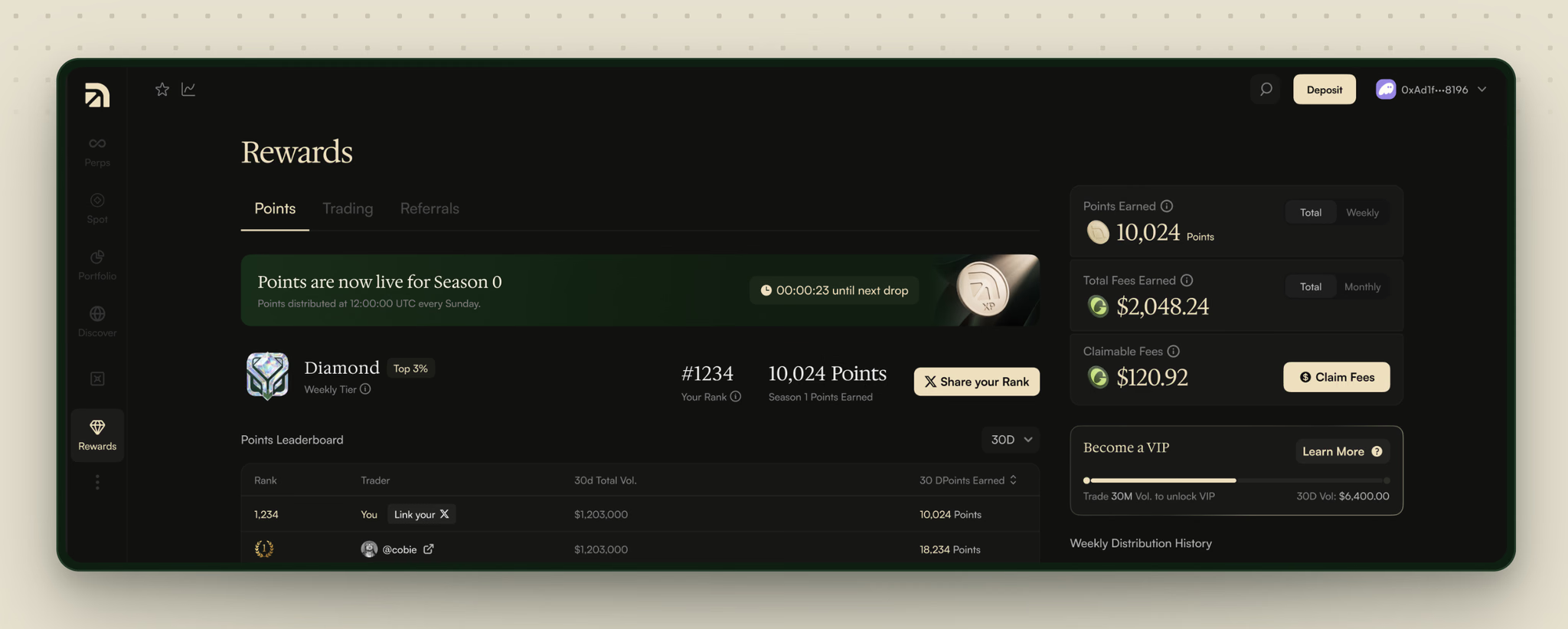
Arcus Points recognize users’ contributions to the platform. Earning points does not guarantee a specific token allocation.
Annex C of the Protocol Terms states that points cannot be redeemed for cash, confer no ownership rights, and do not guarantee a token generation event (TGE) or an airdrop. Use these terms as the basis for evaluating the program, rather than assigning a cash value to your points.
For claims about a separate token and an allocation to the dYdX community, Airdrops.io cites a statement by Charles d’Haussy on X. The original post could not be retrieved to verify its full context. This guide therefore does not confirm the $ARCUS ticker, an entitlement for DYDX holders, a snapshot or an allocation percentage. An allocation to the “dYdX community” would not necessarily make every holder eligible.
Season 0 vs. Season 1
The Arcus Points announcement outlines the two seasons as follows:
Season 0 should not be treated as an open token claim. New users also cannot recreate activity from before they joined.
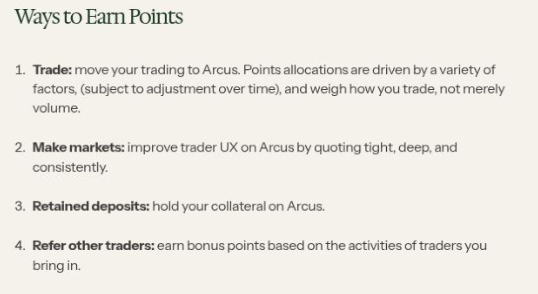
How to earn points and how they are calculated
The announcement does not provide a fixed USD-volume-to-points formula, full activity weightings or a token conversion rate. A volume target alone is therefore not enough to calculate an expected allocation.
Current points boosts
Arcus has announced a focus on RWA markets and trading outside US market hours. Spot swaps routed through Arcus from Robinhood Wallet also receive a boost within the spot category. Boosts may change, and this guide does not use a fixed multiplier because none has been verified.
You do not need Robinhood Wallet to participate in every part of the program. If you use that integration, check that your swap is actually routed through Arcus.
How to get started with the program
The sources reviewed do not list an “airdrop activation” fee, a daily check-in or mandatory social tasks to unlock points. The participation flow is to gain the relevant access, use the platform and check your dashboard.
Following Arcus on X helps you keep up with announcements. However, there is no verified basis for treating each follow or repost as a points-earning task.
Trading fees to check before you start
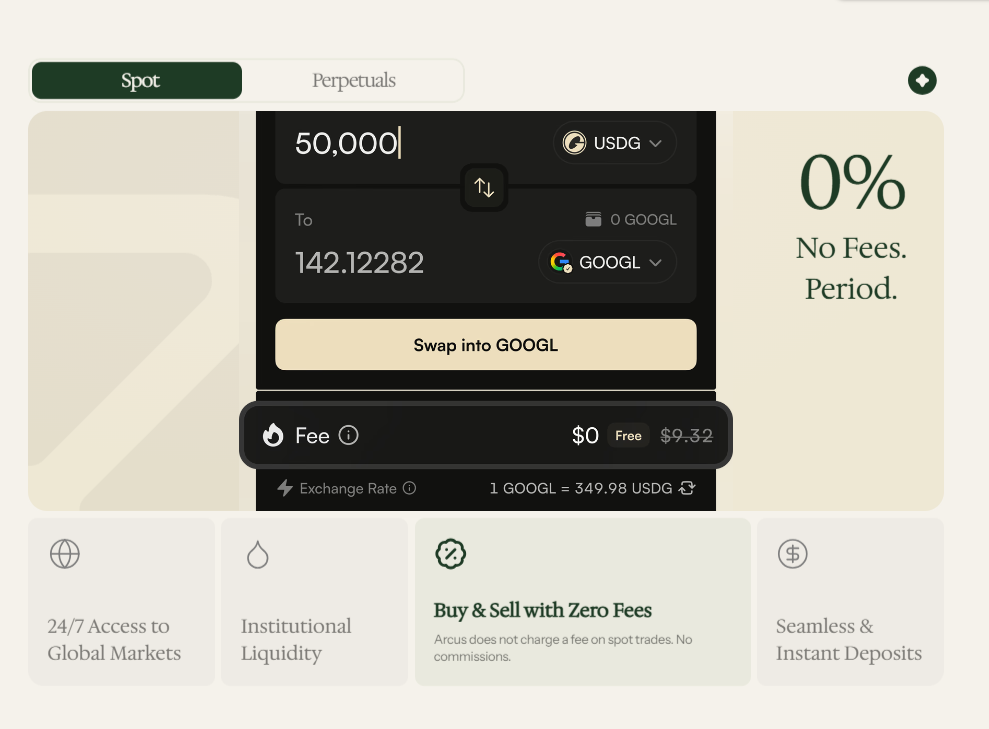
Arcus advertises 0% trading fees for spot Stock Tokens. For perpetual futures, DeFiLlama’s Arcus NVDA dashboard showed a 0% maker fee and a 0.0225% taker fee in the 01/10/2026 snapshot.
Those figures apply to the market checked and should not be assumed to cover every account, fee tier or promotion. The 0.0025% taker rate mentioned in some summaries has not been verified.
At a 0.0225% taker fee, a $10,000 notional order would cost $2.25. Opening and closing the same notional position as a taker would cost $4.50 in trading fees, before funding and execution costs. This is an illustration, not a fixed cost for every Arcus trade.
How to Get Started on Arcus: Step by Step
Step 1: Open the app and connect your wallet
Visit app.arcus.xyz and choose a supported wallet connection method.
Read the access requirements before depositing. Arcus restricts users in the US, Canada, the UK and other jurisdictions or categories specified in its terms. An invite code does not override those eligibility requirements.
Check the domain and read any signature request carefully. Never share your seed phrase or private key with a website, an invite-code sender or someone offering support through a direct message.
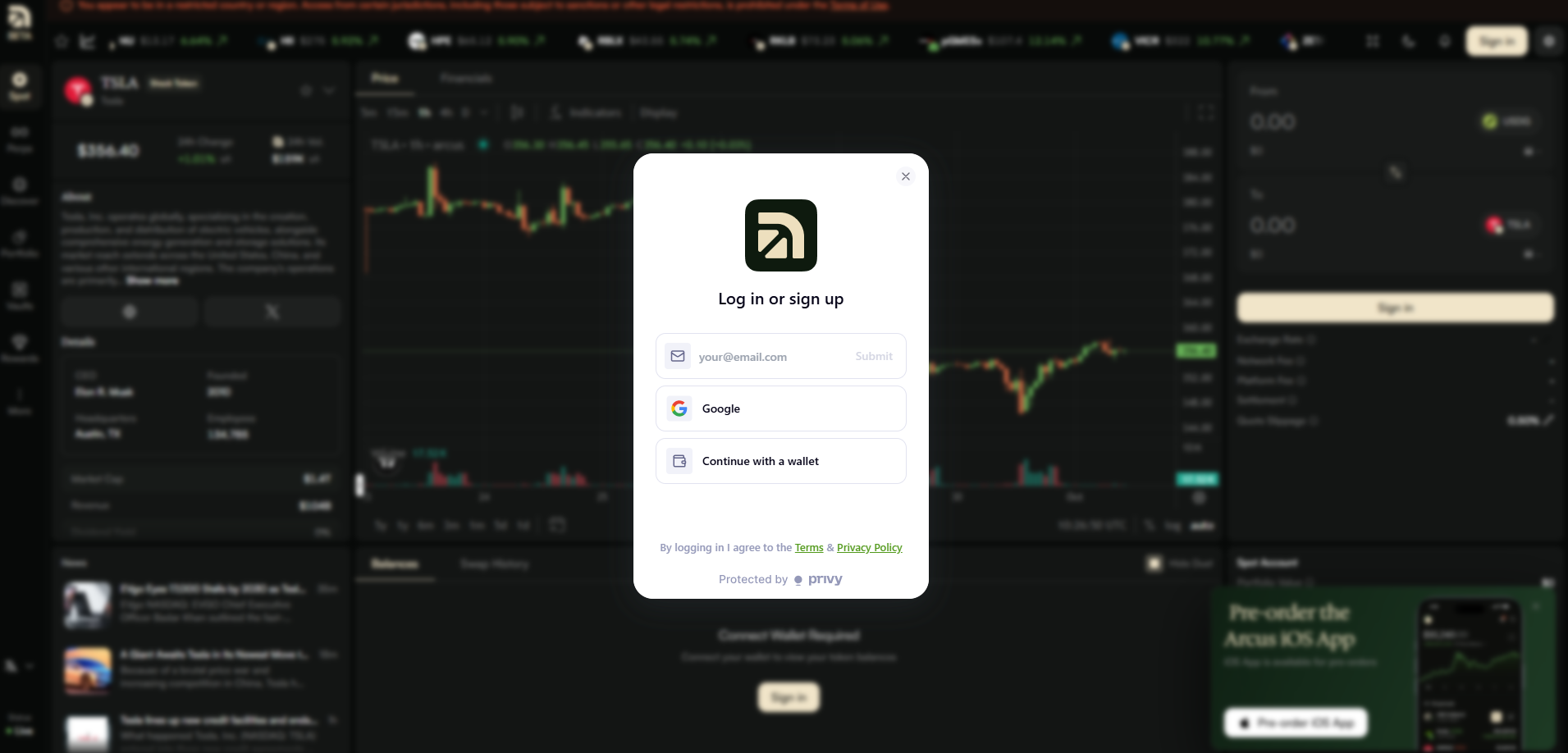
Step 2: Enter an invite code to access perps
The October 1 invite-code announcement explains that new users can connect a wallet, enter a code and deposit to start trading perps. Users who already have access do not need a new code.
Existing participants earn one invite code for every $1 million in qualifying perps volume, including their own volume and that of direct referrals. This is the threshold for earning codes to invite others, not a deposit requirement or a minimum trading volume for new users.
If you need a code, check the official community channels. Arcus does not recognize code sales. Do not pay someone for a promise of an “airdrop spot.”
Some FAQs still describe the earlier waitlist. This guide follows the newer perps access announcement; the website describes spot trading as open to eligible users.
Step 3: Deposit through the official app
Open the deposit flow in the app. Before confirming, check:
- The supported token and network for your chosen deposit route.
- The receiving address or deposit method.
- The displayed fees, minimum deposit and processing time.
- The amount expected to reach your account.
Start with a small test deposit. Add more funds only after the balance reaches the correct account and you understand how withdrawals work.
The supported networks, deposit assets and minimum amounts were not verified directly in the app for this guide. Do not assume every stablecoin or network is supported. Cross-check the deposit screen with the Help Center.
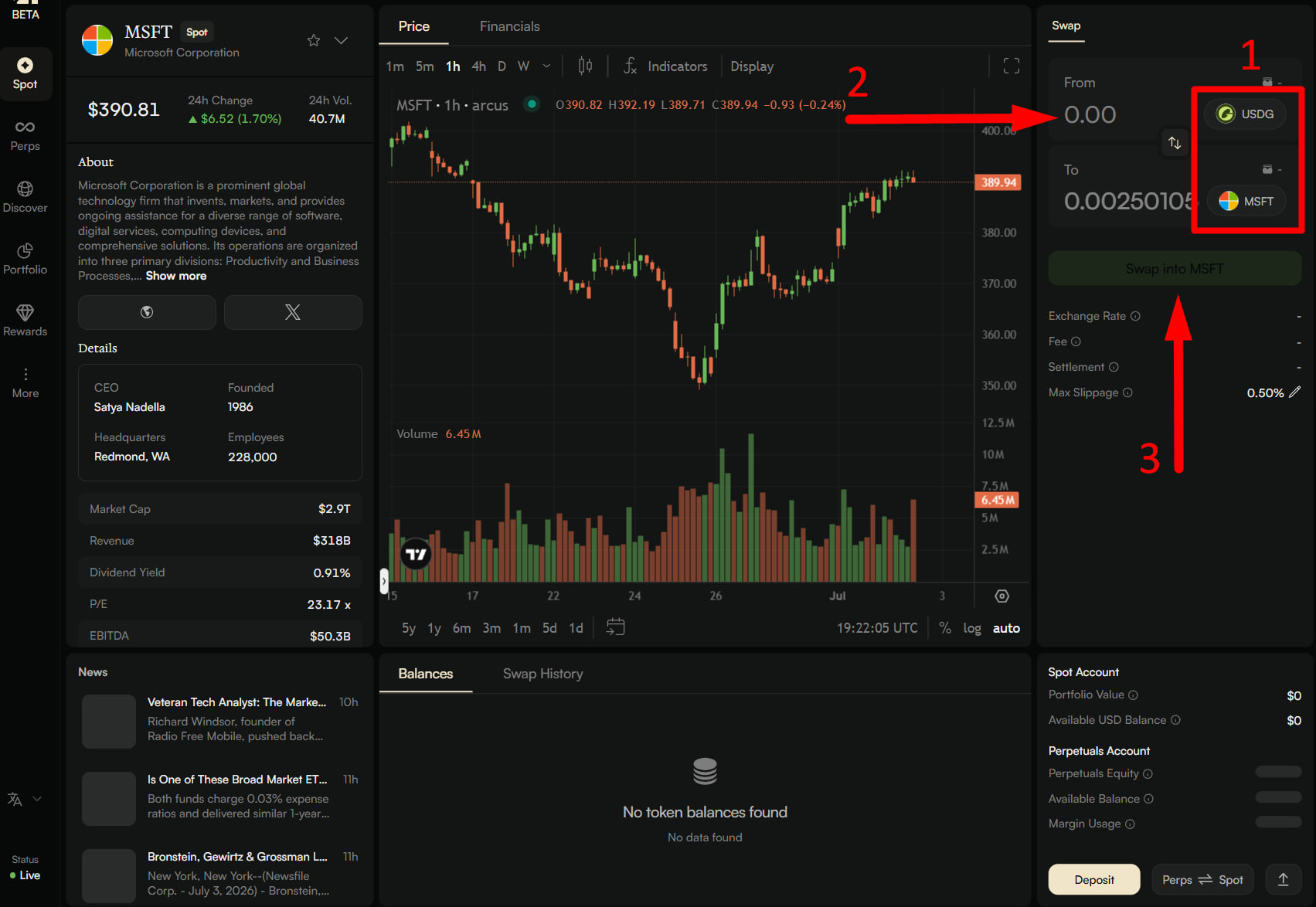
Step 4: Place a trade that fits your plan
Choose your market, product and order size. Check the expected execution price, fees and remaining balance before submitting. For perps, also review margin, leverage, funding and the liquidation level.
If the interface offers post-only orders, read how that option works before using it. A limit order can execute immediately against existing liquidity and be charged as a taker order, so selecting a limit order does not guarantee a maker fee.
Trade RWA markets or outside regular market hours only when you understand the market and accept the pricing conditions. A points boost alone is not a reason to open a position.
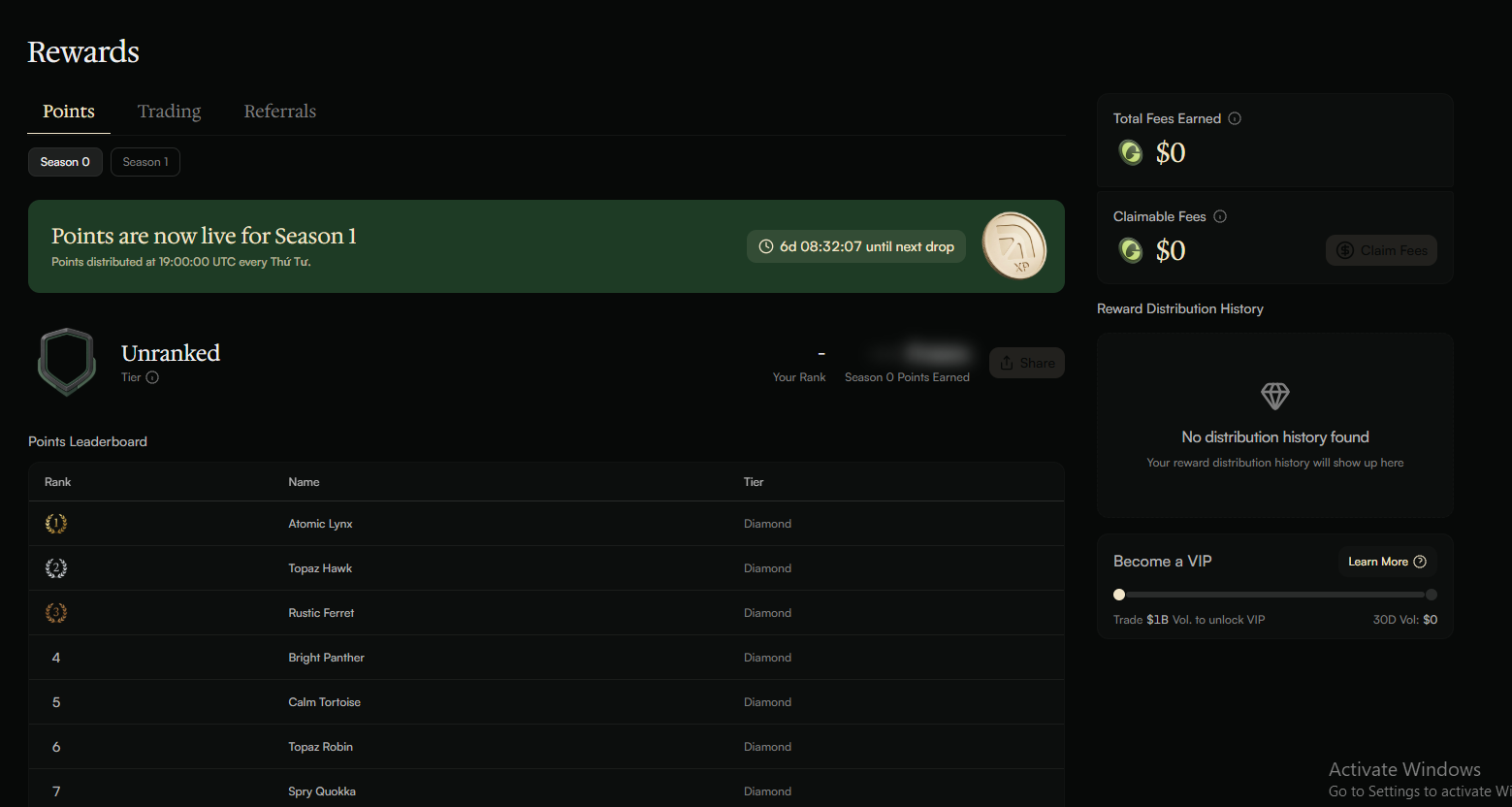
Step 5: Check the Points Dashboard
Open the Points Dashboard with the same wallet you used to trade. Compare the displayed information with your activity and the distribution schedule.
The terms allow point balances to be adjusted or displayed with a delay. If an update is missing, save your transaction details and contact official support instead of increasing volume to try to “activate” your account.
Track points separately from trading performance. Moving up the leaderboard can still come with substantial fees or losses.
Step 6: Share an invite code if you qualify
The invite-code announcement directs users to the Referrals tab under Rewards. When a new user enters a code, it generally links them to that referrer. If they already have a referrer, the original referral relationship is retained.
Share codes with people who want to use the platform. Explain that you may receive referral benefits and let them decide whether to trade. Do not promise a fixed number of points or tokens for signing up.
Tips and Risks to Keep in Mind
Track your total costs
A simple spreadsheet can help you record deposits, realized PnL, trading fees, funding and the points shown in your dashboard. Keep costs you have already incurred separate from rewards whose value is still unknown.
Avoid assigning a price to points and using it to justify a losing trade as “profitable after the airdrop.” Reward eligibility and any future market value remain uncertain.
Low fees still leave execution risk
Spreads and slippage can leave you buying or selling at a worse price than expected. Check quotes or market depth before placing a large order. Whales’ guide to slippage explains how these costs affect a trade.
When trading an asset outside its underlying market’s regular hours, understand the reference price and available liquidity. Whales’ article on RWA perps offers more context on these issues.
Market making and retained collateral have their own costs
Market making requires managing inventory, fills and adverse price moves. The fact that an activity earns points is not enough reason to take it on.
Keeping collateral on Arcus exposes that capital to protocol risk and limits your ability to use it elsewhere. Retain only what fits your plan. There is no verified deposit threshold that guarantees an allocation.
Avoid artificial activity
The terms allow Arcus to exclude Sybil activity, referral rings, self-trading and hedged or delta-neutral strategies used primarily to farm points. Do not assume that taking an offsetting position on another exchange is an accepted points strategy.
Using multiple wallets to manage assets does not automatically constitute a violation. Splitting identities or volume to simulate genuine usage, however, could make you ineligible.
Verify announcements before claiming
This guide has not verified an official token-claim process. A page asking you to pay an “allocation unlock” fee is not part of the participation flow described here.
If a new announcement appears, cross-check it against the website, the official X account and other official channels. Do not infer a token contract from the name $ARCUS, especially as unrelated projects may use a similar name.
FAQ
Do I need social tasks to activate Arcus Points?
The sources reviewed do not confirm follows, reposts or daily check-ins as mandatory activation tasks. Follow X for updates, use the platform according to its official guidance and check your dashboard.
Is there a fixed volume-to-points formula?
The points announcement does not provide a fixed conversion rate or full activity weightings. You can track what you do on the platform, but you cannot calculate an exact reward from a volume target alone.
Are DYDX holders guaranteed an airdrop?
That has not been confirmed from the original source retrieved for this guide. Any allocation to the dYdX community needs clear eligibility criteria, snapshot details and distribution terms before it can be treated as an entitlement for all holders.
Do I need $1 million in volume to participate?
No. That threshold applies to qualifying perps volume used by existing traders to earn additional invite codes. New users need access and must meet the platform’s eligibility requirements; they do not need to reach that volume first.
When will the airdrop and token claim happen?
This guide has not verified a TGE date, snapshot or claim page. The points program is the current activity to follow. Check official announcements before making decisions based on a future token.
Disclaimer: This article is for informational purposes only and does not constitute investment advice. Points do not guarantee an airdrop. Trading and using a protocol can result in a loss of funds. Check the current terms, access requirements and fees before participating.