

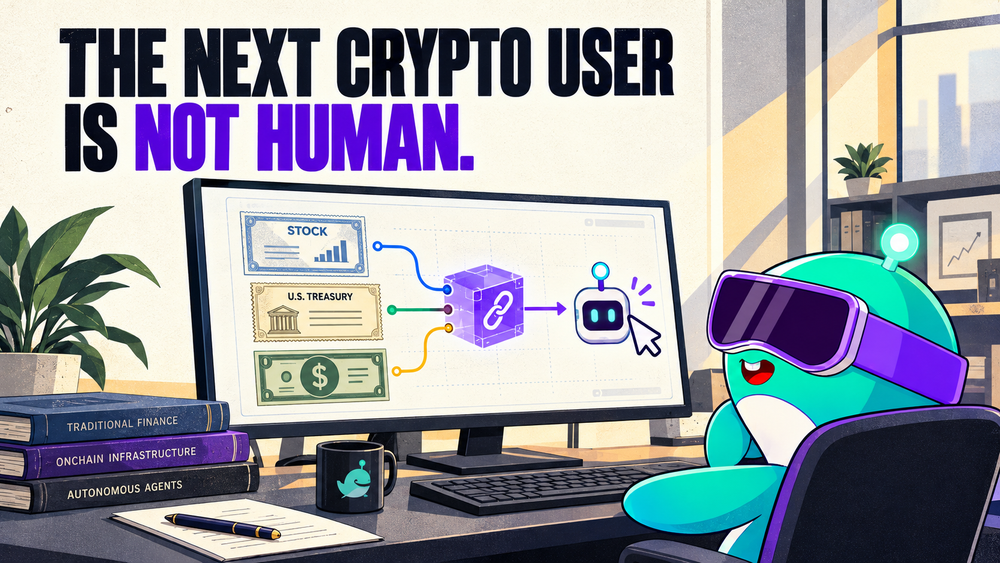
Crypto has spent most of its history asking humans to adapt to machines.
Install a wallet. Protect a seed phrase. Bridge funds. Sign transactions. Pay gas. Learn which version of a dollar exists on which chain.
That friction has always limited the market. But the next major onchain user may not care about any of it.
An AI agent does not need a beautiful interface. It needs machine-readable assets, programmable permissions, reliable settlement, and enough liquidity to complete a task.
That is the deeper idea behind Citrini Research’s public introduction to Breaking the Wall. The asset side of finance is becoming tokenized at the same moment the user side is becoming agentic.
The bullish conclusion is tempting: blockchain has finally found its mass-market use case.
The better question is harder: if agents start moving money, where do the economics actually accrue?
TL;DR
- Tokenization gives software access to assets that previously lived behind broker accounts, market hours, and manual settlement.
- AI agents give onchain finance a user that can navigate wallets, APIs, and smart contracts without caring about crypto’s poor consumer UX.
- RWA.xyz tracked about $38.9 billion in distributed tokenized assets and $295.1 billion in stablecoins in October 2026. The market is growing, but it remains tiny relative to traditional finance.
- The strongest value-capture layers may be issuance, settlement, liquidity, permissions, identity, and compliance rather than generic AI-agent tokens.
- Coinbase says x402 processed more than 230 million transactions and over $54 million in volume within roughly a year. That is real activity, but transaction count alone does not prove durable agent demand.
- The thesis fails if agents remain inside closed banking apps, tokenized assets cannot move between venues, or security and compliance costs erase the efficiency advantage.
What Changed on Both Sides of the Market?
For years, DeFi and traditional finance developed in parallel.
DeFi had programmable markets but mostly crypto-native assets. Traditional finance had the assets people wanted to own, but they remained inside brokerages, custodians, clearing systems, and fixed trading hours.
Two changes are closing that gap.
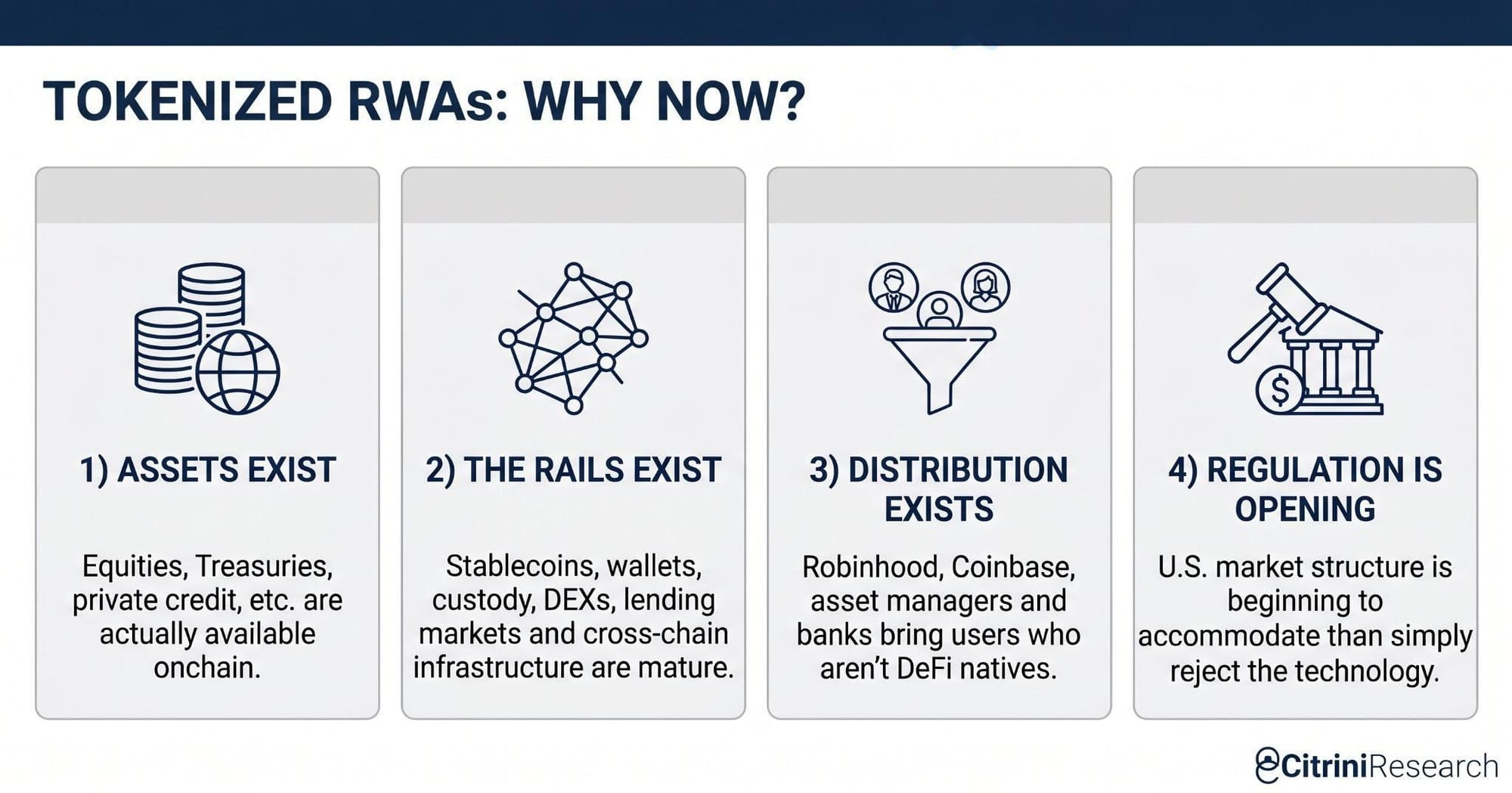
First, more financial assets are becoming machine-readable. Tokenized Treasuries, equities, private credit, commodities, and fund shares can now exist as blockchain-based instruments or representations.
Second, software is becoming capable of acting. Agents can search across products, pay for data, monitor conditions, and execute within limits set by a user.
Tokenization solves the asset problem. Agents may solve the interface problem.
The combination matters because blockchains were never especially good at making humans feel comfortable. They are much better at giving software a shared state, programmable ownership, and settlement that does not close at 4 p.m.
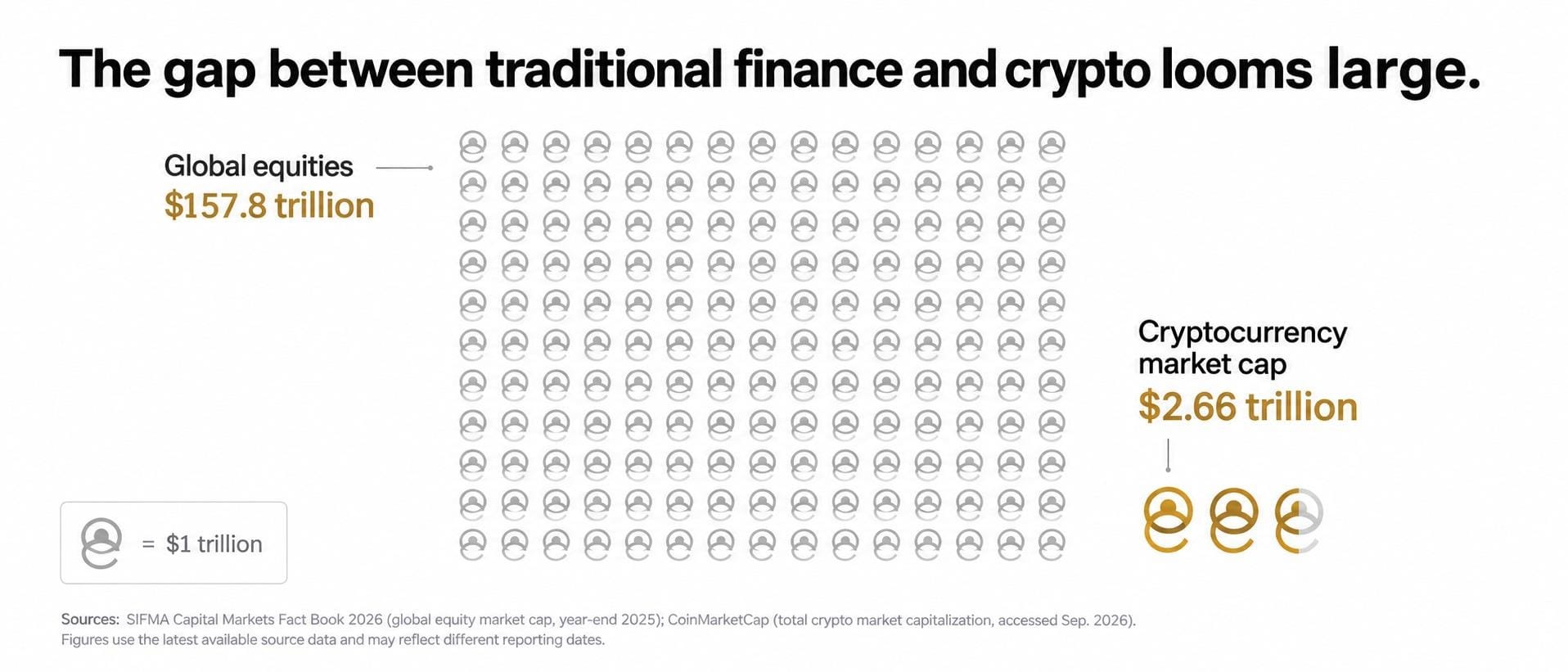
Traditional equity markets remain much larger than crypto. The gap is an addressable market, not a forecast that all of it will move onchain. Source: Citrini Research, citing SIFMA and CoinMarketCap.
The size gap should be read carefully. A $157 trillion equity market does not imply a $157 trillion tokenization opportunity. Most assets do not become more valuable simply because a blockchain records them.
The relevant opportunity is the share that benefits from global access, continuous settlement, programmable collateral, or distribution beyond the original venue.
Why Does Tokenization Matter More When the User Is Software?
A human may tolerate a slow brokerage workflow because they make a few investment decisions each month. An agent may compare thousands of prices, yields, and collateral routes in a day.
That changes which frictions matter.
An agent needs assets that can be discovered through APIs, transferred under clear rules, and settled without waiting for a person to approve every step. A tokenized asset can carry ownership data, transfer restrictions, and settlement logic in a form software can process.
The market is no longer theoretical. RWA.xyz tracked approximately $38.88 billion in distributed tokenized assets, $361.62 billion in represented asset value, and $295.09 billion in stablecoins in October 2026.
Those categories should not be combined carelessly. Represented value can include assets recorded onchain without being freely transferable. Distributed value is closer to what actually circulates. Stablecoins are larger because they already solved a simple, repeatable job: moving dollars across crypto markets.
This distinction is crucial. Putting an asset on a ledger is not the same as creating a liquid market for it.
Research on tokenized RWA markets has found that outstanding value alone does not reliably predict turnover or active usage. Gold, Treasuries, and private credit can show very different liquidity profiles even when the headline asset value looks impressive.
The best signal is not how much an issuer tokenizes. It is how often outside users move, trade, borrow against, or settle with the asset.
Which Layer Could Capture the Economics?
“Crypto benefits” is too broad to trade.
If agentic finance becomes real, the stack may reward five different layers. Each one captures value differently, and each needs a different metric.
The chain with the highest transaction count may not be the biggest winner. Cheap execution can be commoditized.
The more durable businesses may sit where regulation, liquidity, and trust create switching costs. An issuer with legally enforceable claims, a venue with deep two-sided liquidity, or a permission layer embedded across agent wallets may hold stronger economics than a generic L1 processing low-value activity.
This is where the source thesis becomes more useful for crypto investors. The opportunity is not just “more assets onchain.” It is the creation of new toll roads between assets, software, and settlement.
Why Is x402 Important but Not Proof of an Agent Economy?
Traditional checkout was designed around human behavior. A user sees a price, fills in a form, confirms a card, and waits for approval.
x402 turns payment into part of an HTTP request. A service can respond with payment instructions, the client can authorize the amount, and the request can continue after settlement.
That is useful for an agent paying a few cents for data, model inference, storage, or a specialized tool. There is no subscription to manage and no person needs to approve every micro-purchase.
The protocol has moved beyond a one-company experiment. The Linux Foundation’s x402 Foundation launched under open governance in July 2026 with more than 40 member organizations across payments, cloud infrastructure, stablecoins, and commerce.
Coinbase reported more than 230 million x402 transactions and over $54 million in volume by September 2026. The small average payment size is consistent with micropayments, but the headline still needs skepticism.
Transactions can come from agents, bots, testing, incentives, or speculative activity. They do not automatically prove that agents are buying economically useful services.
The more useful metrics are paid services with repeat customers, revenue per merchant, facilitator concentration, payment failures, and the share of activity unrelated to incentives or memecoins.
Security is also part of the product. Coinbase’s Agentic Wallet documentation emphasizes guardrails, while its wallet stack supports spending limits and policy controls. Those constraints are not optional details. They are what turns a wallet from an automated hot key into usable financial infrastructure.
Whales explored the same control problem in its analysis of AI agents, wallets, x402, and verification. Intelligence can propose an action. Permission, identity, and validation determine whether that action should move money.
Can Tokenized Stocks Become More Than Price Mirrors?
Tokenized equities are the clearest test because traders already understand the underlying product.
The first generation often behaved like a wrapped price feed. Users gained exposure, but rights, redemption, portability, and liquidity varied by issuer. A token that follows NVDA is not automatically equivalent to owning an NVDA share in a brokerage account.
The next stage is composability. If a tokenized stock can move between approved venues, serve as collateral, settle continuously, and retain clear legal claims, it becomes more than a mirror.
Regulation is starting to create room for that experiment. In September 2026, the SEC issued a temporary, conditional innovation exemption for eligible venues trading tokenized NMS stocks through permissioned automated market makers and liquidity pools.
The word “permissioned” matters. The likely US path is not fully anonymous DeFi. It is programmable market infrastructure with identity, compliance, and transfer controls built into the rail.
The derivatives side is moving too. The CFTC product database listed Coinbase single-stock perpetual futures as approval pending in September 2026.
Whales has already covered how demand is forming in RWA perpetual markets. But perps and tokenized stocks solve different jobs. A perp provides price exposure. A tokenized share can potentially provide ownership, transferability, collateral utility, and settlement.
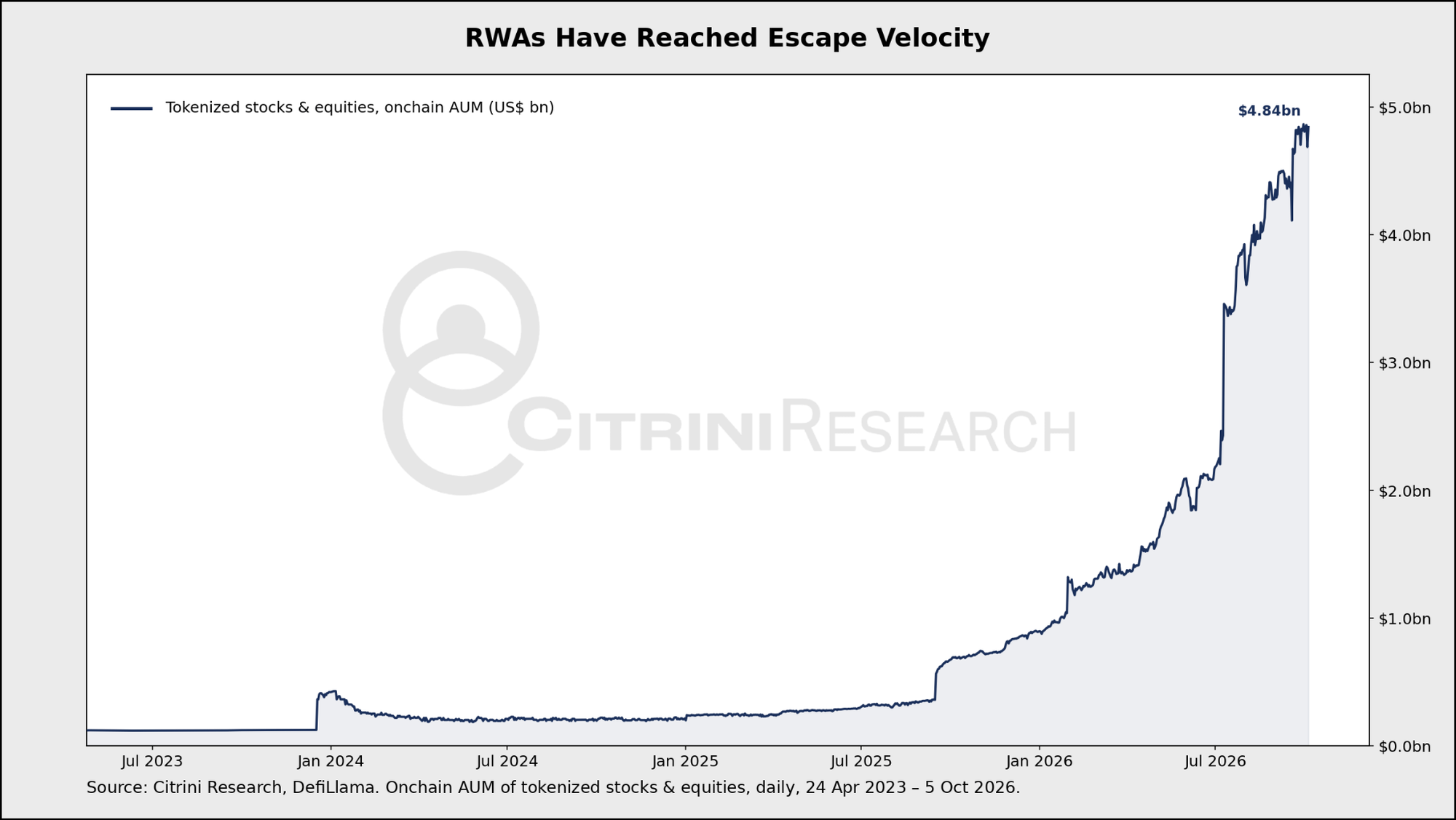
The market should not confuse issuance with liquidity. A token can reach billions in represented value and still trade with wide spreads, fragmented venues, and limited redemption access.
The winner will not be the platform that lists the most synthetic tickers. It will be the one that makes those assets useful across the rest of the financial stack.
Why “Buy Every RWA Token” Is the Wrong Trade?
A strong infrastructure thesis can still produce weak token returns.
Stablecoins can grow while the settlement chain captures little value. Tokenized funds can expand while governance tokens receive none of the fees. Agent payments can increase while activity concentrates around a centralized facilitator.
The label is not the business model.
Before treating an RWA or agent token as exposure to this theme, ask four questions.
- Does the product have third-party transaction flow, or is activity generated by its own incentives?
- Does growth create revenue that reaches the protocol or token?
- Can users move the asset elsewhere, or is it trapped inside one issuer’s venue?
- What remains valuable if transaction fees fall toward zero?
Whales’ RWA market guide is useful for mapping the sector, but rankings should be treated as a starting point. For this thesis, the best projects are not necessarily those with the largest TVL. They are the ones that sit in repeated workflows and keep earning when incentives decline.
Pre-market pricing can add another signal when an agent or RWA project has not launched a token. The useful comparison is not whether the narrative sounds large. It is whether the implied FDV makes sense relative to product usage, fees, unlocks, and competing infrastructure. Whales’ pre-market evaluation framework covers those checks in more detail.
What Would Break the Thesis?
The cleanest bear case is that agents arrive, but blockchains do not capture them.
Banks and brokerages could build closed agent interfaces that keep assets, identity, and settlement inside existing databases. Users may prefer one regulated provider over portable onchain assets.
Tokenization could also remain mostly cosmetic. If tokens cannot move between venues, cannot be redeemed reliably, or do not carry enforceable rights, they are digital wrappers rather than open financial primitives.
Security failures are another risk. Agentic payments introduce weak intent binding, permission misuse, and the possibility that payment settles without the requested service being delivered correctly. Academic research in 2026 identified unresolved authorization and accountability issues across agent-to-agent payment systems.
Finally, liquidity may fragment faster than assets arrive. Hundreds of tokenized stocks across multiple chains sound like distribution. Without shared liquidity and routing, they may create worse execution than a traditional broker.
The thesis strengthens when assets become portable, agents generate repeat paid activity, and regulated liquidity grows across more than one venue. It weakens when the market produces more wrappers than users.
The Next Signal Is Not Another Token Launch
The market will probably price this story before the business models are proven. That is normal for crypto.
The next useful signal will be a workflow that repeats without subsidies: an agent pays for data, moves collateral, trades or refinances, and settles under a permission policy that a user can audit.
Watch net settlement value rather than raw transaction count. Watch outside holders rather than represented assets. Watch spreads and redemption activity rather than the number of listed tickers. Watch fees that remain after incentives disappear.
Most importantly, watch whether tokenized assets become inputs for other products. Composability is where a digital representation begins to behave like financial infrastructure.
Conclusion
Crypto may finally be meeting a user that fits the technology.
Humans wanted simpler interfaces. Agents want programmable assets, permissions, and settlement. Tokenization is supplying the assets at the same time software is gaining the ability to use them.
That does not make every blockchain, RWA protocol, or AI-agent token a winner.
The durable value should accrue where the new system cannot function without a service: legally valid issuance, trusted data, controlled wallets, deep liquidity, compliant transfer, and reliable settlement.
The biggest shift will not be people learning to use crypto.
It will be crypto disappearing into the background while software moves value across it.
Frequently Asked Questions
Are tokenized stocks the same as owning traditional shares?
Not always. Rights depend on the issuer and structure. Some products represent direct or beneficial ownership with redemption rights, while others provide synthetic price exposure. Investors should check custody, voting rights, dividends, redemption, transfer restrictions, and legal jurisdiction before treating a token as equivalent to a brokerage-held share.
Why can AI agents use blockchains more easily than humans?
Agents can interact directly with APIs, wallets, and smart contracts. They do not need a visual interface, but they do need clear permissions, machine-readable instructions, reliable settlement, and limits on what they can spend or call. Blockchains provide programmable execution, though they do not solve identity, compliance, or security by themselves.
Does x402 require crypto payments?
No. x402 is designed as an open payment standard and can support different payment types. Stablecoins are currently a natural fit because they can settle programmatically with low friction, but the protocol is not limited to one asset, network, or provider.
Which metrics show real RWA adoption?
Look beyond represented asset value. Useful indicators include distributed value, outside holders, transfer volume, turnover, redemptions, collateral usage, secondary-market spreads, repeat users, and revenue earned without incentives. A large token issuance with little movement may show distribution progress but not liquidity.
Is this a prediction that every RWA or AI-agent token will rise?
No. This is a market-structure thesis, not a blanket token call. A protocol can benefit from the narrative without capturing fees, and a token can trade at an FDV that already assumes years of adoption. Value capture, token design, liquidity, and valuation still determine the investment outcome.