


AI could be the most important technology of this decade, and AI stocks could still be overvalued. Those two ideas are not contradictory.
The concern is not whether AI is useful. It is how the market is financing the race for compute, how returns have concentrated in a small group of stocks, and how that risk is beginning to move through private credit, banks, insurers, and back into asset markets.
Avian Capital's original analysis describes the current cycle as a combination of Dotcom and 2008. The thesis is compelling, but to make it useful for traders, it needs to be broken into links that can be observed and tested.
TL;DR
- The Dotcom parallel is real technology paired with profit expectations that may be running ahead of companies' ability to monetize it.
- The 2008 parallel lies in the financing structure. AI infrastructure increasingly relies on debt, private credit, and short-lived collateral such as GPUs.
- OpenAI projects rapid revenue growth through 2030, yet it could still generate a cumulative $278 billion in negative free cash flow from 2026 to 2030.
- The ten largest companies accounted for roughly 40% of the S&P 500 by mid-2025. When an index depends on a small group of AI stocks, a miss in that group can spread far beyond the technology sector.
- This is not proof that a crisis is inevitable. The bear case gains credibility only when AI revenue misses expectations, compute pricing weakens, credit stress rises, and market breadth deteriorates at the same time.
- The goal is not to predict the exact day a bubble bursts. Watch the transmission chain instead: AI stocks, credit conditions, liquidity, and then the relative reaction of BTC and altcoins.
Real Technology Does Not Guarantee a Fair Valuation
Dotcom did not collapse because the internet was fake. The internet transformed the economy. The problem was that markets priced in the future too early, before most companies could turn it into cash flow.
AI shares that tension. Models are becoming more useful for coding, data analysis, search, and workflow automation. But a good product does not automatically create a business model strong enough to cover compute, infrastructure, and price competition.
The original thesis across many AI labs was that model intelligence would create one dominant winner. Whoever controlled the most compute, moved closest to AGI, and automated the most labor would capture most of the value. Reality is proving more complicated.
Users can switch models relatively easily while new alternatives keep appearing. For many tasks, the quality gap is not large enough to justify the price gap. Cost, speed, privacy, and the ability to deploy models internally all shape the buying decision.
The Vercel chart cited by Avian Capital shows that open-weight models have rapidly gained token share on AI Gateway in recent months. It is a useful signal, but it reflects traffic on one platform, not the entire AI market.
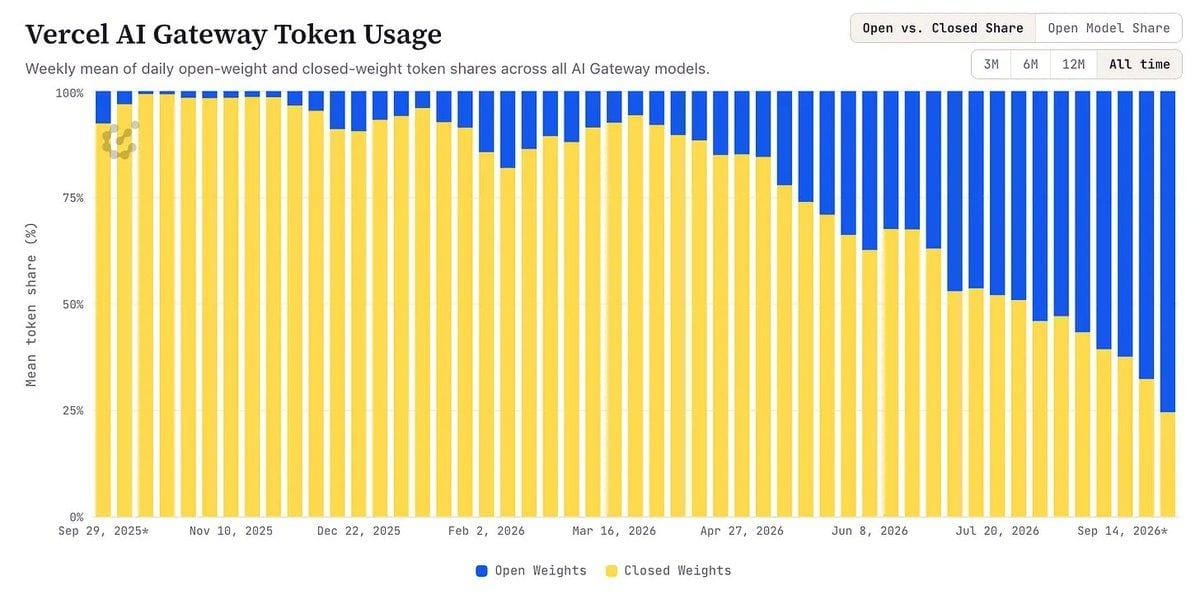
Open-weight models may not replace closed models entirely. But when companies have a good-enough, cheaper option, frontier models must prove that their premium pricing delivers superior economic value.
The consumer market has not yet demonstrated a willingness to pay that matches expectations. Data published by a16z in September 2026 shows that only about 3% of US consumers pay out of pocket for AI tools, up from less than 1% in 2023. Wider adoption does not necessarily mean revenue per user will grow fast enough.
That is the first sign of Dotcom-style risk. Adoption is real, but monetization and valuation may be moving at very different speeds.
Compute Turns Growth Into a Constant Need for Capital
If models become cheaper and harder to differentiate, AI labs must cut prices while continuing to spend aggressively to stay at the frontier. This is where the financial strain begins.
According to an internal presentation reported by the Financial Times and summarized by Reuters, OpenAI projects revenue rising from $36 billion in 2026 to $350 billion in 2030. At the same time, the company expects cumulative negative free cash flow of $278 billion from 2026 to 2030 and $856 billion in compute and infrastructure spending.
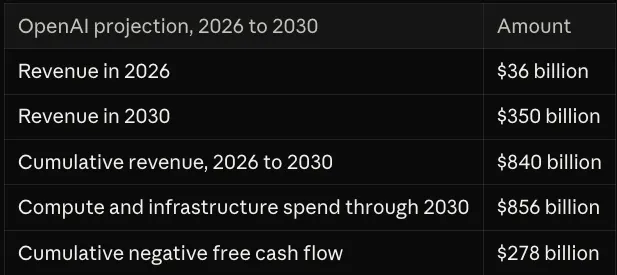
These are internal projections, not realized results. But even the high-growth scenario requires an enormous amount of capital, making access to financing a core part of the business model.
In October 2026, CME Group began listing futures based on the rental cost of Nvidia H100 and B200 GPUs. The products can help companies hedge compute-price volatility and improve market transparency. Their existence also shows that compute has become a financial cost large enough to require its own derivatives market.
During Dotcom, equipment vendors lent customers money to buy their own hardware. Today, AI labs sign long-term compute commitments while neoclouds borrow against customer contracts to expand. The structures are not identical, but both can pull future demand into the present before end users generate enough revenue.
The biggest risk is that compute does not remain as scarce as expected. A leap in model efficiency, inference, or chip design could reduce the compute required for the same workload. High-end GPUs also lose their economic edge much faster than homes. If cash flow weakens before the debt matures, borrowers become more dependent on refinancing.

Concentration Turns One Trade Into a Market-Wide Risk
A sector bubble becomes a macro problem only when it grows large enough within major indices, capital spending, and investor portfolios.
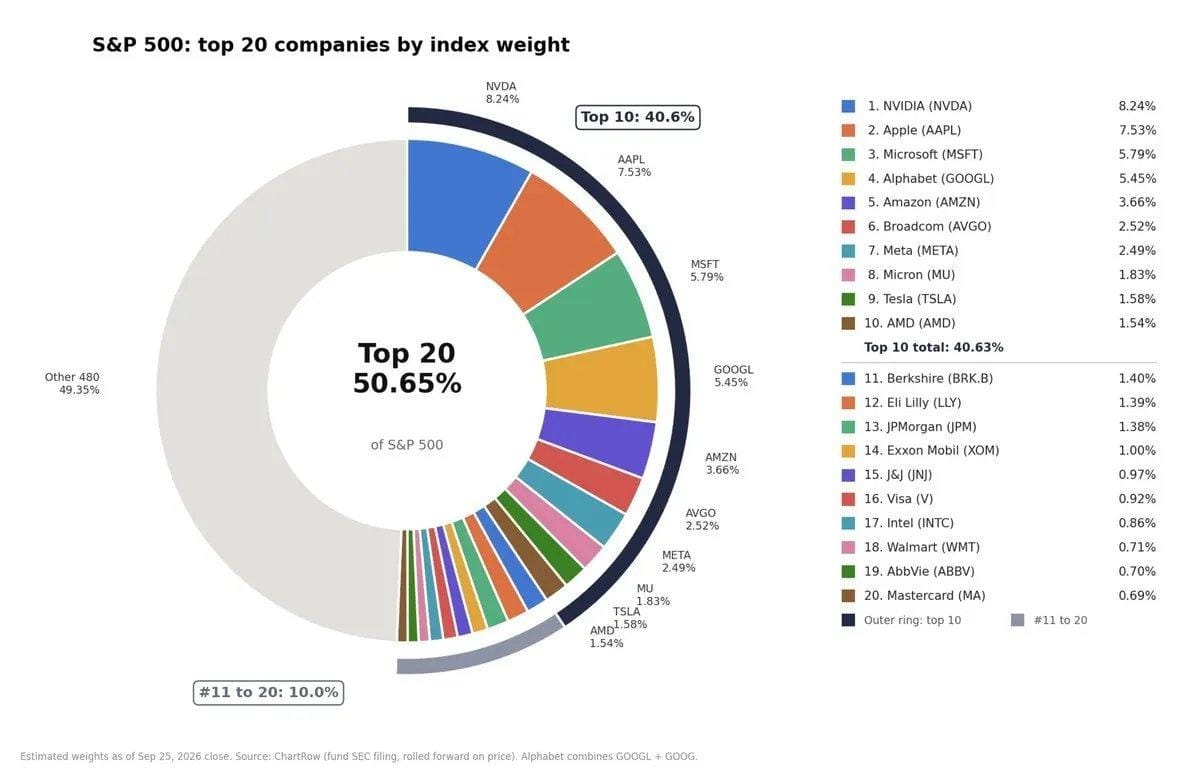
S&P Global reported that the ten largest companies made up nearly 40% of the S&P 500 by mid-2025, the highest concentration since the mid-1960s. The image in the original article compares today's structure with the Dotcom peak and shows that the top 20 now account for more than half of the index..
High concentration does not automatically mean the market is about to collapse. Today's leaders are far more profitable than many Dotcom companies were in 1999. However, if AI capex slows or revenue misses expectations, the same shock could hit chips, hyperscalers, data centers, power markets, and index funds at once.
This is why traders should not focus only on the S&P 500 sitting near its highs. A cap-weighted index can remain strong while most stocks weaken. As market breadth narrows, a smaller group must keep rising fast enough to offset the rest.
Confirmation is not one sharp drop in NVDA. It is a combination of negative earnings revisions, deteriorating market breadth, wider credit spreads, and delayed capex plans.
Credit Is Where Dotcom Meets the Structure of 2008
The 2008 parallel is not that GPUs resemble mortgages. They do not. It lies in how risk is packaged, financed with leverage, and transferred across the balance sheets of multiple institutions.
Private credit expanded rapidly after the global financial crisis as banks faced tighter lending standards. The Financial Stability Board estimates the market at roughly $1.5 trillion to $2 trillion and warns about its links to banks, insurers, private equity, leverage, and limited transparency.
Stress has already appeared. Fitch recorded a 6.1% US private-credit default rate for the 12 months ending in July 2026. By August, the figure cited by the Financial Times had risen to 6.3%. This does not mean the entire market is about to collapse. Fitch's sample covers only part of the market, and its default definition can include soft restructurings. It does show that the pressure is no longer hypothetical.
Banks remain connected to this market. Federal Reserve data shows that US bank lending to non-depository financial institutions reached roughly $1.4 trillion by the end of 2025. Risk can travel through credit lines, NAV lending, and fund financing.
Insurers are another link. Moody's estimates that US life insurers held $807 billion in private credit and illiquid fixed-income assets at the end of 2025, equal to roughly 20% of the industry's fixed-income portfolio. Most of it is rated investment grade, so this is not evidence of insolvency. The concern is concentration and liquidity when many holders need to sell or reprice assets at the same time.
As GPU financing is promoted as a new asset class, the key question is who ultimately holds the risk if compute-rental revenue misses forecasts and GPU values fall quickly. If loans are transferred to pension funds, insurers, or retail products, the originator no longer bears the full long-term cost.
Consumers Entered This Cycle With Less Room for Error
An AI correction becomes more dangerous when household finances and consumer credit are already weak.
According to the Bureau of Economic Analysis, the US personal saving rate stood at 3.0% in July 2026. The New York Fed reported $1.26 trillion in credit-card balances in Q2 2026 and total household debt of $18.8 trillion. The share of debt in some stage of delinquency eased to 4.7% in the quarter, but it still shows that part of the consumer base remains under pressure.
The auto market reflects the same problem. Auto-loan balances reached $1.71 trillion in Q2 2026. Longer terms reduce monthly payments but leave borrowers tied to depreciating assets for longer. If AI stocks fall sharply, the wealth effect weakens at the top while lower-income consumers remain under credit pressure.
Energy prices and yields are two catalysts to watch. Higher oil and diesel prices push transport costs through the economy. Elevated long-term yields make refinancing more expensive just as AI infrastructure needs to issue more debt. A system may absorb each pressure on its own, but it becomes more fragile when they arrive together.
If the AI Trade Reverses, Where Will Crypto React First?
The link does not run directly from AI stocks to Bitcoin's price. It runs through liquidity. When the Nasdaq falls, volatility rises, and credit conditions deteriorate, funds often have to reduce risk across their portfolios. Crypto trades around the clock, making it one of the fastest places to cut exposure.
The first signal is not whether BTC rises or falls in one session. It is relative strength. If BTC holds up better than the Nasdaq while AI stocks sell off, the market may be repricing the AI trade rather than facing a broader liquidity shock. If BTC also weakens as credit spreads widen, the story is starting to move from valuation to funding.
The difference should become clearer in altcoins. Market liquidity is now spread across far more tokens than in the previous cycle. As Whales explained in Crypto Reality 2025, total market cap can rise while capital remains concentrated in BTC and a handful of short-lived narratives. When risk appetite fades, tokens with thin order books and heavy unlock schedules often lose their bids first.
Leverage determines the speed of the move. A spot selloff alone does not necessarily create systemic stress. Risk rises sharply when open interest remains high, funding stays positive, and collateral values fall at the same time. Whales' guide to recursive leverage shows how the same position can be reused across multiple protocol layers, while the funding-rate guide explains why holding costs and crowded positioning must be read alongside volume and open interest.
In the milder scenario, AI stocks correct while credit spreads remain stable, stablecoin supply does not contract, and crypto leverage gradually resets. The market may still be volatile without entering a prolonged deleveraging cycle.
The more dangerous scenario begins when AI capex is delayed, lenders tighten financing, and BTC loses its relative strength. If stablecoin supply also weakens while funding remains elevated, pressure can spread from BTC to altcoins much faster than liquidity can return.
This matters even more in pre-market trading. Prices before TGE often reflect the narrative before real liquidity and supply exist. In a de-risking market, a high valuation, near-term unlocks, and weak spot demand can turn a pre-market price into an expectation that is difficult to defend after listing. Whales' framework for evaluating pre-market projects helps separate real demand from the premium attached to the AI narrative.
What Would Invalidate the Bear Case?
A strong thesis should explain what would prove it wrong.
The Dotcom-plus-2008 thesis weakens if AI labs prove that revenue and gross margins can grow faster than compute costs while product prices continue to fall. It also weakens if open-weight models expand the market rather than take revenue away from closed models.
At the infrastructure layer, risk falls if compute utilization remains high across multiple chip generations, lease contracts involve strong counterparties, and assets are depreciated in line with their economic lives. Compute futures could also help the industry hedge risk rather than encourage speculation.
At the financial layer, the thesis loses force if private-credit defaults stabilize, redemptions slow, banks avoid meaningful asset-quality deterioration, and market breadth expands beyond AI. An expensive and concentrated market can keep rising if earnings continue to meet expectations.
Finally, historical parallels should not be treated as prophecy. Dotcom, 2008, and the current cycle involve different collateral, banking systems, and monetary policies. History gives us a risk checklist, not an expiration date.
Conclusion
The most important point is not that AI is a bubble. It is the gap between the technology's value and the financing structure built around that value.
AI may continue to transform how people work. But if the race is built on oversized compute commitments, constant private financing, and rapidly depreciating assets, a growth disappointment can turn a valuation problem into a credit problem.
The sequence of transmission matters most. AI earnings misses, delayed capex, and rising credit stress are not enough on their own to prove that crypto is entering a crisis. But if stablecoin supply contracts while leverage remains elevated, the market can move very quickly from repricing to deleveraging.
The market may not repeat Dotcom or 2008. It does not need to repeat either one perfectly to trigger a major deleveraging event.
Frequently Asked Questions
Does an AI Bubble Mean AI Has No Value?
No. A technology can create enormous long-term value while related stocks and infrastructure remain overpriced in the short term. Dotcom is the clearest example. The internet won, but many companies and investors still lost money because valuations and capital structures were unsustainable.
Why Is Compute Financing Compared With 2008?
The comparison is about financing and risk distribution, not because GPUs resemble homes. When loans are secured by rapidly depreciating assets and then transferred to funds, insurers, or other investors, a revenue shortfall can spread across multiple balance sheets.
How Would an AI Stock Correction Affect Crypto?
The main channels are liquidity and deleveraging. When investors cut risk, thinly traded altcoins and leveraged positions are often sold first. The impact depends on yields, stablecoin supply, ETF flows, funding, and BTC's relative performance against the Nasdaq.
Which Data Matters Most for Confirming the Thesis?
No single indicator is enough. Look for confirmation across four groups of data: AI-lab economics, compute pricing and utilization, market breadth and concentration, and credit stress. For crypto, add stablecoin supply, funding, open interest, and order-book liquidity.
Is This Thesis a Call to Short the Market?
No. This is a framework for monitoring risk, not a timing signal. An expensive, concentrated market can keep rising longer than expected. Shorting too early with leverage can lose money even when the long-term thesis is correct.
Disclaimer: This article is for informational purposes only and does not constitute financial advice. Crypto, equities, derivatives, and private credit all involve significant risk. Do your own research and size positions appropriately.