

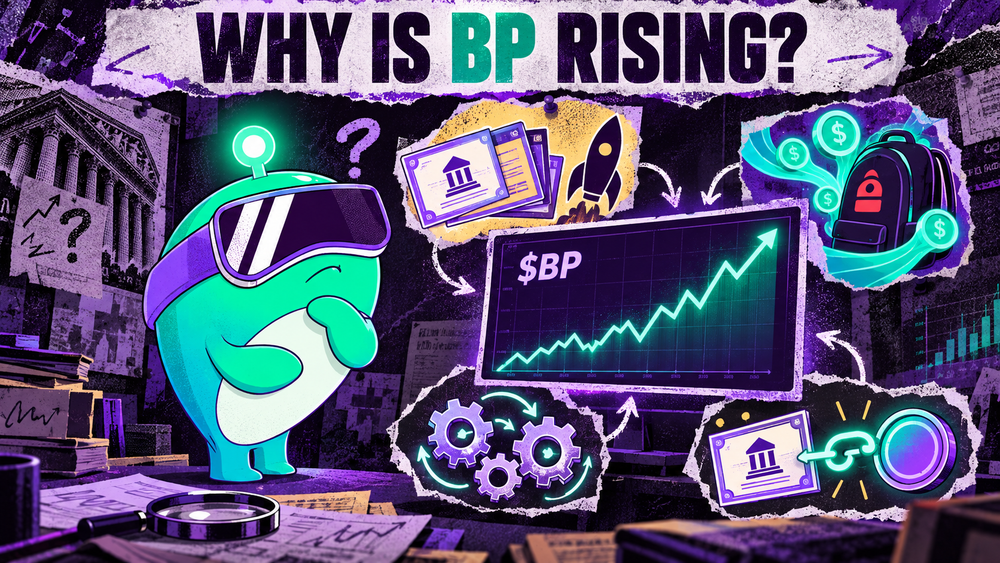
In just five trading sessions, BP's closing price rose from around $0.46 to $0.90, a gain of nearly 94%. The token also reached an all-time high near $0.98, while daily trading volume jumped above $25M. CoinGecko's historical data shows that this was not a minor move in an illiquid market.
The easiest answer is that tokenized equities are hot. That answer is not enough.
Tokenized equities existed before the rally. Backpack's propAMM model was not built overnight either. What changed was the market's ability to see how the pieces connect: a more open regulatory environment, the expansion of Backpack Securities, concentrated liquidity, equities used as collateral, and a potential path for BP to capture business value.
In other words, BP is not rising simply because Backpack added more products. The market is testing a new valuation model for the company.
TL;DR
- BP is rising because the market is revaluing the tokenized equity sector after a major regulatory shift in the United States.
- Backpack is moving beyond a wallet and crypto exchange toward an onchain brokerage that combines equities, crypto, lending, and derivatives.
- Backpack represents only a small share of tokenized equity supply on Solana but attracted most of the volume in the cited measurement period. The advantage appears to come from liquidity rather than asset count.
- PropAMMs and 1:1 redemption help Backpack build a stronger liquidity loop than a token that only tracks an equity price.
- The rally can last only if growth at Backpack Securities creates real demand for BP. FDV, uncirculated supply, and concentrated trading volume remain major risks.
Tokenized equities just received a major regulatory tailwind
Token prices rarely wait for revenue to appear before reacting. They move when the probability of a favorable future changes.
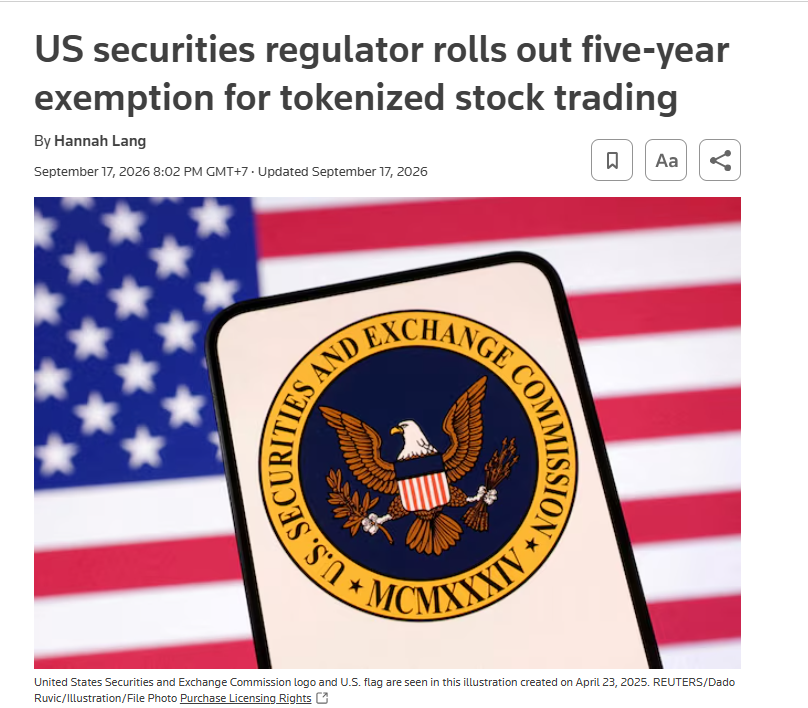
That is what just happened to tokenized equities in the United States. The U.S. securities regulator introduced a five-year exemption for platforms that support tokenized securities trading. Liquidity providers in this market also received exemptions from certain dealer registration requirements for the same period.
The important detail is that this framework does not cover every kind of stock token. Synthetic products that create exposure through derivatives are excluded. Platforms must also notify a company before listing a tokenized version of its shares and cannot proceed if the issuer objects.
This changes how the market views Backpack. In the past, Backpack Securities could be valued as an experiment sitting between crypto and traditional securities, with difficult-to-measure regulatory risk. Under the new framework, tokenized equities have a clearer path to grow. As the regulatory discount falls, the valuation multiple investors are willing to pay may rise.
Backpack also has a structural advantage. The platform does not simply issue tokens that track prices. Backpack starts with ownership of traditional securities, then allows those assets to move into an onchain form and back again. This model aligns more closely with a regulatory approach that favors clear ownership rights over synthetic exposure.
However, a regulatory tailwind does not mean Backpack has already won. Coinbase, Robinhood, Kraken, and traditional financial institutions can all enter the market as the rules become clearer. The legal catalyst expands the opportunity, but it also brings more competitors to the table.
Backpack is no longer viewed as a typical exchange token
Backpack's original thesis was familiar: a self-custody wallet, spot exchange, perpetual futures, lending, and a strong community within Solana.
The new thesis is much broader. Backpack aims to become a place where users can hold real equities, move them onto Solana, trade around the clock, use them as collateral, and manage everything alongside crypto in one account.
Backpack Securities allows users to hold security entitlements through traditional brokerage infrastructure. For eligible assets, users can convert between traditional securities and tokenized versions on Solana. Dividends and corporate actions are also handled through the product structure instead of merely simulating price movements.
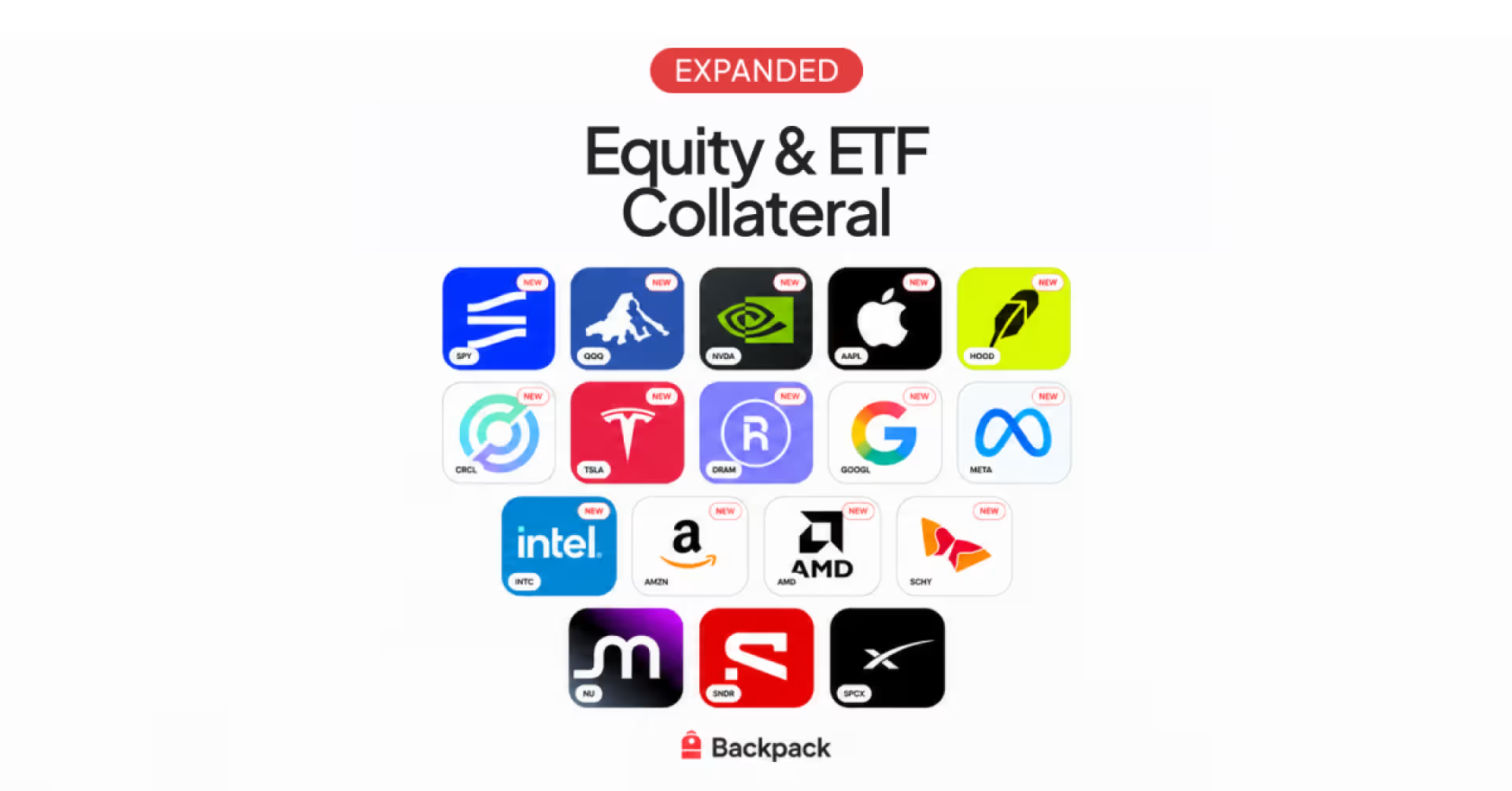
A more important step came when Backpack added 14 equities and ETFs to its collateral system, bringing the total number of supported equity collateral assets to 17. Users can hold equities, borrow USD, trade spot on margin, or open perpetual positions without selling the underlying assets.
This is more than adding another Trade button.
Once an asset can be used as collateral, it begins to support more revenue-generating activity. An equity holder can become a borrower, perpetual trader, or liquidity user within the same system. Capital becomes less fragmented, switching costs rise, and Backpack gains more opportunities to retain users.
This fits the broader thesis Whales previously explored: every crypto app is becoming a trading app. Competition is no longer about the number of features. Platforms are trying to own the full lifecycle of capital: deposit, collateral, borrow, trade, settle, and earn.
The downside is that risk also becomes more concentrated. When several assets share the same margin system, volatility from equities, crypto, and derivatives can spread across markets. Unified capital improves efficiency, but it requires a far stronger risk engine, haircut framework, and liquidation system.
The more useful signal is how many users actually use equities as collateral, borrow against them, and trade other products. That is the evidence that Backpack is becoming a multi-asset brokerage rather than an exchange with an extra Stocks tab.
Backpack is winning the liquidity race, not the issuance race
In tokenized equities, putting an asset onchain is not enough to attract traders.
A token may be backed 1:1 and carry a large market cap. However, if spreads are wide, depth is thin, and even an average order moves the price sharply, the market is still difficult to use. For traders, execution often matters more than the number of available tickers.
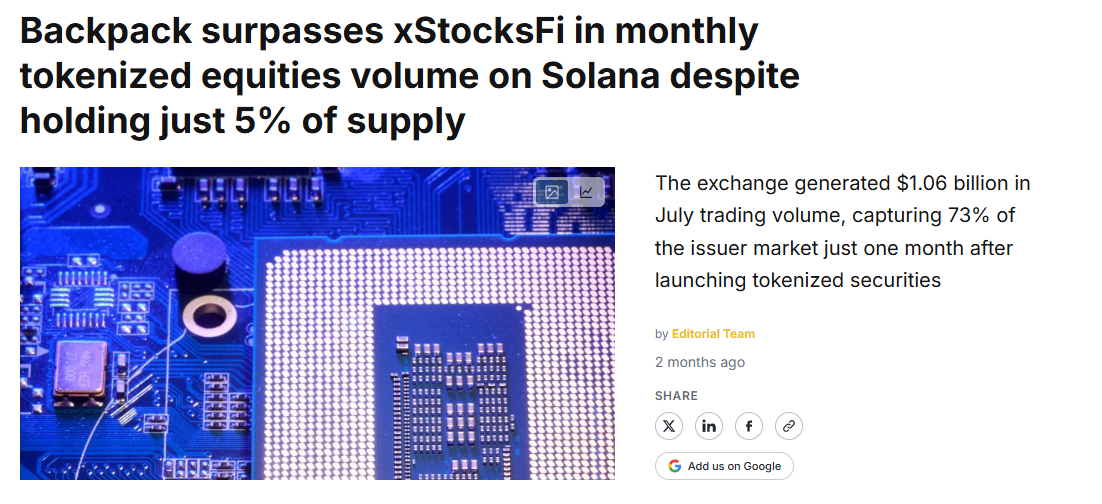
According to July data compiled by Crypto Briefing, Backpack generated about $1.06B in volume, equal to 73% of issuer-level volume on Solana, despite representing only around 5% of the tokenized equity supply.
In a separate study, Blockworks found that propAMMs handled between 66% and 74% of Backpack's weekly volume, averaging about 71% across the four weeks analyzed.
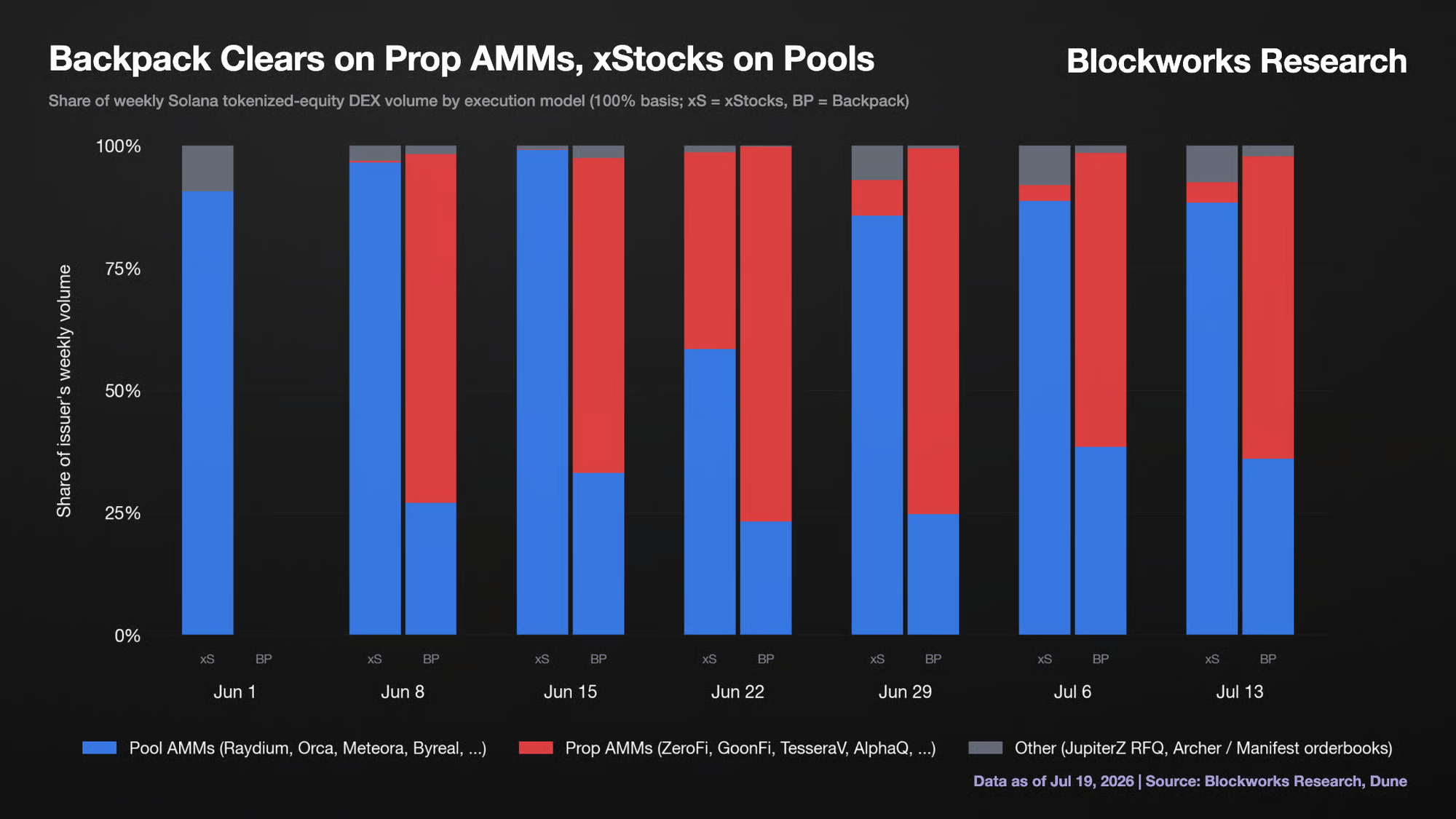
The gap between supply share and volume share still reveals something important: capital is turning over faster in assets issued by Backpack.
Supply shows how many assets have been brought onchain. Volume shows whether traders actually want to trade them. When an issuer has limited supply but high turnover, the market is choosing a venue based on execution rather than inventory.
This is why liquidity can create a powerful feedback loop:
Better depth → lower slippage → larger traders can enter more easily → volume grows → market makers have more reason to maintain depth.
Whales' guide to slippage explains why this advantage matters. In a low-liquidity market, a trader's real cost is not limited to the trading fee. Price impact and execution price can erase the apparent advantage of a product that looks cheaper.
However, Backpack's volume still appears concentrated in a few flagship assets, including SPCX and MU. A popular product can lift volume very quickly, but the same metric can fall just as fast when the narrative cools or a competitor offers better execution.
PropAMMs and redemption create a market structure that is harder to copy than a listing
Backpack's liquidity advantage did not appear on its own. Two mechanisms sit behind it: propAMMs and the ability to convert tokens into the underlying securities.
A passive AMM usually prices assets through a mathematical curve and the ratio of assets in a pool. When a large order moves through the pool, that ratio changes and the price moves with it. This model is permissionless, but it is not always ideal for equities, where offchain reference prices change continuously.
As Jump Crypto explains, a propAMM combines an offchain pricing engine with an onchain execution program. Market makers can continuously estimate fair value, manage inventory, and post executable bids and asks onchain. Trades still settle onchain, but the quoting logic is closer to professional market making than to a passive pool.
For tokenized equities, this capability is especially important outside traditional market hours. Prices still need to reflect new information, while liquidity providers must protect themselves from adverse selection and inventory risk.
The second piece is redemption.
Eligible Backpack tokenized securities can be converted 1:1 into the underlying security entitlement through Backpack Securities. The process also works in reverse: securities held in an account can be tokenized and withdrawn to Solana.
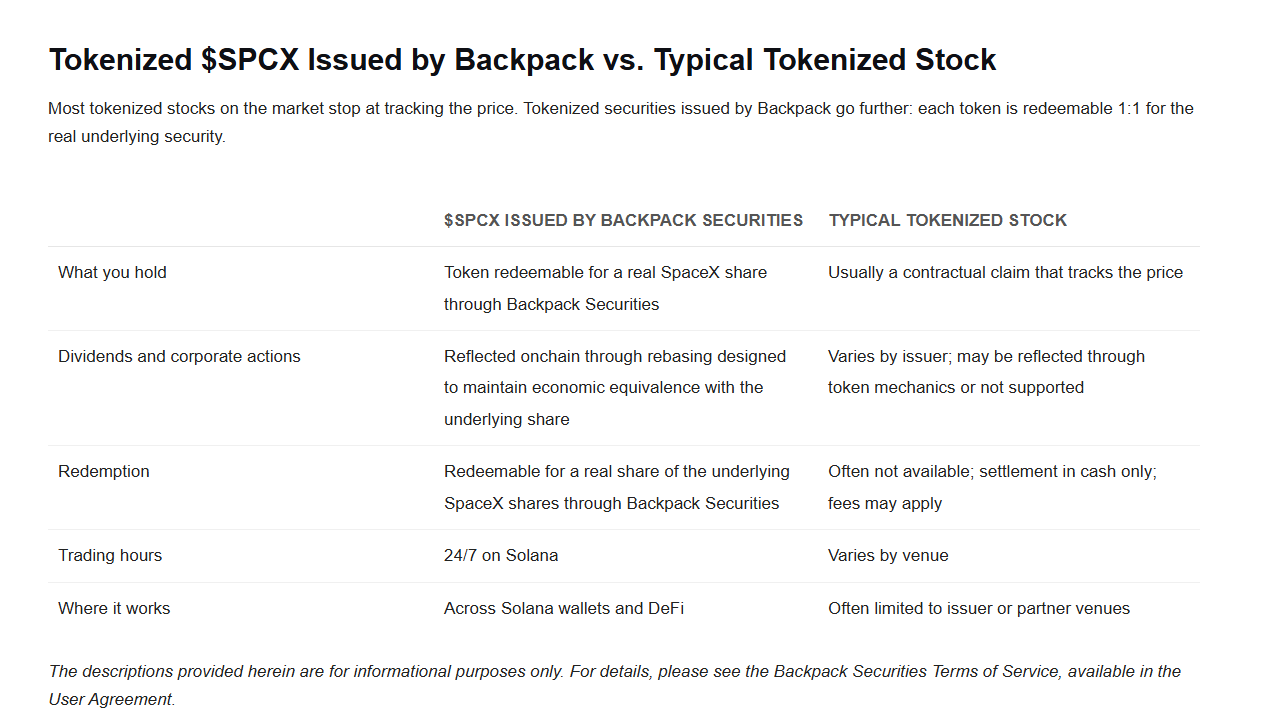
This two-way mechanism creates a price anchor. If an onchain token moves too far from the value of the underlying equity after fees and operating limits are considered, arbitrageurs have an incentive to buy the cheaper side and redeem into the more expensive one. This does not remove every price gap, especially outside market hours, but it provides a clearer route back to fair value than a synthetic token that only promises price exposure.
Together, propAMMs and redemption create a reinforcing loop:
Clearer reference prices → better inventory management → tighter spreads → more traders → deeper liquidity.
Even so, this is not proof that all volume is organic. If most trading comes from a small group of market makers, incentives, or high-turnover strategies, headline volume may look larger than real user demand.
Conclusion: BP is rising because Backpack's valuation story has changed
BP's rally does not come from a single factor.
A regulatory tailwind makes tokenized equities look less like a legal experiment. Backpack Securities brings equities into a unified capital system. propAMMs concentrate liquidity. Redemption creates an anchor to the underlying asset. BP then gives the market a way to price the long-term growth of the broader ecosystem.
The core thesis is not that Backpack offers a large number of tokenized equities.
The thesis is that Backpack is trying to own the full market stack: asset ownership, onchain distribution, liquidity, collateral, execution, and ultimately the relationship with users.
That model may deserve a higher valuation than a typical crypto exchange. However, BP has already rallied before most of the economic value has been proven. From here, the price needs support from retention, revenue, diversified volume, and staking demand, not only a new narrative.
Traders do not need to predict BP's next move immediately. The better approach is to track the metrics that can confirm or break the thesis: weekly securities volume, spreads, repeat traders, the share of volume outside flagship assets, collateral usage, revenue, and the pace of BP unlocks.
When these metrics rise together, the repricing has a stronger foundation. If only the token price moves higher, the market may simply be paying too early for a future that has not arrived.
FAQs
Why is BP rising so fast?
BP is rising because several catalysts arrived at the same time: a more supportive regulatory environment for tokenized equities, the expansion of Backpack Securities, the use of equities as collateral, and data showing that liquidity is concentrating around Backpack-issued assets. As a result, the market is beginning to value Backpack as an onchain brokerage rather than only a crypto exchange.
What is a propAMM?
A propAMM is a market-making model that combines an offchain pricing engine with onchain execution. Instead of relying only on a fixed curve, market makers can update bids and asks, manage inventory, and adjust risk more flexibly. The goal is to provide deeper markets and tighter spreads for traders.
Are Backpack's tokenized equities backed by real shares?
Backpack states that eligible tokenized securities can be redeemed 1:1 into the underlying security entitlement through Backpack Securities. However, rights, supported regions, fees, trading hours, and redemption conditions may vary. Users should read the terms for each product before trading.
Does growth at Backpack Securities guarantee that BP will rise?
No. Business growth supports BP only if it creates more token utility, staking demand, or economic benefits. If securities activity grows but BP does not capture value, or if supply unlocks faster than demand grows, the token price can still fall.
Which metrics matter most when tracking BP?
The main metrics are weekly securities volume, unique and repeat traders, spreads, market depth, the share of volume outside leading assets, collateral usage, revenue, BP staking, and the unlock schedule. A one-day volume record is a signal, not proof of sustainable growth.