

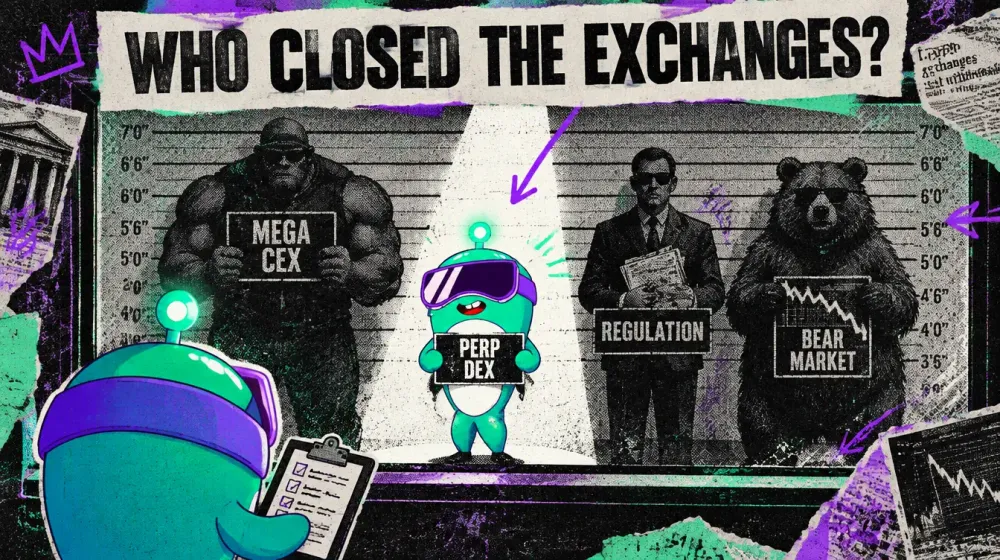
CoinEx has just announced that it will shut down after nearly nine years of operation. Less than two months earlier, BitMEX, one of the exchanges that helped shape the perpetual futures market, also announced that its exchange will close on September 23, 2026.
But there is an obvious contradiction. Top exchanges such as Binance and OKX are still growing trading volume steadily. So why are lower-tier CEXs shutting down? And does this wave have anything to do with Perp DEXs? That is the question this article tries to answer.
TL;DR
- CoinEx says it is shutting down after a prolonged market downturn, shrinking trading volume and liquidity, and rising regulatory requirements, compliance costs, and operational uncertainty.
- This looks different from the collapse wave of 2022. CoinEx says its reserves remain above 100%, while BitMEX says its closure is not driven by financial distress, a hack, or immediate regulatory pressure.
- CEXs are facing two pressures at once: overall volume has weakened, while the remaining activity is becoming more concentrated among large exchanges. Binance accounted for 38.7% of top-10 CEX spot volume in Q2 2026 and 46.9% of centralized derivatives volume in August.
- Perp DEXs have not replaced CEXs. DEX futures accounted for 13.9% of futures volume in August 2026. Still, they are eroding several moats that once helped tier-2 CEXs stand out, from listing access to distribution and self-custody.
- The thesis worth watching is not “DEXs are killing CEXs.” It is that the middle layer of the CEX market is getting squeezed.
2026 Is Not 2022: An Exchange Can Still Be Solvent but Decide It Is No Longer Worth Operating
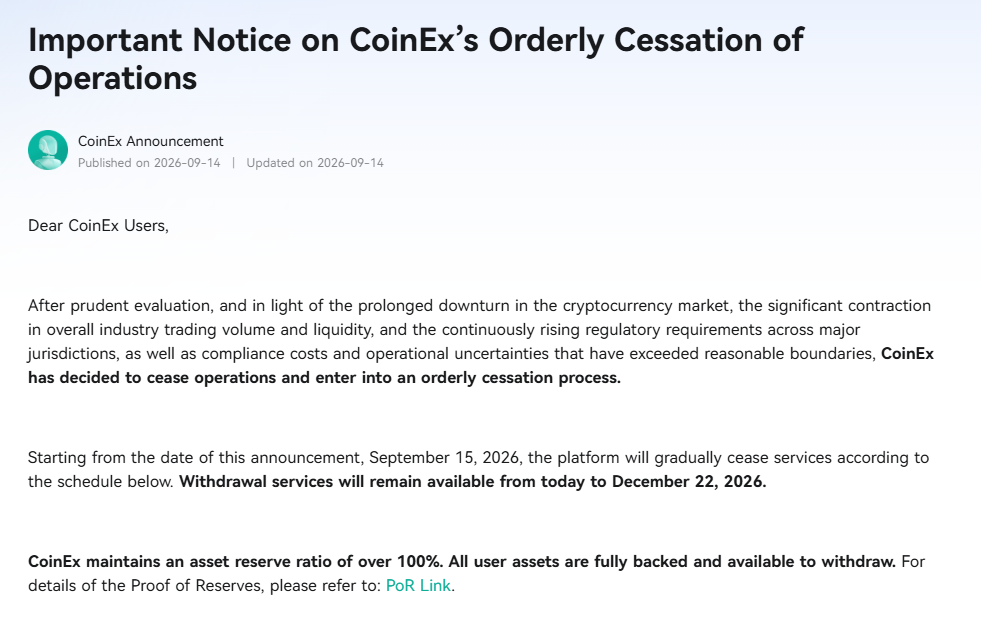
In its official announcement, CoinEx said it would begin an orderly cessation, stop non-spot services on September 22, stop spot trading on September 29, and keep withdrawals open until December 22, 2026. The exchange also said its reserve ratio remained above 100% and all user assets were fully backed.
What stands out more is the reason CoinEx gave: a prolonged market downturn, shrinking trading volume and liquidity, rising regulatory requirements, and compliance costs and operational uncertainty that had moved beyond “reasonable boundaries.”
Founder Haipo Yang put the economics more bluntly: revenue can fall, but responsibility does not. In his words, taking on “unlimited risk for limited revenue” no longer makes sense.
BitMEX will close its exchange on September 23, 2026 after a strategic review, and says the decision was not driven by financial distress, a hack, or immediate regulatory pressure. BitMart also announced an orderly cessation in July, although it later updated users on a possible restructuring.
The common thread is not that “these exchanges ran out of money.” It is that the risk-adjusted economics may no longer be attractive enough.
Pressure 1: The CEX Pie Has Shrunk
An exchange lives on flow. Lower volume means lower fee revenue, while thinner liquidity leads to wider spreads and worse execution. According to CoinGecko, spot volume across the top 10 CEXs fell 27.9% QoQ in Q2 2026, from $2.70T to $1.95T. Top-10 perp CEX volume fell 10%, from $14.1T to $12.7T.
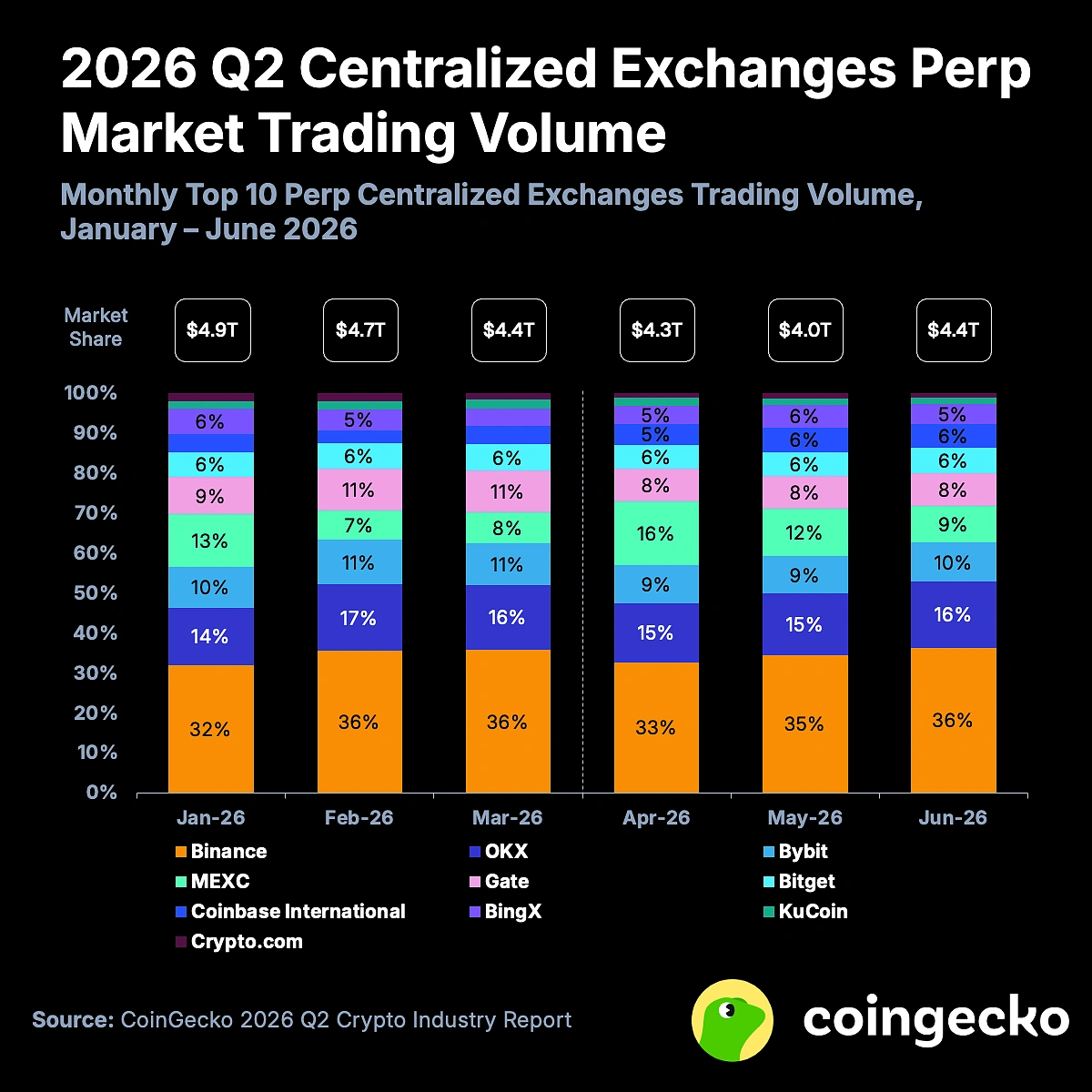
Zooming out, average monthly volume across the top 11 perp CEXs in the first four months of 2026 was $4.69T, 34% below the 2025 average. So a smaller CEX is not only losing market share. It is competing inside a smaller revenue pool.
But the trend is not linear. In August, combined CEX volume rebounded 12.7% to $4.29T. Spot volume rose 18.7%, while derivatives volume increased 11.3%.
That raises the more important question: when volume returns, does it spread back across the industry, or does most of it flow toward the venues that already have the deepest liquidity?
Pressure 2: Remaining Liquidity Is Concentrating at the Top
In Q2 2026, Binance accounted for 38.7% of spot volume across the top 10 CEXs. Bybit ranked second at 10%. By August, Binance had increased its centralized derivatives market share to 46.9%, the highest level since November 2023 and its sixth consecutive month of share gains.
The network effect is simple: more traders → more market makers → deeper order books → better execution → even more traders.
When the market contracts, liquidity tends to move toward the most efficient venues. That means the biggest threat to a tier-2 CEX may not be Hyperliquid. It may still be Binance, OKX, or Bybit.
Perp DEXs are the newer competitive force. Liquidity concentration at the top of the CEX market is the older force, and it is becoming harsher. That is why the market is starting to polarize:
- Mega-CEXs ← mainstream flow and liquidity.
- Tier-2 CEXs ← squeezed in the middle.
- Perp DEXs ← crypto-native flow and onchain distribution.
Pressure 3: Perp DEXs Are Too Large to Treat as a Side Market
It is too early to say Perp DEXs are “killing CEXs.” But it is also no longer accurate to treat them as a small DeFi niche.
CoinGecko recorded $6.38T in volume across the top 12 Perp DEXs in 2025, up from $1.50T in 2024. Average monthly volume during the first four months of 2026 was $611.57B.
In August 2026, DEX futures volume reached $549B and represented 13.9% of futures market share. That still leaves roughly 86% on centralized venues.
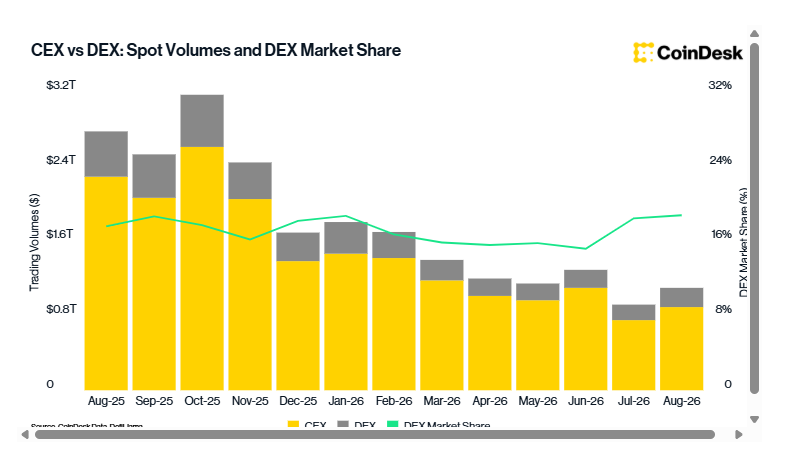
CEXs have not been replaced. Perp DEXs have simply become a large enough alternative venue for traders to choose from. Whales already has a guide to Perp DEXs for the basics; the more important point here is that a higher onchain share makes the economics of smaller CEXs harder when total market volume is not growing fast enough.
Perp DEXs Do Not Need to Take Volume Directly. They Are Taking Away Reasons for Tier-2 CEXs to Exist
There is no public evidence showing that $1 of volume on Hyperliquid directly equals $1 of volume lost by CoinEx. But Perp DEXs are weakening several value propositions that once helped tier-2 CEXs survive.
Advantage 1: List What Binance Has Not Listed Yet
Tier-2 CEXs historically accepted thinner liquidity in exchange for earlier access to new tokens. MEXC and Gate, for example, listed 1,281 and 1,273 tokens respectively over 13 months, yet long-tail assets still appear onchain faster than listing committees can keep up.
On the derivatives side, Hyperliquid’s HIP-3 allows eligible builders to deploy perp markets permissionlessly on HyperCore. Listing can therefore become infrastructure rather than only an internal exchange decision.
Advantage 2: Trading Used to Mean Visiting the Exchange Website
Perp DEXs are weakening the distribution moat.
Hyperliquid builder codes allow wallets, interfaces, bots, and apps to route orders into Hyperliquid after users authorize the fee.
According to CoinGecko, Phantom had generated more than $20.6M in cumulative builder revenue as of May 25, 2026, while other frontends were also routing flow into the same liquidity layer.
A trader can open a familiar wallet and trade perps without starting from an exchange homepage. This is a distribution battle, not just a fee battle.
Advantage 3: CEXs Used to Be More Convenient Than Onchain Trading
The UX gap is narrowing through self-custody trading, embedded wallets, builder frontends, and order-book infrastructure. Risk has not disappeared. Perp DEXs replace CEX counterparty risk with smart-contract, oracle, validator, bridge, and liquidation-engine risk.
But the question for crypto-native traders has shifted from “Is a DEX good enough?” to “What does a smaller CEX offer that a top CEX or an onchain venue does not?”
The Real Problem Is Operating Leverage: Revenue Falls Faster Than Costs Can
Exchange revenue scales with activity. When volume falls, fee revenue drops almost immediately.
But many cost centers do not scale down at the same pace: KYC/AML, licensing, legal, security, custody, audit, surveillance, customer support, and incident response.
MiCA is a clear example of regulatory fixed-cost pressure. According to ESMA, the transitional period across the EU ended no later than July 1, 2026. Entities without the appropriate authorization must stop providing relevant services to EU clients.
A top exchange can spread compliance costs across a much larger fee base. A smaller exchange carries many of the same layers of responsibility across far less volume.
That is why Haipo Yang’s line matters: revenue can fall, responsibility does not. When downside liability stays large while the fee pool shrinks, shutting down can become rational before an exchange ever becomes insolvent.
Who Is Actually Winning?
If the thesis is right, Perp DEXs are not the only winners.
Mega-CEXs benefit from liquidity consolidation. A trader leaving a smaller CEX can just as easily move to Binance instead of Hyperliquid.
Perp DEXs benefit from self-custody, onchain access, and composability, but their market share is still the minority.
Wallets and frontends can also win if the execution layer becomes infrastructure. Phantom’s more than $20.6M in builder revenue shows that a wallet can become an exchange frontend without bootstrapping its own order book.
This is not simply “CEXs lose, DEXs win.” The exchange value chain is being broken apart and redistributed.
What Could Prove This Thesis Wrong?
First, a bull market could rescue the middle. If total volume returns and tier-2 CEXs recover market share, many current closures may reflect the cycle more than a structural shift.
Second, points and airdrop expectations may inflate Perp DEX activity. If rewards disappear and users do not stay, sticky demand may be weaker than the narrative suggests.
Third, regulation could follow derivatives onchain and narrow the cost advantage.
Fourth, CEXs can copy onchain UX. August also showed that CEXs can still create new product demand, with RWA perps volume reaching $602B.
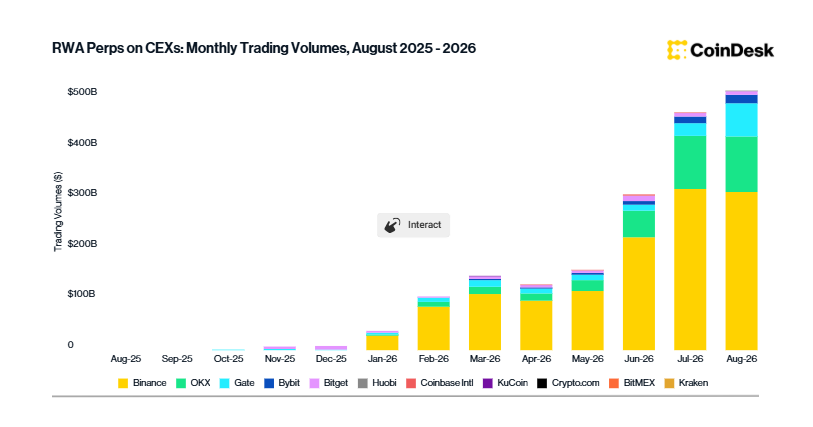
The most important signal is therefore market share across cycles.
If total volume recovers while Perp DEXs hold or grow share, the structural thesis becomes stronger. If flow returns to smaller CEXs and DEX share contracts materially, much of today’s pressure may simply be bear-market selection.
Conclusion
CoinEx and BitMEX shutting down does not prove that the CEX model has failed or that derivatives flow will move entirely onchain.
The data points to a more nuanced structure: CEXs still dominate volume, mega-CEXs are consolidating market share, and Perp DEXs are now large enough to erode several advantages that once belonged to smaller CEXs.
Compliance, custody, security, and responsibility do not disappear when fee revenue falls. That is why the middle of the market is the layer worth watching most closely.
Perp DEXs do not need to become 100% of the market. They only need to make the choice to “open one more small CEX account” increasingly hard to justify.
If price discovery keeps shifting earlier toward pre-market and onchain venues, traders also need to change where they look for signals. Instead of waiting for a listing announcement to validate the narrative, the focus should move to where liquidity, valuation, and positioning begin to form before listing.
Whales Market allows traders to observe and trade pre-market allocations before TGE, where implied valuation and filled orders can add another data point to the price-discovery process. Being “early” alone is not a reason to buy. It is one market input that still needs to be read alongside tokenomics, liquidity, and listing conditions.
FAQ
Are Perp DEXs Replacing CEXs?
Not yet. DEX futures accounted for 13.9% of futures market share in August 2026. Most activity still sits on centralized venues, but Perp DEXs are now large enough to compete with smaller CEXs in several use cases.
Why Is CoinEx Shutting Down?
CoinEx cited a market downturn, shrinking volume and liquidity, rising regulatory requirements, and higher compliance costs. The exchange also said its reserve ratio remained above 100%, but that is a project claim rather than an independent audit.
Is BitMEX Shutting Down Because of Perp DEXs?
There is no evidence of that. BitMEX says the closure followed a strategic review and was not caused by financial distress, a hack, or immediate regulatory pressure.
Are CEXs or DEXs Safer?
There is no absolute answer. CEXs carry counterparty and custody risk, while DEXs carry smart-contract, oracle, bridge, and liquidation risk. Each venue needs to be assessed on its own.
Disclaimer: This article is for informational purposes only and does not constitute financial advice. Crypto assets, pre-market tokens, centralized exchanges, and decentralized protocols all involve significant risk. Always verify information from official sources and conduct independent research before trading.