

Most AI products today are using models that are too powerful for tasks that are too small.
A ticket may only need to go to Billing or Support. An agent may only need to decide whether to call another tool or stop. Yet the common pattern is still to send a large context window to an LLM, wait for generated text, then parse that text back into a label the code can use.
Jev is built around a simpler question: if software only needs a decision, why does the model need to talk?
Jev is not designed to write articles, generate code, or hold conversations. It takes a state and a set of predefined questions, then returns a Choice, Score, or yes/no probability.
TL;DR
- Jev is the first model in TypeSafe's “System One Models” family. Its outputs are typed, probabilistic decisions rather than free-form text.
- TypeSafe lists Jev at $0.042 per 1M input tokens and reports latency of roughly 70 to 500 ms.
- The headline claims of 193.6x faster and 444.6x cheaper come from TypeSafe's own workflow evals, not from a universal benchmark across every workload.
- Vercel reports that nearly 13% of paid teams on AI Gateway used Jev within its first 24 hours.
- Jev's main value is in routing, classification, scoring, and guardrails, not in competing with LLMs on writing or open-ended reasoning.
What Is Jev, and Why Does It Matter?
What Exactly Is Jev?
TypeSafe launched Jev on September 15, 2026 after about two years in stealth. Founder Diogo Almeida previously worked at OpenAI during the development of instruction-following and RLHF. DCVC also announced that it led TypeSafe's $40M Series Seed.
TypeSafe calls Jev a “System One Model.” For developers, the more useful part is the interface.
Jev takes a state, which can be text or application data, and one or more questions with a predefined answer space. It does not write a long explanation. It returns a decision and a probability distribution that code can use next.
State in. Typed decision out. No paragraph in between.
TypeSafe describes Jev as a “frontier-intelligence function call.” The thesis is simple: intelligence can become a primitive inside software instead of always flowing through a chat interface.
we are officially out of stealth! join the frontier and get access to Jev on our website (link on profile) https://t.co/hGLSb4XsTv
— TypeSafe AI (@typesafeai) September 15, 2026
Why Did Jev Catch On So Quickly?
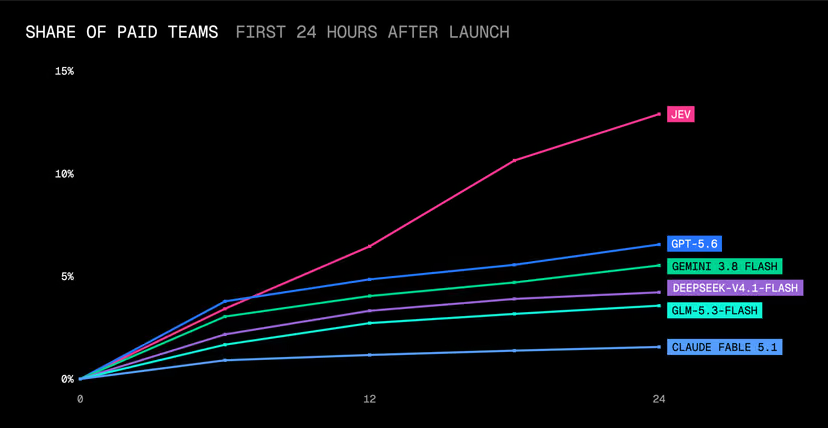
Vercel reports that within the first 24 hours of Jev appearing on AI Gateway, nearly 13% of paid teams had used the model. According to Vercel, that was the fastest adoption in AI Gateway history and more than double any previous model launch in the comparison group.
That does not prove Jev is better than GPT or Claude, but it does show that demand for this type of workload is real.
TypeSafe lists Jev at $0.042 per 1M input tokens, with free output and latency of roughly 70 to 500 ms. In workflows that run thousands of decisions each day, cost per call starts to matter.
This connects directly to the broader AI agent story. Whales explored the same issue in Dario Amodei on AI: once models can use tools and take actions, the real question is whether a decision is reliable enough to execute.
Choice, Score, and Noul: The Three Primitives to Know
Jev does not start with an empty chat box. The API forces developers to define the decision type upfront.
Choice works when there is one answer from a known set, such as Billing, Technical, or Other. Jev returns the selected option along with a probability distribution across the choices.
Score works when the answer sits on an ordered scale such as Low, Medium, High, or Critical. It fits severity, quality, or ranking tasks better than hard classification.
Noul is a yes/no question expressed as a probability. For example: “Is the customer asking for a refund?” A value close to 0.5 should be read as uncertainty, not as a “medium” level.
Because the answer space lives in code, Jev fits into workflows more cleanly than text that has to be parsed afterward.
How Strong Is Jev?
“Zero Hallucinations”: How Far Does That Claim Go?
This is the claim most likely to be taken too far.
TypeSafe says Jev has “zero hallucinations,” but the company also explains that the 0% figure is not an empirical benchmark. Schema matching is guaranteed, which means Jev cannot return a value outside the output set defined by the developer.
If a Choice only includes billing, technical, and other, the model cannot invent something like legal_department.
But Jev can still choose billing when the ticket is actually technical.
Type-safe output removes one class of failure. It does not remove wrong judgment.
Vercel also notes that probability, confidence, and score are different signals. Thresholds need to be tested on labeled examples from the actual application. An output can match the schema and still be wrong in meaning.
In crypto, this becomes more sensitive because an agent may interact with a wallet or smart contract. Whales' What Is ERC-8004? looks more closely at this trust and validation layer.
193.6x Faster and 444.6x Cheaper: What Does the Benchmark Actually Show?
The headline on TypeSafe's homepage is strong, but it does not mean Jev is always 193x faster than an LLM.
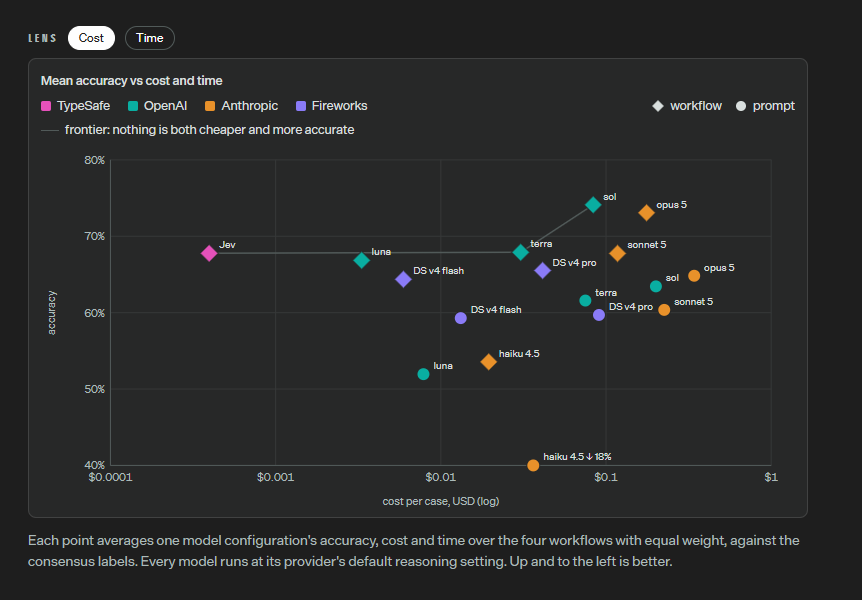
TypeSafe built four automation workflows: Customer Service, Invoice Processing, Security Incidents, and Agent Trace Observability. Each workflow is split into smaller judgments, while deterministic rules and control flow stay in code.
The more useful lesson is the task decomposition itself. Many LLM workflows become slow and expensive because the model is asked to handle work that code can do better.
Still, this is a vendor-run benchmark. TypeSafe acknowledges possible bias, and the 193.6x and 444.6x multipliers sit at the high end of the gains the company expects in practice. The reference labels also rely on consensus from frontier models rather than independent ground truth for every task.
A more accurate reading is this: on workloads structured around System One decisions, Jev can deliver competitive quality at much lower cost and latency. Whether a production workload fits that shape still needs to be tested.
What Do Independent Tests Show?
Parallel tested Jev on search reranking, topic classification, and query freshness. In reranking, Jev reached an NDCG@10 of 0.7, comparable to at least one of Parallel's internal custom rerankers. But Parallel's specialized model won on topic classification and freshness. Parallel also noted that Jev had a higher cost per document than its self-hosted systems at scale.
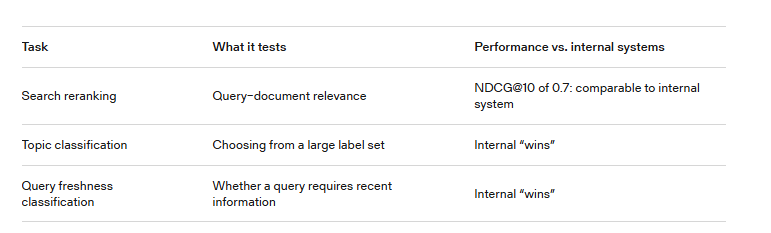
Parallel compares Jev with internal systems across reranking and classification.
Jev's real competitor is not always GPT or Claude. When a team already has a strong dataset and inference infrastructure, a specialized classifier can still win. When that classifier does not exist and a zero-shot decision layer is needed, Jev becomes more interesting.
Mike Taylor, Head of Evals at Every, used Jev as a “vibe checker” to score several fuzzy criteria. This is a useful guardrail pattern: an agent can check its own output without calling a frontier LLM for every small check.
Where Does Jev Fit Best?
A simple rule works well here: if the answer shape is known in advance, Jev is worth testing. If the model needs to create the answer space itself, an LLM is the more natural fit.
Jev fits routing, classification, scoring, fraud flags, agent control, RAG relevance checks, and guardrails, especially when the same decision runs repeatedly at high volume.
On the other hand, Jev is not a good fit for writing emails, generating code, long-form research, or brainstorming. AI is also unnecessary for rules that code can resolve exactly. Invoice > $75 is a comparison, not a judgment.
How to Use and Master Jev
How to Use Jev
TypeSafe's official JavaScript SDK has a fairly short quickstart:
npm install @typesafe-ai/sdk
After setting TYPESAFE_API_KEY:
import { choice, TypeSafeClient } from "@typesafe-ai/sdk";
const client = new TypeSafeClient();
const result = await client.systemOne({
state: { ticket: "I was charged twice and need a refund." },
questions: {
category: choice("What is this ticket about?", {
billing: null,
technical: null,
other: null
})
}
});
console.log(result.answers.category.choice);
The important part is not the syntax. Jev is given one narrow judgment: which category does the ticket belong to? Policy and the next action still stay in code.
How to Master Jev: Stop Thinking Like a Prompt Engineer
Syntax can be learned in minutes. Decision design is the harder part.
1. Start from the branch in the code. Before writing a question, define what the answer will change in the logic.
2. One question should measure one thing. “Is the user angry and at risk of churning?” combines two judgments, so split them.
3. Make the boundaries clear. Billing and Technical should be different enough that a new team member can classify them consistently. For Score, concrete scenarios usually work better than empty labels like Low, Medium, or High.
4. Send only the minimum state needed for the decision. If the decision only needs the current message and subscription status, a 200-message history adds noise.
5. Keep hard rules in code. Arithmetic, date comparisons, permissions, and exact matches do not need a model. Jev should handle semantic ambiguity.
6. Calibrate thresholds with real data. Vercel recommends using labeled examples and measuring error rates at each cutoff. A score of 0.9 does not automatically mean “safe.”
7. Give low-confidence cases an exit. Route them to human review or a stronger LLM. Good automation is not 100% automation. It knows when to stop.
A Practical Architecture: Code + Jev + LLM
The question “Is Jev or an LLM better?” misses the point.
Code handles deterministic rules and side effects. Jev handles narrow semantic judgments. LLMs handle generation and open-ended reasoning.
A support agent can use code to check the refund window, Jev to decide whether the customer is asking for a refund or only asking about policy, and an LLM to draft the response. If Jev is uncertain, the workflow can hand the case to a person.
Jev does not need to replace ChatGPT. It only needs to remove generative-model calls that are being used where a smaller decision layer would be enough.
For a broader look at AI agents in crypto, Whales has an AI hub covering Grok Bot, ERC-8004, and agent infrastructure. With Jev, the key question is still whether the workload is bounded enough to turn into a decision.
What to Know Before Putting Jev Into Production
There are three risks worth watching.
First, structured-output LLMs may continue to get cheaper and faster. If the overhead of frontier models falls far enough, Jev's economic gap will narrow.
Second, calibration may not hold up on messy production data. Probability is only useful when confidence maps to measured reliability on the real task.
Third, specialized classifiers remain strong competitors. Parallel's test already shows that Jev does not win every task. Zero-shot convenience is a major advantage when data and infrastructure are missing, but it is not a promise that Jev is always optimal.
The best test is shadow mode: take 50 to 200 real cases, keep the current workflow as the baseline, run Jev in parallel, then compare quality, latency, cost, and review rate.
Conclusion
The most interesting thing about Jev is not that TypeSafe released another AI model. The important part is that the company is rethinking the interface between AI and software.
LLMs are optimized to talk to people. Jev is optimized for code to ask a narrow question and receive a typed decision, a probability, and an uncertainty signal. When a workload contains thousands of small judgments, that difference can matter more than the ability to write a paragraph.
But the main benchmarks still come from TypeSafe, independent evidence is still limited, and specialized classifiers can still win.
The clearest way to understand Jev is to take one decision already inside the stack, run Jev alongside the current system for a few days, and let accuracy, latency, cost, and the error budget answer the question.
FAQ
What Is Jev AI?
Jev is TypeSafe AI's first System One Model. It takes a state and typed questions, then returns a Choice, Score, or yes/no probability for software to use directly.
Is Jev an LLM?
TypeSafe does not position Jev as a chat LLM. Jev focuses on typed probabilistic decisions. The company says the model uses its own architecture, sampler, and RLCD training method, but has not published the full architecture.
Is Jev Better Than ChatGPT or Claude?
There is no single answer. Jev fits bounded decisions, while GPT and Claude are better suited to generation and open-ended reasoning. In production, the two approaches can complement each other.
Does Jev Really Have Zero Hallucinations?
Jev guarantees that output stays inside the defined schema, but it can still choose the wrong valid option. Schema correctness and semantic correctness are different things.
How Much Does Jev Cost?
TypeSafe currently lists Jev at $0.042 per 1M input tokens, with free output. Early-access pricing can change.