

On September 16, Arc officially opened its doors. Within 24 hours, users on the chain had created more than 97,000 tokens and pushed DEX volume into the hundreds of millions of dollars.
By the next morning, a long list of those tokens had fallen 50-80% from their highs. One trader on X summed it up in two words: "It's cooked." The timeline started writing Arc's obituary.
Open DefiLlama, though, and the picture looks very different. More than $300M is still sitting quietly in lending pools, and almost none of it has anything to do with memecoins.
So where is the real money on Arc actually going? Whales breaks it down, one layer at a time.
This analysis has 6 parts: the real day-one volume, why memecoins cooled so fast, where the remaining money sits, the ARC token, the two sides of the debate, and the metrics worth tracking.
TL;DR
- Day-one volume depends on the source. Dune recorded $410.8M, while DefiLlama recorded around $82M, because the two count within different scopes.
- Memecoins cooled off in less than 24 hours. The leading tokens dropped 56-77% from their highs.
- The money that stayed is in lending. Around 91% of the $338.95M in TVL sits in Morpho and Aave V4.
- The key contradiction: the biggest speculative asset tied to Arc is not a memecoin. It is the ARC token, which Circle has not committed to launching.
Arc's First Day: $410M or $82M?
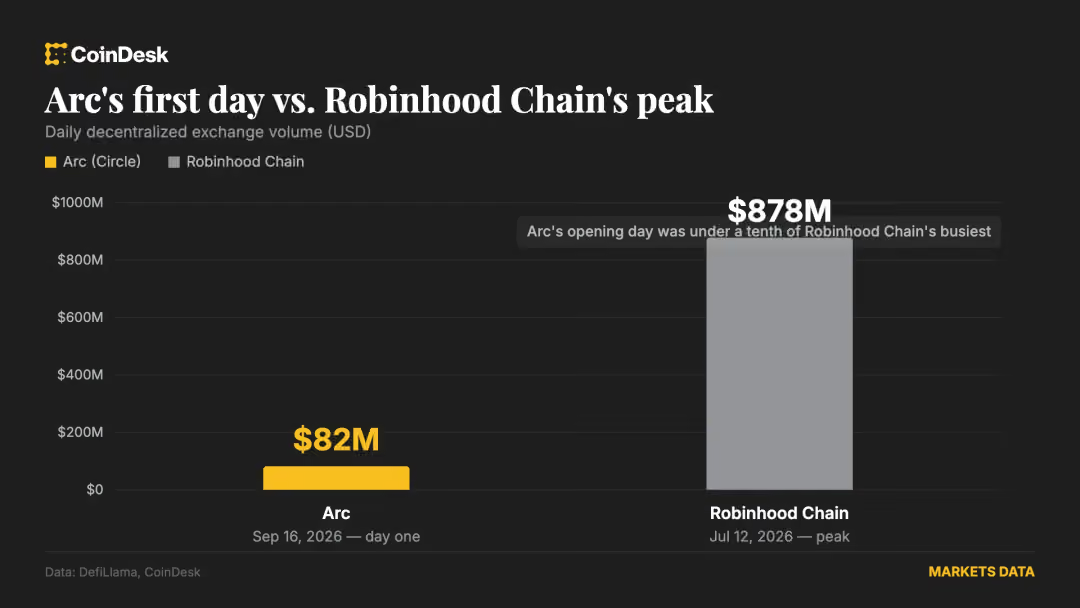
The number that spread fastest on X was $410.8M in DEX volume on September 16, based on Dune data compiled by analyst adam_tehc. Memecoin launchpads contributed about 82% of that, with Arguspad alone accounting for $202.35M.
However, according to CoinDesk, citing DefiLlama, day-one volume was only around $82M. Neither number is wrong. Dune counts each launchpad separately, while DefiLlama, at the time of checking, did not track Arguspad as a standalone protocol. One source counts the whole casino. The other only counts the tables that have signed in.
Why does volume inflate so easily? Picture this:
A user brings 1,000 USDC to Arc, buys token A and sells it, then uses the proceeds to buy token B and sells that too. After 10 rounds, the dashboard shows about $20,000 in volume. Yet the real capital that entered the chain is still just 1,000 USDC.
Transaction count works the same way. According to CoinDesk, Arc processed 7.83M transactions in its first 24 hours, but total USDC transfers since launch stood at only about 624,000. The chain was built for payments, yet payments have barely started.
In short, "$410M" measures how fast money spins inside the casino, not how much real capital came into Arc. The number worth watching is non-launchpad volume, which Cryptopolitan estimates at around $74.6M on day one.
Why Did Arc Memecoins Cool Off So Fast?
The short answer: token supply grew faster than the number of buyers.
Before mainnet, 18 launchpads were already lining up to become "the Pump.fun of Arc." Arguspad alone minted 83,751 tokens in 24 hours, more than 86% of all new tokens on the chain. According to Argus's repo, the launchpad collects fees through a Uniswap v4 hook whether tokens go up or down.
Still, nearly 100,000 tokens does not mean 100,000 ideas. It means buying power got split into 100,000 pieces. Whales calls this guest liquidity: money that shows up for the grand opening and leaves once there is nothing new to chase.
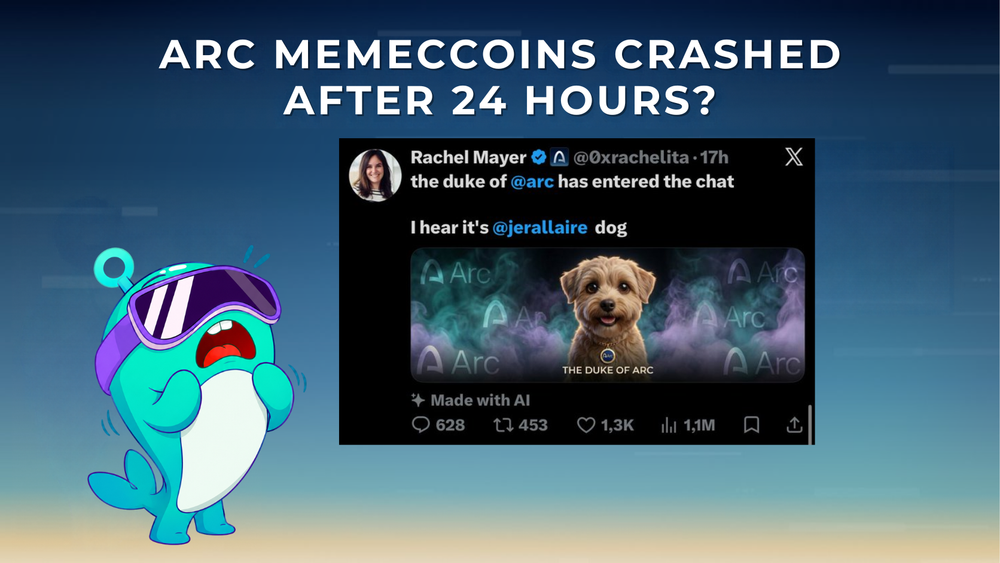
The marketing backfired, too. Arc's VP of product posted an AI-generated image promoting DUKE, a memecoin said to be CEO Jeremy Allaire's dog. The post pulled in around 1M views, along with a wave of accusations that Circle was shilling tokens.
The deeper problem is the buyer base. Robinhood had the buyers first and built the chain later. Arc built the chain first and then went looking for buyers. Arc's distribution runs through exchanges and wallets, not through an app that tens of millions of retail investors open every morning.
In short, Arc memecoins did not cool off because the team "doesn't get memes." They cooled off because dozens of launchpads were splitting a limited pool of buyers. The playbook can be copied. The players cannot.
Where Is the Money That Stayed on Arc?
As of September 18, Arc's TVL stood at $338.95M. Morpho Blue held $181.46M and Aave V4 held $126.53M, while the largest launchpad, Tolly, held only about $256,000. That puts roughly 91% of TVL in lending, with all launchpads combined at less than 0.1%. Stablecoin market cap on the chain reached $646.9M, and 98.84% of it is USDC.
Whales calls this resident liquidity. Memecoins need new buyers every hour. Credit needs borrowers who come back every month.
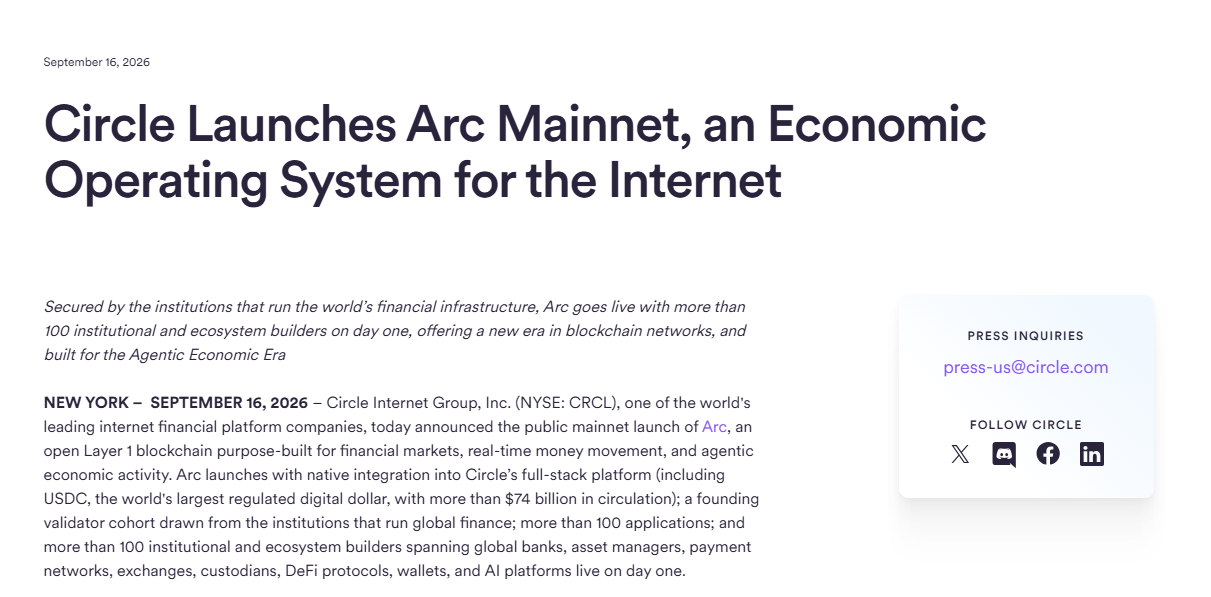
It is too early to celebrate, though. Circle's own press release says Galaxy, Keyrock, Cumberland, Steakhouse Financial and other partners supply USDC and EURC to the lending markets. Part of this TVL is seeded capital, so it does not yet prove real borrowing demand. The numbers are also swinging hard: on the same day, Morpho fell 20.23% while Aave V4 rose 63.65%.
What about the "dead chain" story? DEX volume over the past 24 hours on DefiLlama was $124.21M, against $193.51M over 7 days. Memecoins may be fading, but activity on the chain is not.
Beyond lending, Circle says StableFX (24/7 FX across more than 20 local stablecoins) is already live, while privacy features and the Payment Sector are still on the roadmap. These are slow-moving pieces that rarely spark a pump in the first week.
In short, the bottom layer is a casino with big volume but thin capital, and the top layer is lending with deep capital, part of which is seeded by partners. Launchpads can win Twitter. Lending has to win over time.
ARC Token: 10B Minted, Not Yet Launched
During mainnet launch week, Circle minted the full 10B $ARC supply. Circle made it clear this is not a commitment to a public launch, but a technical milestone as Arc explores a move to Proof of Stake in 2027. ARC is not trading yet and has not activated staking, governance or fees.
According to the whitepaper, fees paid in USDC will be converted into ARC, with part going to validators and stakers and the rest burned.
So is the $3B FDV a market price? It helps to look at what a presale fund actually holds:
A fund buys 1M $ARC at $0.30, or $300,000. According to the 8-K filing, these tokens are locked for at least one year after Arc moves to PoS, and possibly for up to four years. If PoS arrives in 2027, the earliest the fund can sell is 2028. In return, the fund gets its money back if Arc has not moved to PoS by May 8, 2028.
An investment with a refund right and a token that can be sold today are two different assets, even if they share the same ticker.
What has not been announced yet: the launch date, how much of the 60% ecosystem allocation goes to users, vesting for Circle and the reserve, and whether there will be an airdrop at all. For users farming in hopes of a distribution, Whales' Arc airdrop guide covers the tasks worth tracking.
When a major token has a presale price but no TGE, pre-market is usually the first place where traders show their expectations. If ARC appears on Whales Market pre-market, the $0.30 price becomes a natural anchor for comparison. Users new to the mechanics can start with the guide to pre-market trading.
Pre-market pricing reflects what willing buyers and sellers currently agree on for an expected allocation; it does not forecast the post-launch token price.
In short, $0.30 is the price of capital locked for years with a refund right attached, not a market price. Every expectation around ARC is a bet on an event that still has no date.
"It's Over" vs. "Too Early to Tell": Who Is Right?
The bearish camp looks at price. According to CoinDesk, trader wale.moca said Arc was already "cooked" as every coin dropped 50-80%. Abbas Khan argued that the team misread meme culture, leaving Arc stuck somewhere between a meme chain and a corporate stablecoin chain. Macro did not help either: the Fed raised rates by 25 basis points on September 16, its first hike since July 2023.
The patient camp looks at precedent. Robinhood Chain went through the same sequence: memecoins first, real assets later. RWA value on that chain reached $168.13M as of September 17, and the chain cooled off in August before setting a record of $3.7B in single-day volume in September. Arc is also not the first stablecoin chain to face this test.
This article's thesis, that the lending layer matters more than memecoins, could also turn out to be wrong if:
- TVL is seeded capital that gets pulled once partners stop supporting it.
- Institutions use Arc without leaving any trace that traders can act on.
- Memecoins come back stronger, as they did in Robinhood Chain's second wave.
- ARC launches very late, or never launches at all.
In short, the bears are right about memecoins, and the patient camp is right about time. What settles the debate is not this week's token prices, but whether USDC stays once partners stop seeding capital.
Conclusion
Arc stumbled on the meme layer because the chain was never built for that layer. Its real weakness is the lack of proof of organic demand: deposits are partly seeded by partners, payments have barely started, and ARC has a price but no date.
The open question is not "which memecoin will 10x," but who will borrow USDC on Arc once partners stop seeding capital.
The timeline wrote Arc's obituary after 24 hours. Maybe it was right about the memecoins. The obituary for the chain, though, should wait until USDC starts leaving. And if ARC opens on pre-market, Whales Market will be one of the first places to show which layer of Arc traders are betting on.
Frequently Asked Questions (FAQ)
When did Arc mainnet launch?
On September 16, 2026. Arc is EVM-compatible, uses USDC for gas, and is operated by Circle together with 11 founding validators, including BlackRock, Visa and Mastercard.
Can the ARC token be traded yet?
No. Circle has minted 10B $ARC, but the token has not launched, is not trading, and has no staking or governance functions yet.
Will Arc have an airdrop?
This has not been confirmed. The whitepaper allocates 60% of supply to the ecosystem, but it does not say how much of that, if any, goes to users.
Which launchpad is the largest on Arc?
According to Dune data from September 16, Arguspad led with around $202M in volume. Rankings on a new chain change very quickly, though.
Where can ARC be traded before TGE?
Expected allocations can be traded peer-to-peer on pre-market platforms such as Whales Market, with collateral locked in smart contracts until settlement. Pre-market pricing reflects what willing buyers and sellers currently agree on for an expected allocation; it does not forecast the post-launch token price.