


A step-by-step thread on building a ‘one-person AI hedge fund’ with Grok Bot reached 1.6 million views on X. Another video showing six AI agents monitoring markets, analyzing trades, managing risk, and executing orders while the user sleeps drew more than 111,000 views.
In a matter of weeks, Grok Bot moved from a workplace automation tool to one of the strongest narratives on Crypto X. Users are assigning agents to read news, monitor large wallets, search for opportunities on prediction markets, and prepare trades around the clock.
The viral posts, however, tend to bundle three very different capabilities together: market research, trade automation, and the ability to generate a profitable strategy. Grok Bot can support the first two when it is connected to the right tools. The third still depends on data, strategy, and evidence that most posts on X do not provide.
This article explains what Grok Bot can actually do, how a multi-agent trading desk would operate, which profit claims remain unverified, and how traders can use the technology without handing an AI system unrestricted control of their accounts.
What Is Grok Bot?
Grok Bot is an AI agent product from SpaceXAI. It is designed as a team of AI coworkers that can receive assignments, use a dedicated cloud computer, and continue working after the user's laptop is closed. According to SpaceXAI's official introduction, each Bot can sign in to tools, work across websites, and complete multi-step processes instead of returning a single answer.
That is the main difference between Grok Bot and the Grok chatbot on X. A chatbot mainly responds inside a conversation. Grok Bot has a persistent work environment, remembers how a user handles tasks, saves skills, runs scheduled routines, and coordinates with other Bots.
One Bot can handle research. Another can monitor data. A third can combine the findings into a report or prepare an action for approval. They operate on a shared cloud computer linked to the user's account.
The model has similarities to Moltbot, an AI assistant that can run workflows and perform tasks on a computer. The important difference is that Moltbot is primarily self-hosted, while Grok Bot runs in a provider-managed cloud environment. Whales Market covers the self-hosted model in more detail in What Is Moltbot?
Grok Bot is not a prebuilt trading strategy. It provides the agent layer and execution environment. Whether the system makes money still depends on the data, tools, and rules supplied by the user.
Why Has Grok Bot Gone Viral on Crypto X?
Interest in Grok Bot was not driven by a technical benchmark. It came from a much simpler promise: one person could operate a trading desk that previously required several analysts, developers, and risk managers.
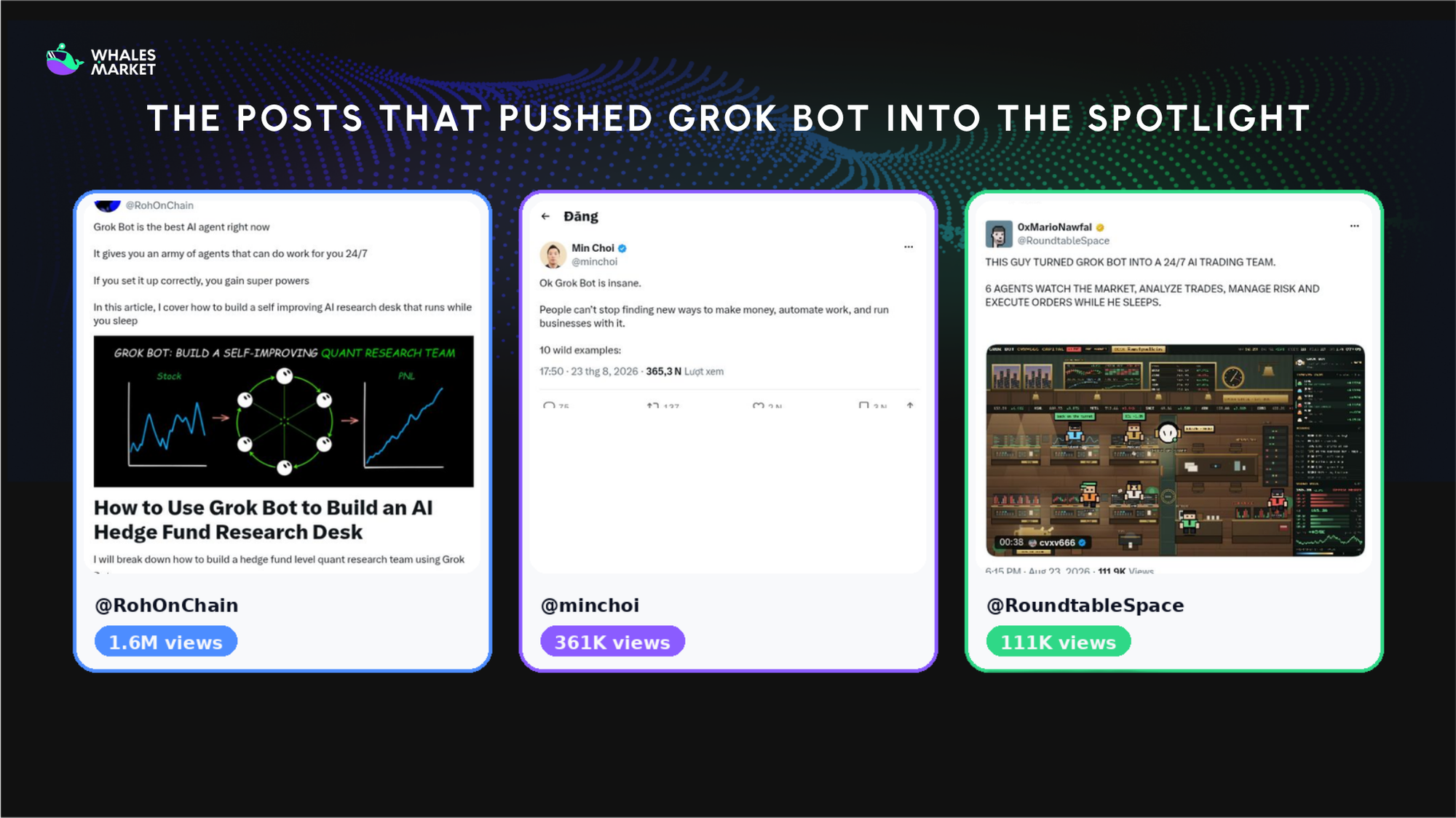
At the time of writing, four pieces of content helped drive the Grok Bot wave on X:
- The ‘AI hedge fund’ thread reached 1.6 million views by showing how multiple agents could handle research, signals, execution, and desk operations.
- A roundup of 10 Grok Bot use cases reached roughly 361,000 views, with money-making and automation examples receiving the most attention.
- The ‘six-agent trading desk’ video passed 111,000 views with the promise of monitoring markets and trading while the user sleeps.
- A post promoting documents that supposedly produced a trading Bot with a 68.4% win rate attracted more than 73,000 views.
The formula is consistent: multiple agents, low cost, fast setup, and 24/7 operation. The difficult parts, including data pipelines, API permissions, backtest quality, trading fees, and drawdown, almost disappear from the headline.
That does not make every demo worthless. It points to a real demand. Crypto never closes, news can break at any time, and no trader can monitor every data source alone. But views prove that a narrative is strong. They do not prove that the strategy behind it is profitable.
How Would a Grok Bot Crypto Trading Desk Work?
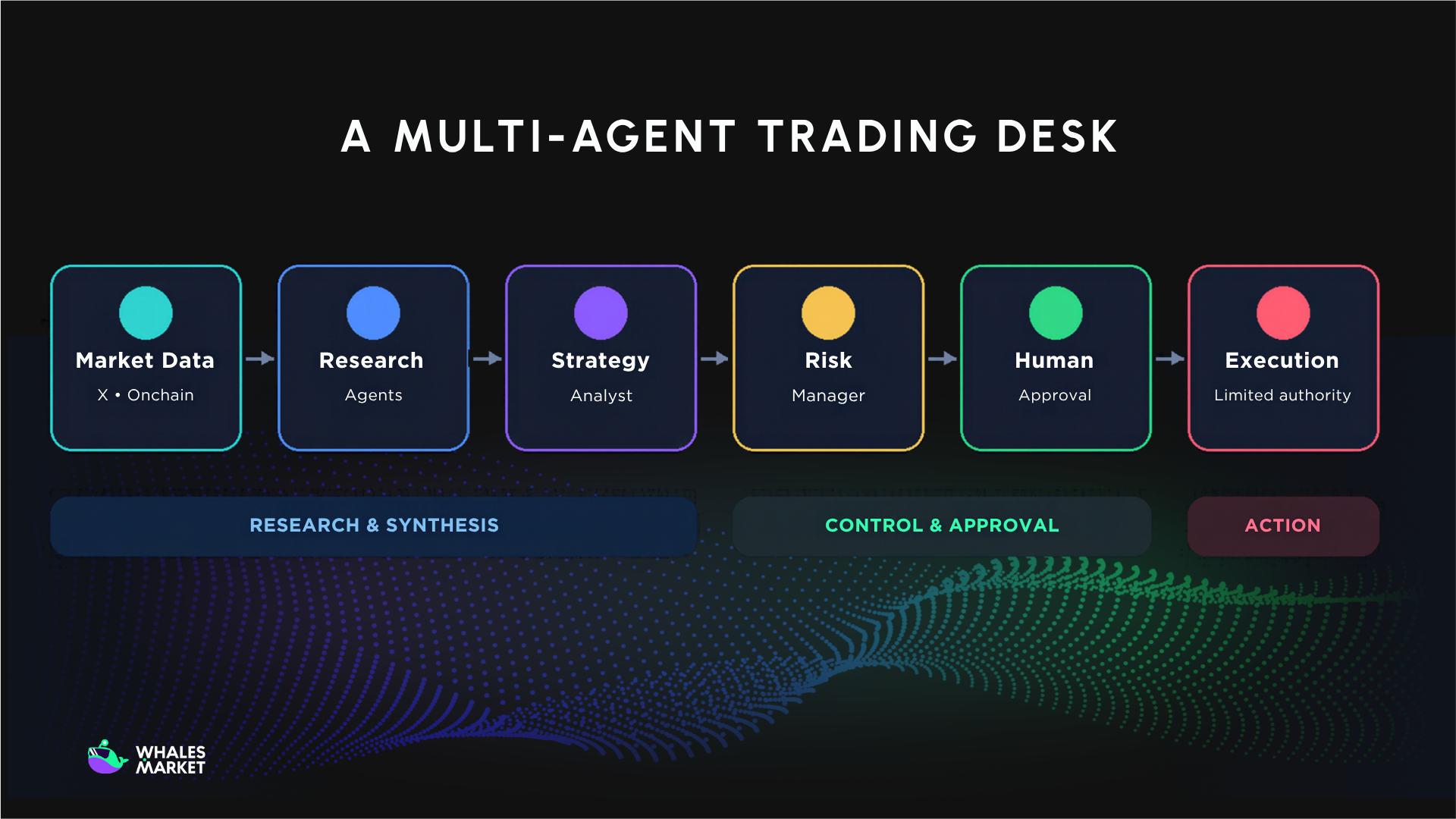
An effective trading desk should not be built by asking one Bot to ‘find trades and execute them for me.’ Each agent needs a defined responsibility, a clear input and output, and a strict permission boundary.
A basic setup could include six roles:
- Market Scanner: Monitors price, volume, order books, funding rates, open interest, and unusual market moves.
- News and X Analyst: Reads project announcements, macro news, exploits, token unlocks, and changes in the narrative on X.
- Whale Tracker: Tracks large wallets, exchange flows, bridge activity, and changes in smart-money positioning.
- Strategy Analyst: Turns the data into a thesis and defines entry conditions, invalidation levels, and exit scenarios.
- Risk Manager: Checks position size, maximum loss, correlation with existing positions, and drawdown limits.
- Execution Bot: Prepares an order or submits it through an approved tool after every required condition has been met.
A human approver should remain the final layer. Before an order is submitted, the user should be able to review the asset, trade direction, price, size, stop-loss, and expected account impact.
In prediction markets, analytics tools already help traders monitor wallet flows, top holders, pricing gaps, and changes in implied probability. Whales Market's guide to useful Polymarket tools shows that data and speed only become an advantage when they sit inside a clear decision-making process. Grok Bot can coordinate these sources, but it cannot improve the quality of the underlying data.
For pre-market trading, Whales Market CLI allows power users to retrieve active tokens, inspect order books, and monitor portfolios directly from the terminal. An agent could use this structured data to generate reports or alerts. Order placement should still stop at the point where the user must confirm the action.
Can Grok Bot Actually Trade Crypto?
Yes, but not immediately after a user creates a Bot.
Grok Bot must be connected to market data, an exchange or prediction market account, the appropriate API or MCP, and an execution system. The user also needs to define the strategy, position sizing, loss limits, and which actions require approval.
Its capabilities can be divided into three levels:
- Research only: Collects news, market data, and whale activity, then produces scheduled reports.
- Decision support: Ranks opportunities, proposes entries and invalidation levels, suggests stop-losses, and prepares draft orders.
- Execution: Submits orders through an authorized API, MCP, CLI, or website.
The difference between these levels is permission, not simply prompt quality. A Bot may produce sound analysis but remain unable to trade without an execution tool. The reverse is also true: a Bot with order permissions can still place a bad trade when its data is delayed or the strategy rules are incomplete.
Grok Bot's official security documentation recommends keeping high-impact actions, including financial transactions, behind human review. Its terms also state that agentic actions may be inaccurate, incomplete, delayed, or different from what the user intended.
The sensible approach is not to give an AI access to a wallet on day one. Start with research and alerts, then expand permissions only after the Bot has demonstrated consistent reliability.
Are Grok Bot Profit Claims Credible?
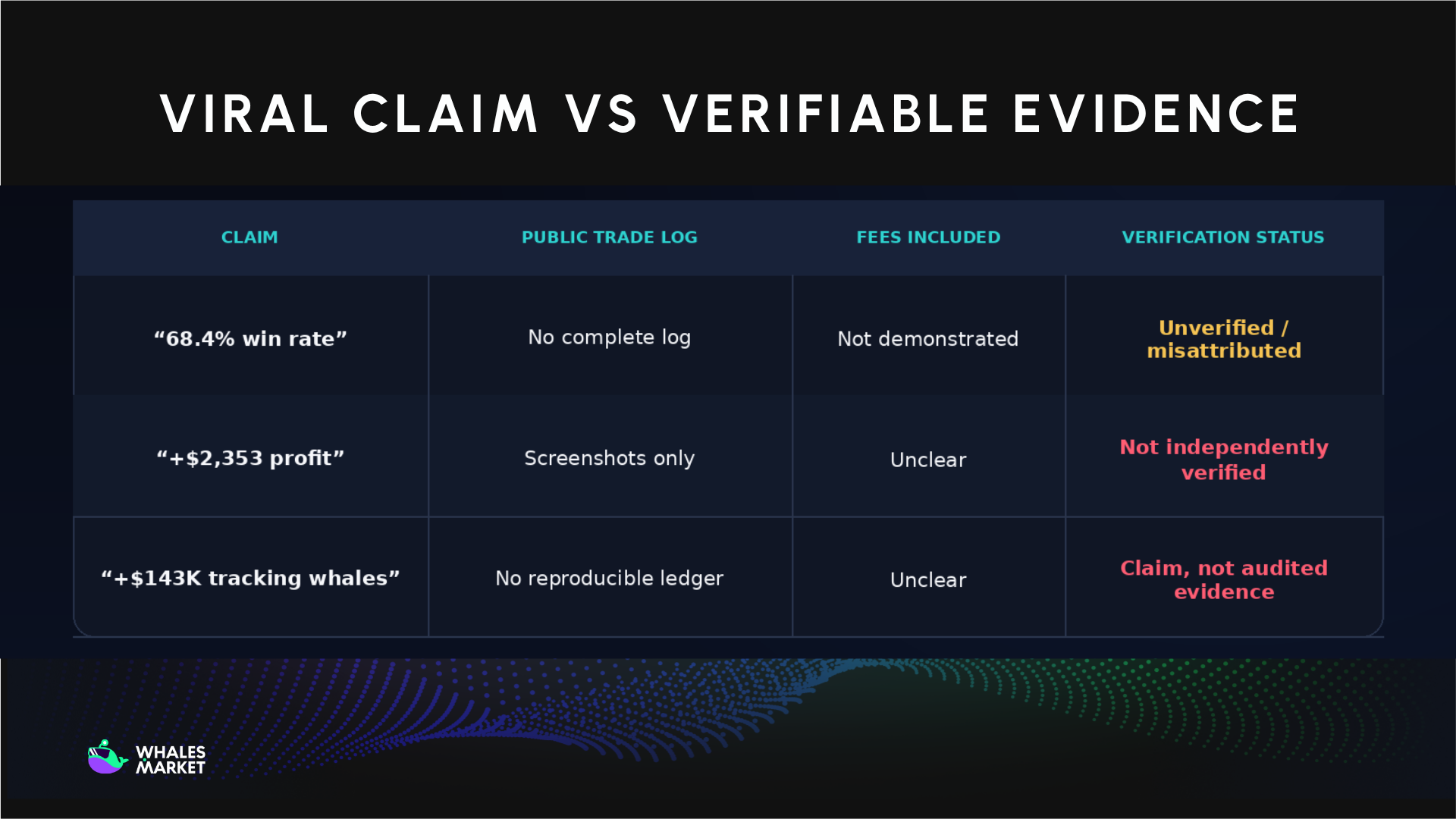
X is full of attractive numbers: three trading Bots built in 15 minutes, $2,353 in profit after one day, a system that copied 12 whales and made $143,000, and a prediction market Bot with a 68.4% win rate.
The problem is not that these results must be false. The problem is that most posts do not provide enough information to verify them:
- No complete trade history covering the periods before and after publication.
- No disclosure of starting capital, open positions, or leverage.
- No complete accounting for trading fees, gas, and slippage.
- No record of maximum drawdown or losing trades.
- No benchmark against the market or a simpler strategy.
The 68.4% claim deserves particular caution. The number appeared in a wave of posts about a ‘33-page guide’ for Claude before it was later attached to Grok Bot. Crypto Briefing reported that a viral PDF carrying the claim contained fabricated result screenshots. Meanwhile, Grok Bot's official guide library does not publish a matching trading benchmark. The 68.4% figure should therefore be treated as unverified, not as official Grok Bot performance.
A more useful reference point comes from the Prediction Arena study. In a 57-day experiment, six models received $10,000 each and traded autonomously with real money. Returns on Kalshi ranged from -16% to -30.8%. On Polymarket, the models averaged roughly -1.1%.
One Grok checkpoint recorded a 71.4% settlement win rate, the highest in the group. Yet a high win rate still did not guarantee a positive overall return.
A strategy can win many small trades and give everything back in a few large losses. That is why PnL, risk-adjusted returns, drawdown, sample size, and execution costs matter more than a standalone win-rate figure.
The Real Cost of a Grok Bot Trading Desk
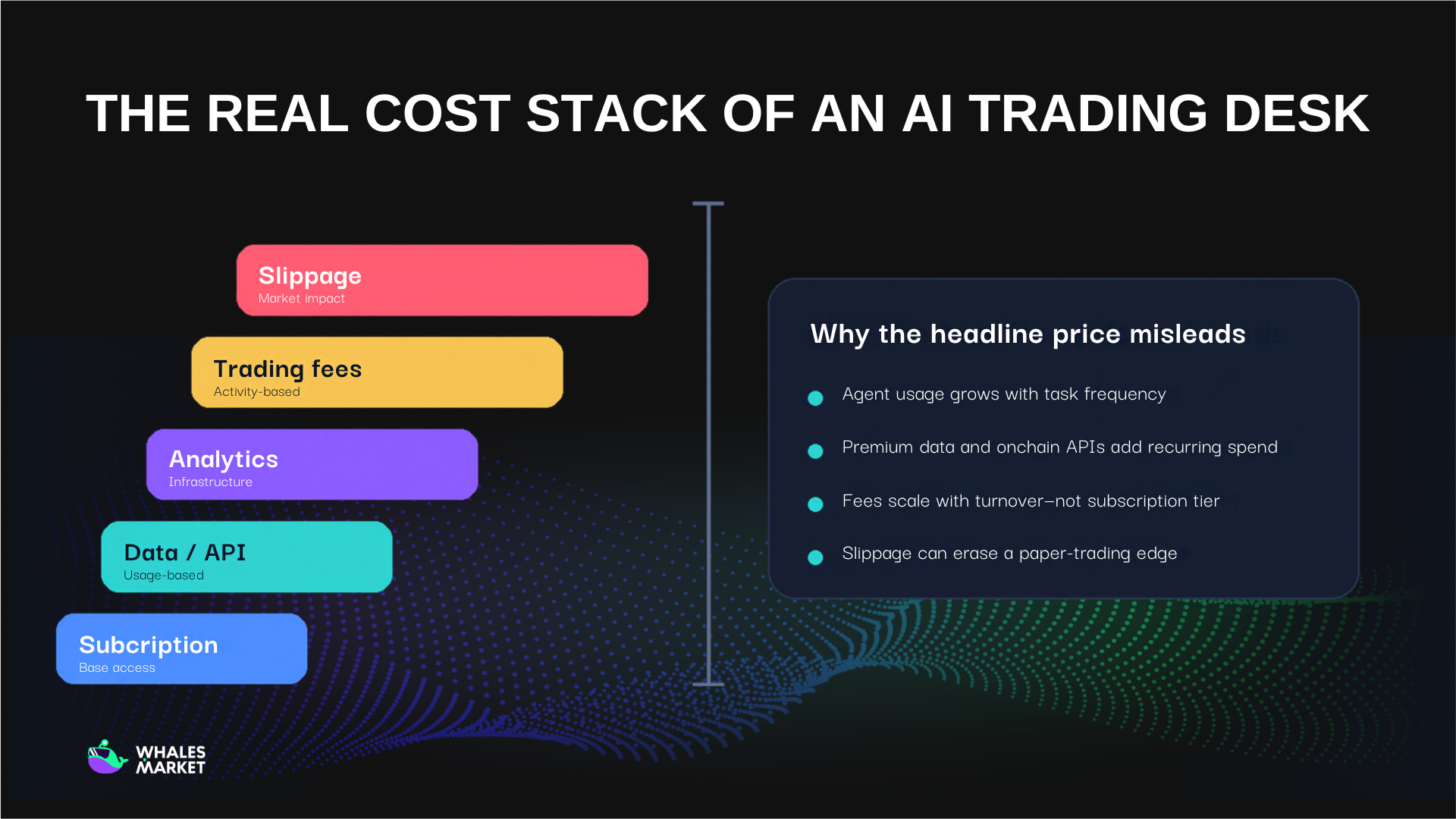
Grok Bot is available through eligible paid Grok and Cursor plans. The official pricing page currently shows entry-level access starting at about $20 per month through Cursor and $30 per month through Grok. That subscription only pays for the agent layer.
A complete trading desk may also need to cover:
- AI usage when several agents run continuously.
- X API access, market data, and news feeds.
- Onchain analytics and whale-tracking tools.
- Exchange fees, gas fees, and funding payments.
- Slippage between the price observed by the Bot and the actual execution price.
- Monitoring, maintenance, and recovery when a workflow fails.
Cursor's pricing documentation estimates that power users running multiple agents or automations may spend $200 per month or more. Actual cost depends on task frequency, data volume, and the models being used.
Traders also need to calculate break-even. If a system produces $150 in gross profit but costs $200 in tools and another $50 in trading fees, it is still an unprofitable desk. Whales Market explains the gap between expected price and execution price in more detail in What Is Slippage?
The Risks Crypto X Rarely Mentions
Bad Data or Data That Arrives Too Late
Crypto markets react to information in seconds. If a Bot misreads a timestamp, relies on a delayed source, or misses an important announcement, a signal that looks logical can still become a bad trade. AI may process information faster than a person, but it cannot create an edge from information the market has already priced in.
Backtests Do Not Fully Reflect Live Trading
A strategy can be over-optimized on historical data. Once it reaches a live market, spreads, slippage, liquidity, latency, and regime changes can pull performance far away from the backtest. A smooth equity curve is not enough to judge whether a Bot is ready for real capital.
Wallets, API Keys, and a Shared Environment
According to the official documentation, Bots on the same account share one cloud computer. Files, browser sessions, and credentials in that environment may be accessible to other Bots in the same roster. Deleting a Bot does not necessarily remove every related file, session, or routine.
For crypto users, this risk is especially serious because onchain transactions cannot be reversed. Seed phrases and private keys should never be pasted into chat. Trading API keys should have withdrawals disabled, be restricted to the minimum required scope, and remain separate from the main account.
Automated Routines Can Keep Running Unattended
The ability to keep working after a laptop is closed is one of Grok Bot's biggest strengths. It also increases the cost of a bad rule. A routine may continue sending alerts, preparing orders, or taking actions after market conditions have changed.
In prediction markets, many traders lose not because they lack information, but because they misread probability, enter too late, or manage positions poorly. Whales Market's guide to common prediction market mistakes explains why speed only matters when it is paired with discipline and risk management.
How to Use Grok Bot More Safely for Crypto Trading
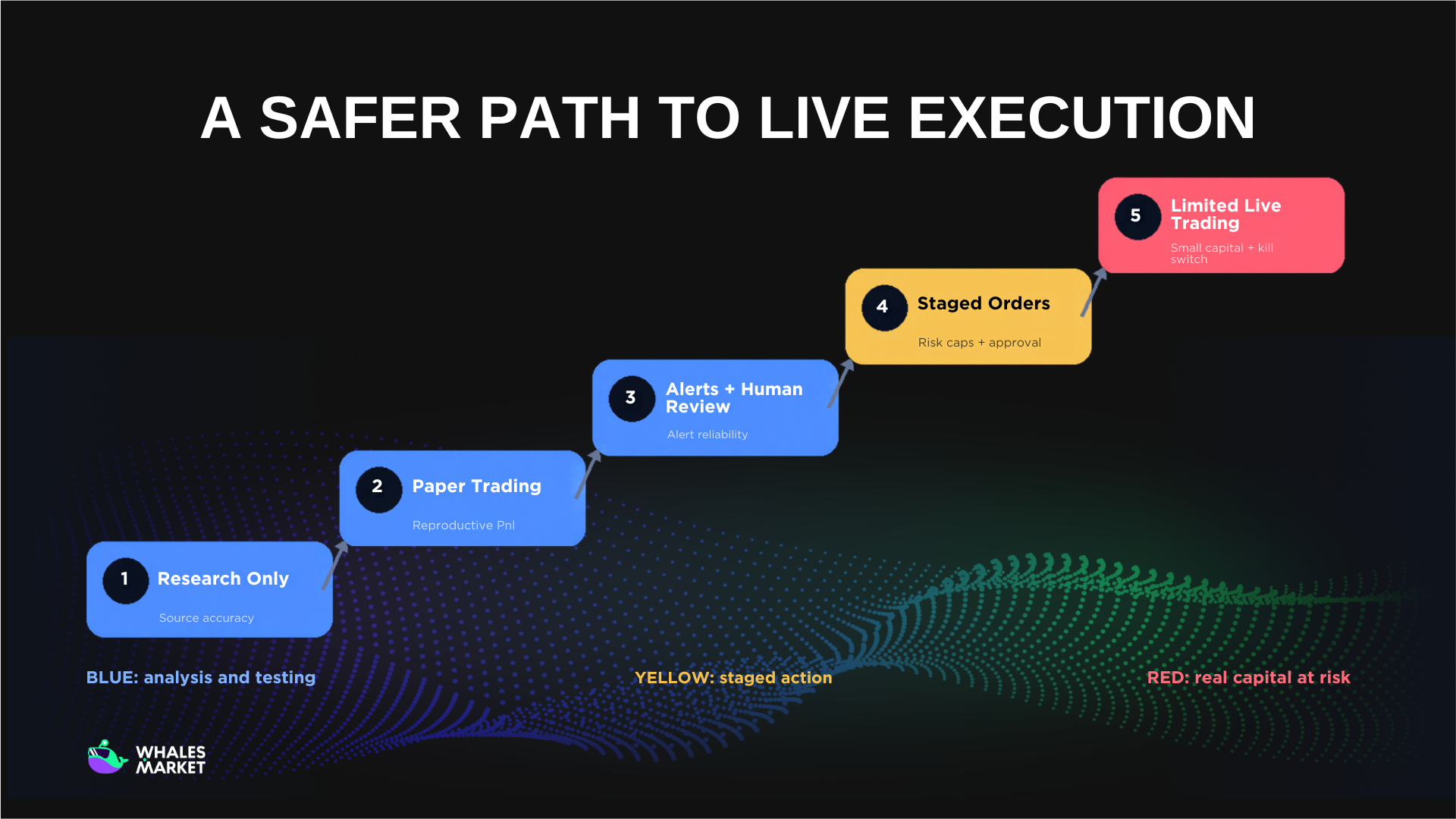
Instead of moving directly from a chatbot to fully autonomous trading, traders should expand access in stages:
- Stage 1, research only: The Bot reads data and produces source-linked reports.
- Stage 2, alerts: The Bot sends a notification when predefined conditions appear.
- Stage 3, paper trading: The Bot records entries, exits, and PnL without using real money.
- Stage 4, staged orders: The Bot prepares an order, but the user reviews and confirms it.
- Stage 5, limited live trading: The Bot receives a small amount of capital, strict size limits, and a daily loss limit.
A safer configuration should follow these rules:
- Use a separate sub-account or wallet for the Bot.
- Do not grant withdrawal permissions.
- Cap the amount of capital used per trade and per day.
- Require approval for every financial action.
- Record data sources, decisions, and action logs.
- Pause routines when the market regime or a data source changes.
- Measure performance after costs instead of focusing on win rate.
In most cases, Grok Bot is most valuable before the Buy or Sell button. It can help traders monitor more sources, detect changes sooner, and prepare more structured decisions. Execution permissions should only be added after the workflow has been tested for long enough to reveal how it fails.
Does Grok Bot Create a Real Trading Edge?
Grok Bot can create an operational edge. It can monitor markets continuously, combine multiple sources, reduce repetitive work, and turn raw data into reports faster. That is useful for researchers, active traders, and teams responsible for several markets at once.
An operational edge does not automatically become a trading edge. If the data is weak, the thesis is wrong, or risk controls are loose, Grok Bot simply executes a bad strategy faster and more often.
For beginners, research, alerts, and paper trading are the most suitable use cases. For quants and developers, Grok Bot can act as an orchestration layer for an existing data pipeline and execution system. For anyone looking for passive income from a tool that can be switched on and left alone, the current evidence does not support that expectation.
Conclusion
Grok Bot shows how AI agents are moving from answering questions to completing entire workflows. In crypto, that creates a new operating model: one person can coordinate agents responsible for research, whale tracking, risk, and execution across a market that runs 24/7.
Grok Bot can automate the work around a trade. It cannot guarantee that the trade itself has an edge. Final performance still depends on data quality, strategy, execution costs, and disciplined risk management.
The right starting point is not to hand an AI system an entire wallet. Let Grok Bot prove its value through research, alerts, and paper trading first. Automation becomes an advantage only when every action has a source, a log, and a clearly defined limit.
Grok Bot also belongs to a wider shift toward AI agents with identities, permissions, and verifiable activity histories. Read What Is ERC-8004? to understand how crypto is building a trust layer for the agent economy.
FAQs
What Is Grok Bot?
Grok Bot is an AI agent system from SpaceXAI. Each Bot can use a cloud computer, access approved tools, remember workflows, and continue working after the user's device is turned off.
Can Grok Bot Trade Crypto Automatically?
Yes, if it is connected to market data, an exchange or prediction market account, and an appropriate execution tool. Financial transactions should still require human approval.
Does Grok Bot Guarantee Profit?
No. Grok Bot can automate research and execution, but it does not create a profitable strategy by itself. Online PnL claims should be checked against a complete trade history, drawdown, and results after fees.
Can Grok Bot Trade on Polymarket?
Grok Bot can research and support prediction market trading when connected to the required data and tools. Execution depends on the account, API, MCP, or workflow configured by the user.
How Much Does Grok Bot Cost?
Entry-level access depends on the user's eligible Grok or Cursor plan. Beyond the subscription, users should account for AI usage, APIs, market data, analytics, gas, trading fees, and slippage.
Is It Safe to Connect Grok Bot to a Crypto Wallet?
Use only a separate wallet or sub-account with limited capital. Never share a seed phrase in chat, never grant withdrawal permissions, and keep every financial action behind an approval step.