

Most memecoin traders do not lose because they picked the wrong token. They lose because they used the wrong playbook.
They buy a token as a short-term trade, then call it a long-term conviction when the price falls. They copy a profitable wallet without checking its entry. Or they chase a narrative after it has already reached every timeline.
The problem is not a lack of opportunities. It is a mismatch between the trade, the trader, and the strategy.
This guide explains five memecoin trading strategies, where each edge comes from, and who should use it. New to the market? Start with What Is a Meme Coin?
First, Find the Game You Can Actually Win
A strategy is useful only when it gives you a repeatable advantage. In memecoin trading, that advantage usually comes from one of five places:
- Researching a token more deeply than the crowd.
- Spotting a narrative before attention peaks.
- Reading wallet behavior and onchain flows.
- Executing faster and managing exits better.
- Knowing one ecosystem better than generalist traders.
Your available time matters just as much as your skill. A trader who checks the market twice a day should not copy a scalper. Someone who panics during a 30% pullback should not build a large conviction position in an illiquid token.
Before entering any trade, answer three questions: What is my edge? How long should this setup take? What would prove me wrong? If the answers are vague, the position is probably driven by FOMO rather than a plan.
Conviction Trading: Build the Thesis Before the Position
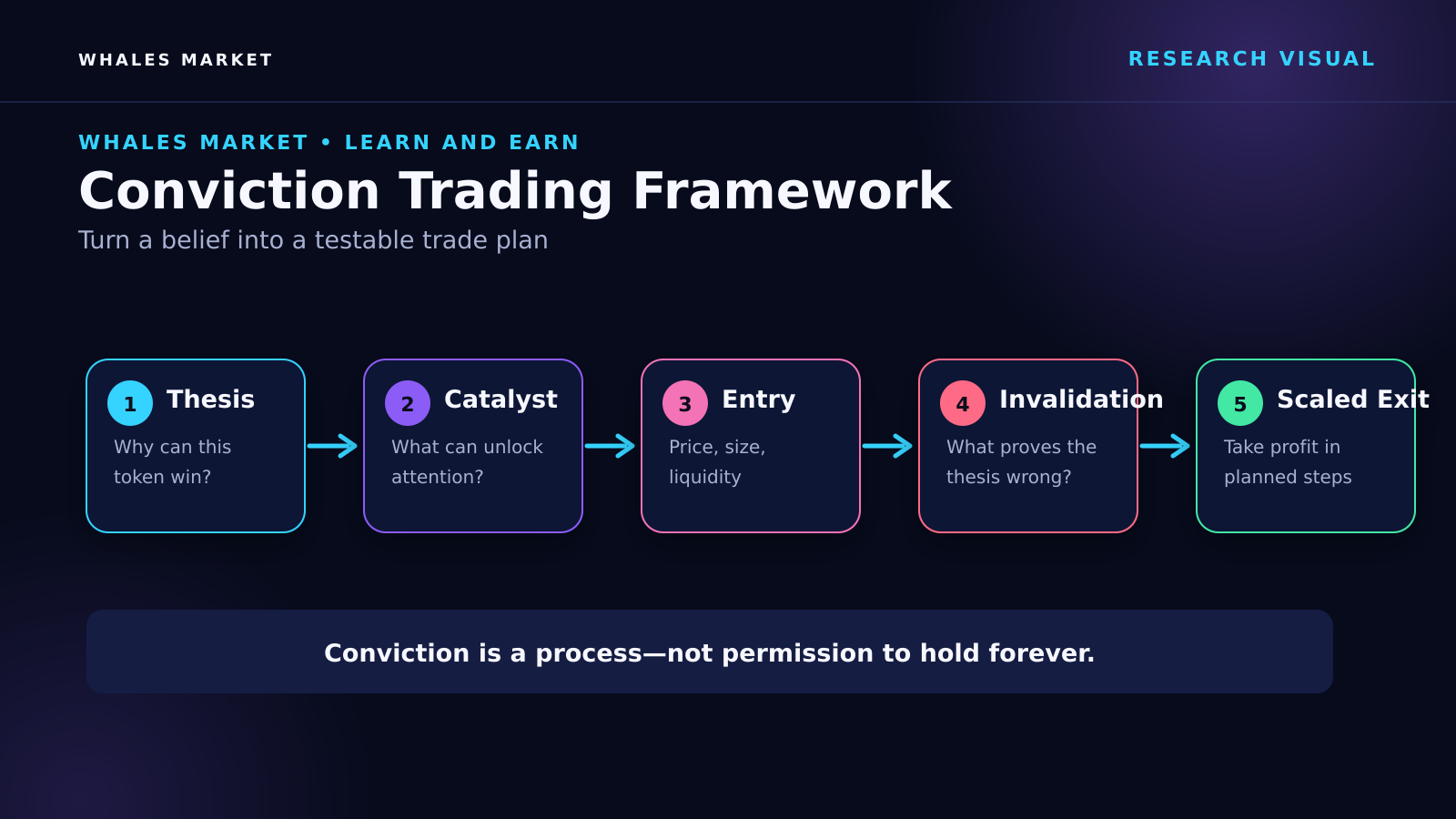
Conviction trading means buying because you expect a specific thesis to develop, not because a candle is already moving.
The thesis might be that a meme can cross into mainstream culture, that an ecosystem will attract new capital, or that a community is growing faster than the token’s valuation. The holding period is usually measured in days or weeks, not minutes.
The edge comes from research and patience: entering before the market agrees, then waiting for catalysts to close the gap.
Who Should Use It?
This approach fits traders who enjoy research but cannot monitor charts all day. It also works for people who prefer a few deliberate positions over dozens of impulsive trades.
You still need to tolerate volatility. Memecoins can retrace sharply even when the broader thesis remains intact. If every pullback changes your opinion, the position is probably too large.
A Practical Playbook
Write the thesis in one sentence before buying. Then define:
- The catalyst that could attract new attention.
- The entry range and maximum position size.
- The evidence that would invalidate the thesis.
- The levels or conditions for taking profit.
Useful evidence may include organic community growth, wider cultural reach, improving holder distribution, stable liquidity, and repeated engagement that does not depend on one influencer.
Scale into the position instead of assuming the first entry will be perfect. When the thesis begins to work, take profit in stages. A conviction trade should become less risky as the market validates it.
When to Exit
Leave when the reason for owning the token disappears. Falling engagement, persistent selling from large holders, declining liquidity, or a failed catalyst can all invalidate the trade.
“Conviction” is not a reason to ignore new evidence. Hold the thesis, not the hope.
Narrative Trading: Enter While the Story Is Still Spreading
Memecoin prices often follow attention. Narrative traders try to identify where that attention is moving before the trade becomes crowded.
A narrative can form around a new blockchain, a product launch, a cultural moment, a public figure, or a meme that begins spreading outside crypto. The best opportunities often appear when several small signals start confirming the same story.
Who Should Use It?
Narrative trading fits people who spend time on X, Telegram, Discord, and onchain dashboards. You need to notice changes in language, engagement, and capital flow without treating every trending phrase as a trade.
It also requires fast research. The goal is to recognize when an early idea is becoming a real market theme.
A Practical Playbook
Start with the ecosystem rather than the loudest token. Use DefiLlama to examine bridge inflows, DEX volume, and capital moving into the chain. Then look at launchpad activity, active wallets, liquidity retention, and the number of communities discussing the same theme.
Robinhood Chain is a useful example. Attention can move through the chain’s memecoins, launchpads, exchanges, and tokenized-asset projects at the same time. Top 5 Robinhood Chain Projects to Watch shows why mapping the whole ecosystem is more useful than chasing its biggest daily winner.
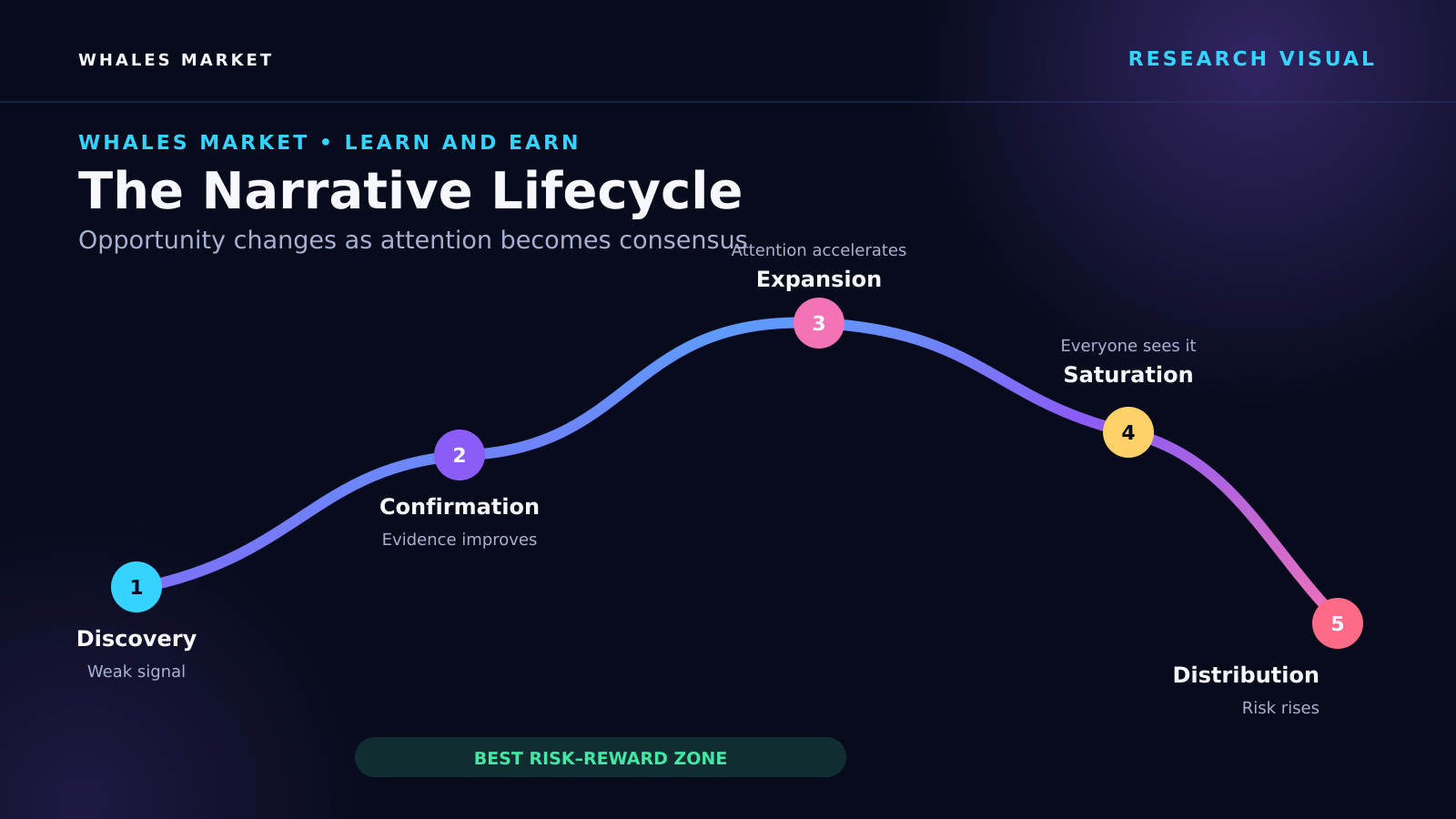
A narrative normally moves through five stages: discovery, confirmation, expansion, saturation, and distribution. The attractive zone is usually between confirmation and expansion. By saturation, upside may still exist, but late buyers are paying a much higher price for the same information.
When to Exit
Exit when attention stops expanding or when capital concentrates in low-quality copies. A popular narrative does not make every related token valuable.
The late-stage trap is buying the “cheaper” copy because its market cap looks smaller. Without its own community, liquidity, or identity, it may only be temporary exit liquidity.
Buy while the story is spreading, not when the story is already consensus.
Smart-Money Following: Track Wallets Without Becoming Exit Liquidity
Smart-money following uses the activity of proven wallets to build a watchlist. It should reduce the number of tokens you research, not replace your research.
The edge comes from following traders who repeatedly enter strong opportunities before the wider market. However, an onchain transaction only shows what happened. It does not reveal the wallet owner’s full portfolio, hedges, private allocations, or tolerance for loss.
Who Should Use It?
This method fits traders who understand block explorers and basic wallet analysis but need a better discovery filter. It is also useful when you cannot monitor every new launch.
If your reaction to every wallet alert is an instant market buy, this strategy is not for you. By the time the alert arrives, the original wallet may already have a better price and a plan to sell.
A Practical Playbook
Track five to ten wallets with enough history to evaluate. Separate them by behavior: early-launch hunters, narrative traders, scalpers, and single-chain specialists.
When a wallet buys, inspect the transaction on Solscan or Etherscan. Compare the order with the wallet’s portfolio size, previous holding periods, and realized exits. A tiny order from a large wallet may be a lottery ticket, not a high-conviction signal.
Use Bubblemaps to check whether major holders are connected. Then review liquidity, contract permissions, holder concentration, and recent volume. Multiple respected wallets buying can justify deeper research, but it does not remove token-level risk.
When to Exit
Do not wait for the tracked wallet to sell. Its transaction may reach you late, and the pool may not absorb every follower’s exit.
Set your own invalidation and check price impact before trading. If you are unclear about how a thin pool changes execution, read What Is Slippage? before copying any onchain signal.
Copy the information. Keep control of the decision.
Short-Term Scalping: Make the Exit Part of the Entry
Scalpers trade short bursts of momentum. They may enter when volume accelerates, price breaks a range, or a catalyst creates immediate demand.
The edge comes from execution. Entry price, fees, slippage, reaction time, and available exit liquidity matter more than a long-term story. A token can rise on the chart while the trade still loses money after poor execution.
Who Should Use It?
Scalping fits traders who can watch the market continuously during a defined session, make decisions quickly, and respect a stop without negotiation.
It is a difficult starting point for beginners. More trades create more feedback, but they also create more fees and more chances to act emotionally.
A Practical Playbook
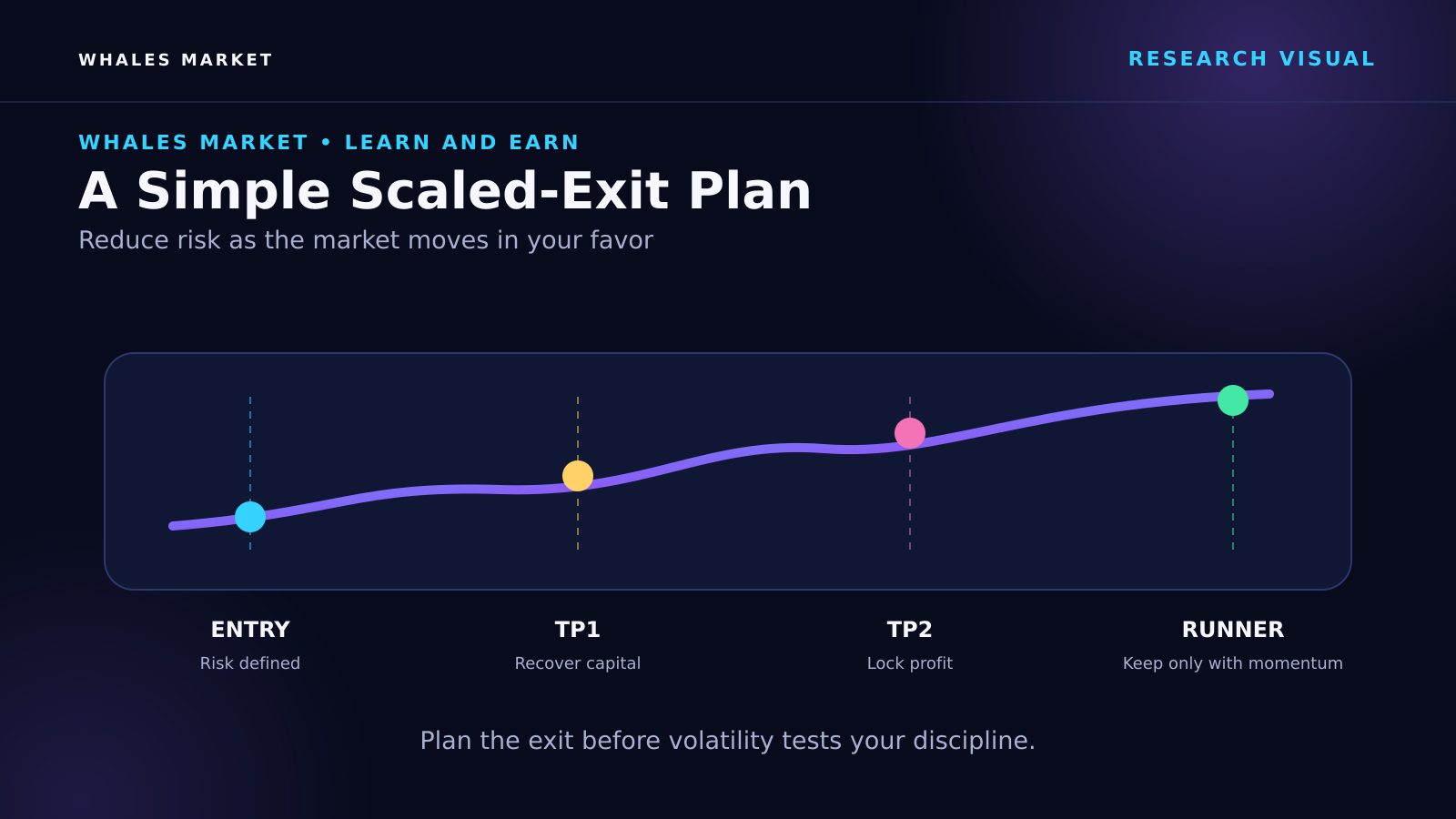
Before buying, define the maximum entry, maximum loss, first take-profit level, and the amount you will leave as a runner.
A simple exit structure is:
- Take partial profit at the first target.
- Recover the original capital when the move allows it.
- Keep a smaller runner only while momentum remains intact.
Use DEX Screener to review liquidity, volume, transaction count, pair age, and price behavior. Market cap alone does not tell you whether the pool can absorb your order. If your position creates major price impact, it is too large.
Time is also an invalidation condition. When a fast setup does not move within the expected window, the reason for staying becomes weaker.
When to Exit
Close the position when momentum fails, liquidity weakens, or the planned stop is reached. Never turn a failed scalp into a conviction trade just to avoid realizing a loss.
Scalpers are paid for leaving well, not merely for entering early.
Single-Chain Trading: Build an Information Advantage Through Depth
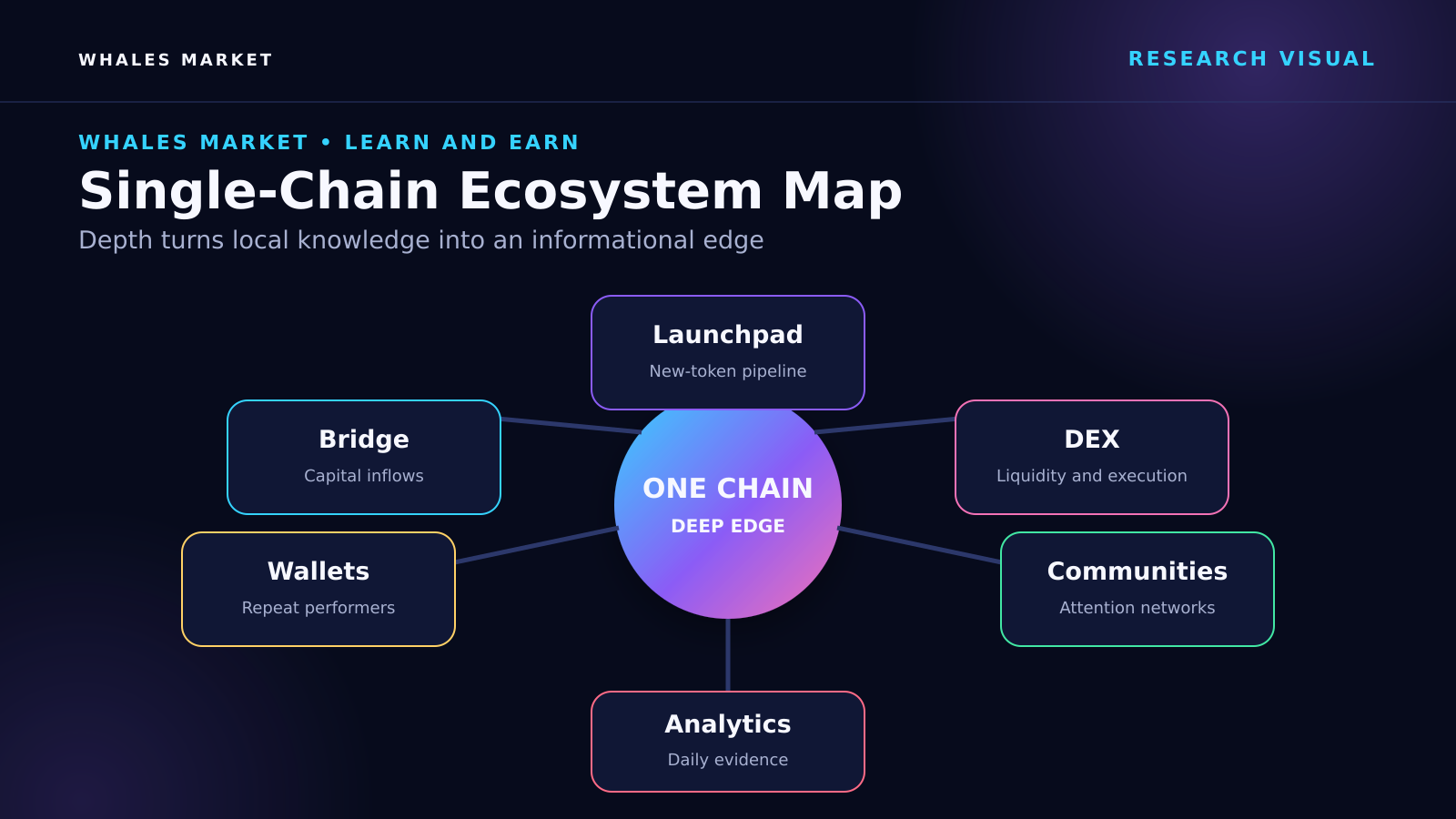
A single-chain specialist focuses on one ecosystem instead of chasing every new network. Over time, they learn where liquidity sits, which launchpads produce viable tokens, which communities move attention, and which wallets consistently perform.
The edge is local knowledge. When outsiders arrive, the specialist already understands the chain’s tools, daily rhythm, and common launch patterns.
Who Should Use It?
This is one of the most practical approaches for beginners because it reduces noise. It also fits experienced traders who already have strong contacts or onchain knowledge in one ecosystem.
The strategy rewards consistency more than speed. You need to recognize which opportunities are unusual for the chain you know.
A Practical Playbook
Create an ecosystem map covering the main bridge, launchpad, DEX, wallet, token scanner, analytics dashboard, community accounts, and active traders.
Track new launches, volume, liquidity after the first day, graduation rates on launchpads, and repeated narrative patterns. Learn where announcements appear first and when activity normally increases.
Depth should improve execution as well as discovery. Knowing the deepest pool, the trusted contract address, and the most reliable dashboard can prevent expensive mistakes during a fast market.
When to Exit
Specialization must not become loyalty. Reduce activity when bridge inflows fall, users leave, liquidity declines, or the market rotates to another ecosystem.
Knowing one chain well is an edge only while that chain still offers good opportunities.
Which Memecoin Strategy Fits You?
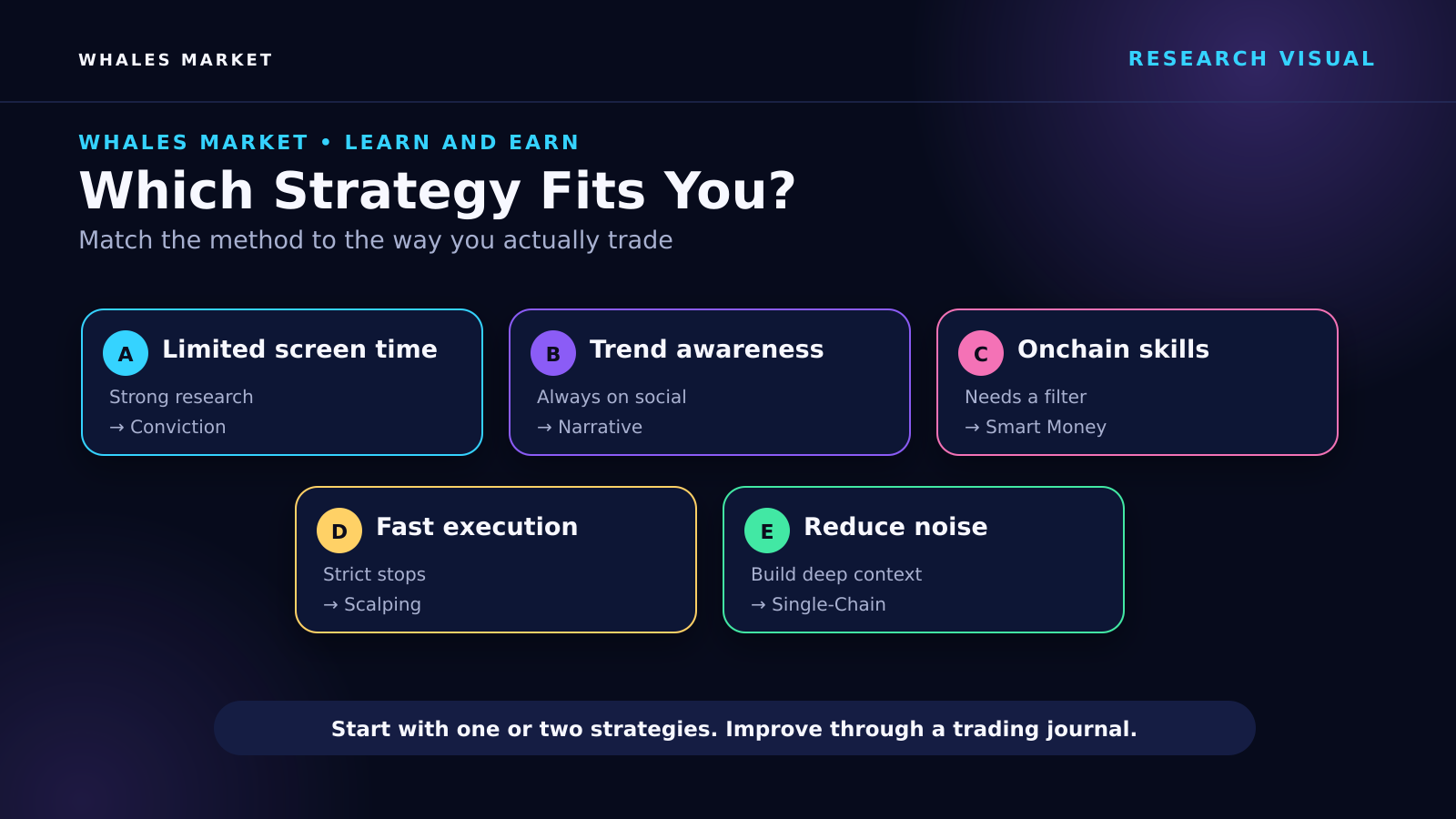
Use your schedule and strongest skill as the filter:
- Strong researcher with limited screen time: Conviction Trading.
- Fast at spotting shifts in attention: Narrative Trading.
- Comfortable reading wallets and explorers: Smart-Money Following.
- Able to monitor charts and execute strict stops: Short-Term Scalping.
- Interested in mastering one ecosystem: Single-Chain Trading.
Start with one primary strategy. You can use another method as supporting evidence, but every position should have one clear identity. If a scalp fails, manage it as a failed scalp. Do not rewrite the trade after the market moves against you.
Four Rules That Apply to Every Memecoin Strategy
Position Size Comes Before Confidence
Memecoin liquidity can disappear quickly. Size the position so a complete loss will not damage your portfolio or force an emotional decision.
Plan the Exit Before Buying
Define both a profit plan and an invalidation condition. A decision made before volatility begins is usually more reliable than one made during panic or euphoria.
Measure Realized Profit
A screenshot of unrealized PnL does not prove that a wallet can exit at the displayed price. Track realized returns, liquidity, and selling behavior.
Keep a Trading Journal
Record the setup, catalyst, entry, size, invalidation, exit, and result. After enough trades, the journal will show which strategy fits you better than any public leaderboard.
How Pre-Market Data Can Support the Strategy
Some opportunities begin before a token reaches public markets. Pre-market prices can help traders evaluate expected valuation and early demand ahead of a token generation event.
Narrative traders can use the data to measure attention before launch. Conviction traders can compare the implied valuation with similar projects. Short-term traders can prepare price scenarios before public-market volatility begins.
However, pre-market price is an input, not a prediction. Circulating supply, settlement terms, liquidity, and launch sentiment can produce a very different market price. The Trading Pre-Market in Crypto guide explains how to evaluate these signals, while the official Pre-Market guide covers the trading and settlement process.
Use Whales Market to improve price discovery before TGE, but keep the same risk rules you would apply after listing.
Conclusion
The best memecoin strategy is not the one with the most impressive screenshot. It is the one you can execute repeatedly without changing the rules halfway through the trade.
Conviction traders need a thesis. Narrative traders need timing. Wallet followers need independent analysis. Scalpers need fast, disciplined exits. Single-chain traders need deep ecosystem knowledge.
Choose the playbook that fits your time, skill, and tolerance for volatility. Track the results. Keep what works, remove what does not, and expand only after you have evidence of a real edge.
Disclaimer: This article is for informational purposes only and does not constitute financial advice. Memecoins are highly volatile and may result in a total loss of capital. Always conduct your own research before trading.
Frequently Asked Questions
What Is the Best Memecoin Trading Strategy for Beginners?
Conviction trading and single-chain trading are usually easier to control because they reduce the number of decisions. Beginners should avoid frequent scalping until they understand liquidity, slippage, position sizing, and stop execution.
Can I Combine Memecoin Trading Strategies?
Yes, but give every position one primary strategy. Wallet activity may support a narrative thesis, for example, but the trade still needs one holding period, one invalidation condition, and one exit plan.
Is Smart-Money Following the Same as Copy Trading?
No. Copy trading repeats another wallet’s order. Smart-money following treats wallet activity as a discovery signal, then requires independent checks on price, liquidity, holders, and risk.
What Should I Check Before Buying a Memecoin?
Check liquidity, trading volume, holder concentration, contract permissions, wallet activity, and community quality. The importance of each factor changes with the strategy, but none should be judged alone.
How Much Should I Risk on One Memecoin?
There is no universal percentage. Use a position small enough that a severe drawdown or total loss will not damage the rest of your portfolio or change your behavior.