

The Avalanche Foundation led a $3 million strategic "Coalition of Compute" round into YOM, a decentralised cloud gaming network that streams AAA games to any browser through a mesh of community-run GPU rigs. The project — operated by YOM B.V. in the Netherlands and YOM UK Ltd — has raised more than $4 million across rounds, with the $YOM token slated for a 2 June 2026 token generation event on Avalanche C-Chain after an EU MiCA-driven delay from the original 25 March 2026 date. Pre-market trading is live on Whales Market ahead of launch.
What is YOM?
YOM is a cloud gaming Decentralised Physical Infrastructure Network (DePIN). Instead of routing every game stream through a centralised data centre — the GeForce NOW, Amazon Luna, and now-defunct Google Stadia model — YOM aggregates GPU capacity from contributors around the world and rents that compute to publishers who want to put their games in a browser link rather than a 100 GB download.
The project's public identity sits at the intersection of three of the most capital-attractive narratives in crypto: DePIN, decentralised GPU compute, and cloud gaming. Where Render Network and Akash served AI compute and Aethir and io.net carved out enterprise GPU rental, YOM positions itself as the only DePIN at scale building specifically for game streaming. CEO Jorrit Velzeboer frames it as "the post-cloud era" — a model where consumer hardware co-located near players outperforms regional data centres on both latency and cost. The team has measured a 93% cost reduction versus the centralised cloud benchmark.
YOM originally operated under the name "Your Open Metaverse" with a broader content-plus-gaming scope. In 2024 the team narrowed the business to pure infrastructure and left content to publisher partners. The token has migrated twice — from Solana (legacy ICO era) to Peaq Network in November 2024, and finally to Avalanche C-Chain as the home chain for the TGE, with LayerZero bridges out to Base, BNB Chain, Solana, and Ethereum.
How does YOM work?
The network has three sides — publishers, players, and GPU contributors — meeting on a permissionless protocol.
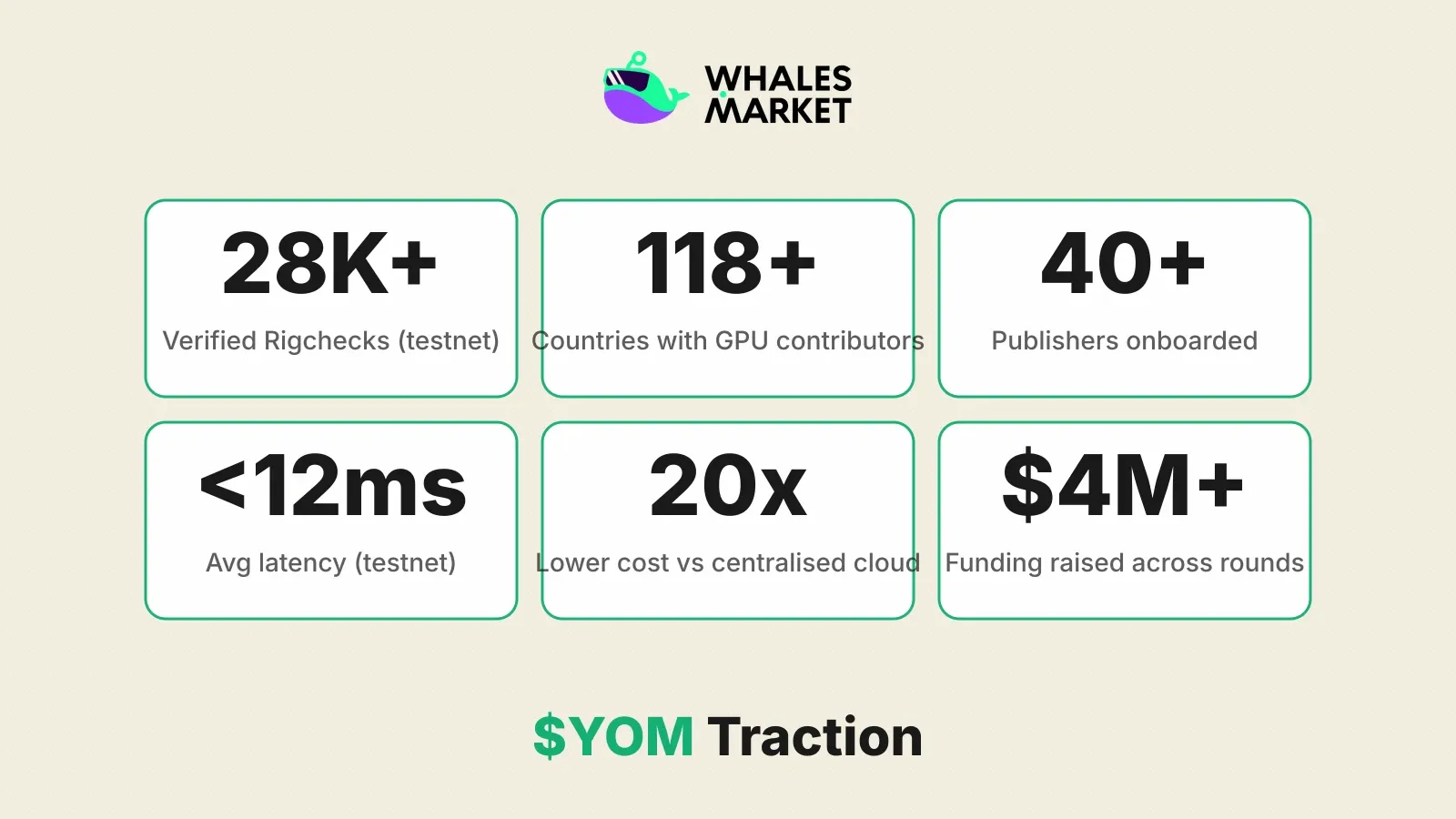
- Publishers integrate YOM's universal pixel-streaming protocol, then issue a browser link. The link opens an actual game session on a contributor's GPU, with input and pixels exchanged through YOM's low-latency relays. Forty-plus publishers have onboarded according to YOM's official site, with one disclosed publisher case study showing a +1316% increase in daily active users after the YOM integration.
- Players open the link from any browser, on any device. No client install, no console purchase. The session is rendered remotely and delivered as compressed video at an average end-to-end latency of under 12 milliseconds in YOM's measured deployments — with sub-10 millisecond figures cited by the team in the Avalanche Foundation press release. The technology page reports 99.2% session success rate and packet loss under 0.1%.
- GPU contributors ("NANO node operators") install YOM's stack on consumer hardware and rent their compute back to the network. Hardware diversity has been the focus of the testnet phase: more than 28,000 verified Rigchecks across 118 countries and 300 distinct GPU configurations have already been recorded.
Settlement and token logic sit on Avalanche C-Chain. The current $YOM contract on Avalanche is 0xdEDed835ffD079c871070c77FC7C9F2582143a04 (verifiable on Snowscan), with LayerZero handling cross-chain bridging to four other ecosystems so traders, publishers, and node operators can interact from the chain they already use.
Key features
- Universal pixel-streaming protocol. A second-generation streaming stack designed to deliver browser-native AAA gaming with sub-10 millisecond latency in co-located conditions and sub-12 millisecond average latency on the live testnet.
- Multi-chain settlement. Avalanche C-Chain is the home chain; LayerZero bridges connect to Base, BNB Chain, Solana, and Ethereum. Five-chain coverage means a buyer or seller on Whales Market can deposit and settle on the chain they hold the asset on.
- Deflationary tokenomics. Five percent of network revenue is burned to maintain a deflationary supply curve, with 40% paid out to node operators and 55% reserved for the network as it scales.
- Regulatory-first launch. MiCA whitepapers have been filed with the Central Bank of Ireland and the Dutch AFM — a deliberate choice that delayed TGE from March to June 2026, in exchange for unblocked listings across the European Union where YOM estimates a majority of its community sits.
- Third-party validation. YOM won Best Startup at Gamescom 2025's Invest Circle competition and holds the European Innovation Council's Seal of Excellence — recognition rare for crypto projects.
$YOM Token Information
Key Metrics
| Field | Value |
|---|---|
| Token ticker | $YOM |
| Home chain | Avalanche C-Chain (ERC-20) |
| Contract address | 0xdEDed835ffD079c871070c77FC7C9F2582143a04 |
| Bridged chains | Base, BNB Chain, Solana, Ethereum (via LayerZero) |
| Total supply | 750,000,000 $YOM (fixed) |
| TGE price | $0.10 |
| Initial market cap | ~$12 million |
| Fully diluted valuation | $75 million |
| TGE target | 2 June 2026 (subject to MiCA + network conditions) |
| Disclosed funding | $4M+ across rounds — $3M strategic led by Avalanche Foundation |
$YOM Token Use Case
$YOM is the unit of account for the entire network economy.
Publisher demand. Studios and broadcasters pay $YOM to power game-streaming sessions. Demand scales with adoption of the universal pixel-streaming protocol rather than with speculative trading volume.
Node operator rewards. NANO node operators receive $YOM for contributing GPU resources. The published split allocates 40% of network revenue to operators, with payouts scaling with contributed compute and the size of the network.
Deflationary burn. Five percent of network revenue is burned irreversibly. As publisher usage grows, supply falls — a direct link between product traction and token economics rather than emissions-driven inflation.
$YOM Token Listing
$YOM has not launched on any centralised exchange. Listings shown on yom.net/tge are labelled "aspirational targets" and "have not been officially announced." The token is currently available on Whales Market pre-market ahead of the 2 June 2026 token generation event. You can buy or sell pre-TGE $YOM on Whales Market — pre-market pricing reflects what willing buyers and sellers currently agree on for an expected allocation and does not forecast the post-launch token price.
$YOM Tokenomics & Fundraising
Tokenomics
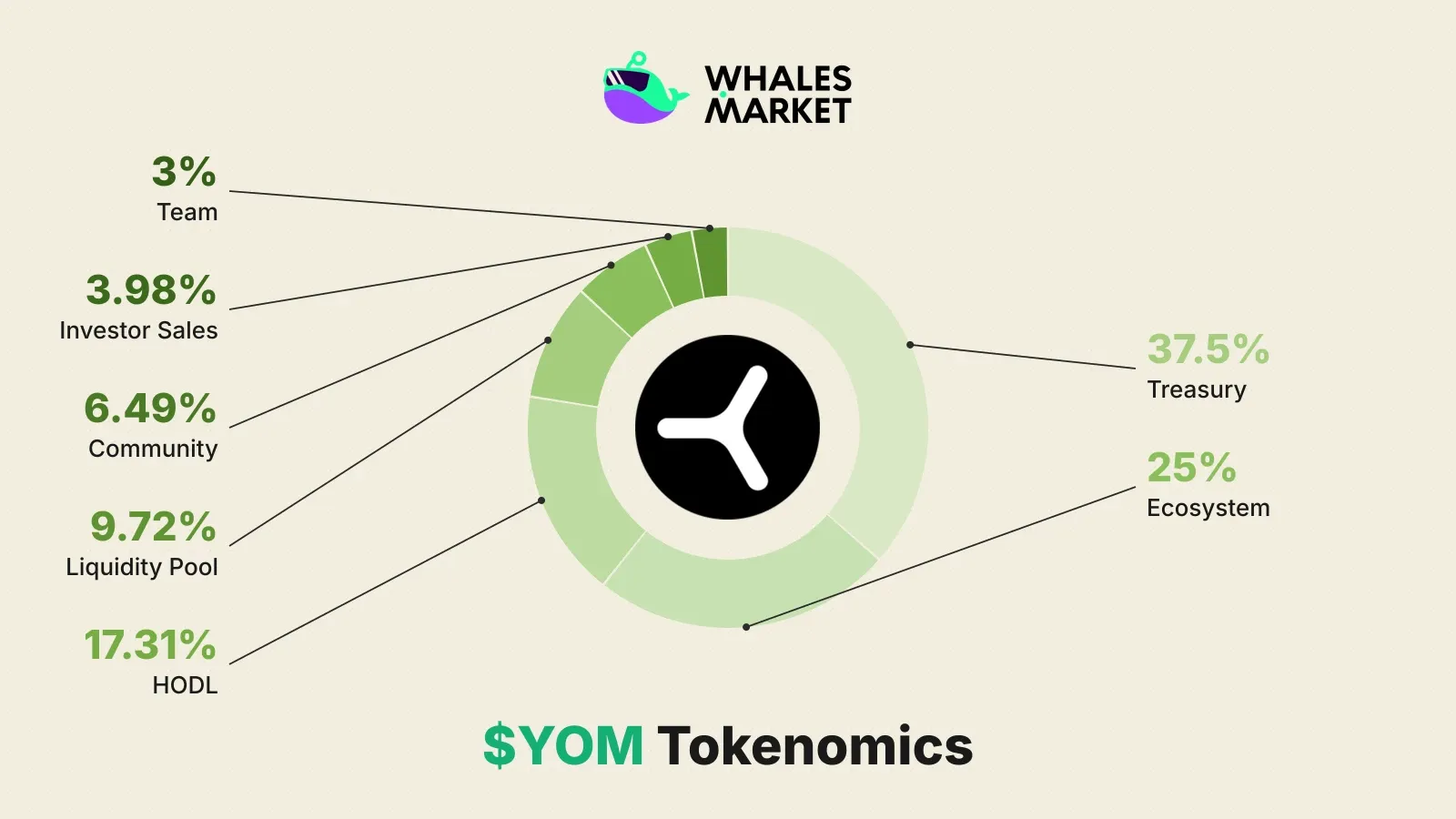
YOM has published a complete allocation and vesting schedule on yom.net/tge — unusually thorough for a pre-TGE project. The 750 million total supply is split across the following buckets:
- Treasury — 37.5%. 20% unlocked at TGE; 9-month cliff; 36-month linear vest thereafter. Source of the loyalty airdrop.
- Ecosystem — 25%. 20% unlocked at TGE; 6-month cliff; 24-month linear vest. Reserved for node operator rewards and ecosystem grants.
- HODL — 17.31%. 9-month cliff; 16-month linear vest (0% at TGE). Long-term holder allocation.
- Liquidity Pool — 9.72%. 35% unlocked at TGE; 24-month linear vest. Bootstraps DEX and CEX liquidity at launch.
- Investor sales (Seed + Private + KOL) — 3.98%. Three sub-buckets with cliffs ranging from 3 to 9 months and linear vests up to 12 months.
- Team — 3%. 9-month cliff; 20-month linear vest (0% at TGE).
- Community + listing partners (Community, Exchanges, Launchpads, Quests) — 6.49%. Mostly short cliffs with vesting tied to programme milestones; small partner allocations unlock at TGE.
Per CoinMarketCap's self-reported figures, roughly 17% of total supply will be circulating at TGE — well above the low-float, high-FDV pattern that has hurt 2024–2025 DePIN launches.
Fundraising
YOM has disclosed over $4 million raised, with the largest publicly itemised round being the strategic "Coalition of Compute".
- Coalition of Compute — strategic — $3 million. Announced 29 April 2026 via lead investor CV VC. Led by the Avalanche Foundation, with participation from Borderless Capital, Outlier Ventures, CV VC, Protein Capital, Blockraise, Simms International, and an unnamed APAC industrial compute operator.
- IDO on TrustSwap Launchpad. Ran on 18 March 2026 ahead of the originally targeted 25 March TGE. Public-sale terms are on the TrustSwap launchpad page.
The Avalanche Foundation lead is the most material signal: ecosystem-fund investment typically unlocks LFJ (Trader Joe) launch liquidity, AVAX Rush incentives, and Avalanche-native CEX integrations that materially improve TGE day-one momentum.
Roadmap & Team
Roadmap
YOM's near-term roadmap centres on regulatory clearance, the rescheduled TGE, and scaling the publisher and node operator network.
- 2 June 2026 — Token Generation Event. Target date for $YOM TGE on Avalanche C-Chain, subject to MiCA statutory review completion and other regulatory clearances.
- Loyalty airdrop distribution. Treasury-funded, earned via XP on quests.yom.net across Season 1 (snapshot completed 16 April 2026) and Season 2 (active May–July 2026). NOT a 1:1 swap from legacy Solana or Peaq holdings.
- Sovereign L1 on Avalanche. Long-term roadmap targets a YOM-specific Layer 1 within the Avalanche ecosystem, with regional compute-pricing logic baked into the chain.
- Continued publisher onboarding. Building from the current 40-plus publisher footprint, prioritising studios with large existing player bases.
Team
YOM lists its core team and titles on yom.net/team. Leadership includes:
- Jorrit Velzeboer — CEO. Public-facing on the "post-cloud era" thesis, cited by CV VC in the strategic round press release.
- Jeff Outlaw — CXO and co-founder. Public spokesperson on the publisher and ecosystem side; active at Token 2049.
- Andrew Pringle — CCO. Identified as a founder on Outlier Ventures' portfolio page.
- Rohan Solanki — CTO. Engineering lead across the protocol and validator stack.
- Jeroen Elout — CMO. Marketing and community.
- John Kavanagh — BD Director. Publisher and partnership pipeline.
The team operates across 16-plus countries and is fully named on the public team page — a transparency profile above the median for pre-TGE projects.
Conclusion
YOM is one of the most disclosure-complete pre-TGE projects in the current pipeline. Tokenomics, vesting, contract address, MiCA filings, named investors, named team — all published before launch. The strategic backing from the Avalanche Foundation, the rare third-party validation from Gamescom and the EU EIC, and a working testnet with 28,000-plus Rigchecks across 118 countries support the thesis that a consumer-GPU mesh can replace centralised data centres for game streaming.
The open questions are execution and timing. The token has migrated three times in three years (Solana → Peaq → Avalanche), the centralised cloud gaming category has so far defeated every challenger, and the TGE date depends on regulatory checkboxes outside the team's full control. For traders who want to take a view before the 2 June 2026 launch, Whales Market pre-market is the price discovery venue today.
Frequently Asked Questions
What is $YOM and what does it do?
$YOM is the native token of YOM, a decentralised cloud gaming network on Avalanche C-Chain. Publishers pay $YOM to stream their games, GPU contributors earn $YOM for renting compute, and 5% of network revenue is burned permanently. The token launches at the 2 June 2026 TGE.
When is the $YOM TGE?
YOM has set a target TGE date of 2 June 2026 on Avalanche C-Chain. The original 25 March 2026 date was delayed to complete EU MiCA whitepaper review with the Central Bank of Ireland and the Dutch AFM. The team has stated the date remains subject to network conditions and regulatory clearances.
Who invested in YOM?
YOM has disclosed more than $4 million in funding. The largest itemised round is the $3 million strategic "Coalition of Compute" led by the Avalanche Foundation, with participation from Borderless Capital, Outlier Ventures, CV VC, Protein Capital, Blockraise, Simms International, and an unnamed APAC industrial compute operator. YOM also ran an IDO on TrustSwap Launchpad on 18 March 2026.
What is the $YOM total supply and how is it allocated?
Total supply is 750 million $YOM. Allocations are 37.5% Treasury, 25% Ecosystem, 17.31% HODL, 9.72% Liquidity Pool, 3.98% Investor sales (Seed + Private + KOL), 3% Team, and 6.49% Community plus listing partners (Community 2.78%, Exchanges 0.03%, Launchpads 0.3%, Quests 0.4%). TGE price is $0.10 with an initial market cap of approximately $12 million and a fully diluted valuation of $75 million.
Where can I trade pre-TGE $YOM?
$YOM is listed on Whales Market pre-market ahead of the 2 June 2026 TGE. Eligible participants can buy or sell expected $YOM allocations before any centralised exchange listing. Pre-market pricing reflects what willing buyers and sellers currently agree on for an expected allocation and does not forecast the post-launch token price.
Is $YOM listed on any CEX?
Not yet. The exchanges shown on yom.net/tge — including OKX, Binance, MEXC, Bybit, Gate.io, Bitget, KuCoin, Kraken, Bitvavo, Bitpanda, PancakeSwap, LFJ, and Blackhole — are explicitly labelled "aspirational targets" by YOM and have not been officially announced. Until those listings are confirmed, Whales Market pre-market is the OTC venue for $YOM exposure.
Disclaimer: This article is for informational purposes only and does not constitute financial, investment, legal, or tax advice. Cryptocurrency markets are volatile and airdrops carry risks including phishing and contract exploits. Always do your own research (DYOR), verify contract addresses on the project's official channels, and never share your seed phrase. Whales Market is not responsible for losses from third-party protocols.