

The term “pre-market” is no longer unfamiliar, especially tied to the initial period before an event officially opens. In crypto, pre-market trading is when exchanges allow users to trade tokens that are not yet officially listed on the market. So what is Pre-market on Prediction Market? Let’s dive into this article.
What is Pre-market on Prediction Market?
Pre-market on Prediction Market is contracts that predict token indices (FDV, market cap) after TGE (token generation event), before the official transaction takes place. Pre-market acts as a form of OTC (Over-the-Counter) trading through an orderbook to reflect expectations before the regular market opens.
Mechanism of Pre-market on Prediction Market
In a pre-market on prediction market, trading operates through a simple yet powerful probability-based mechanism.
Each trade has two types of shares, Yes/No, with a total value always equal to $1. The price of Yes represents the probability that the market predicts the event will occur; No reflects the opposite.
Traders buy and sell these two types of shares peer-to-peer through an order book, causing the price to constantly adjust according to new information.
Learn more about how Prediction Market works.

The types of questions in this category generally revolve around three main groups.
- Valuation questions focus on pricing, such as "Will Token X's FDV exceed $1 billion?", helping the market form early expectations about the valuation upon listing.
- Timing questions relate to timelines. For example, "Will Token Y airdrop before June 30th?", helping traders predict progress and manage risk.
- Listing questions, such as "Will Token Z be listed on Binance?", reflecting the community's confidence in the token's ability to appear on major exchanges.
These types of questions generate strong signals about market expectations, thereby helping traders make more accurate decisions.
Why Pre-market on Prediction Market Matters for Whales Market Traders
Prediction Market and Whale Markets, the best pre market trading platform, create a powerful “Wombo Combo” that helps traders make better decisions, spot inefficiencies, and hedge risks more effectively. Here’s the reason:
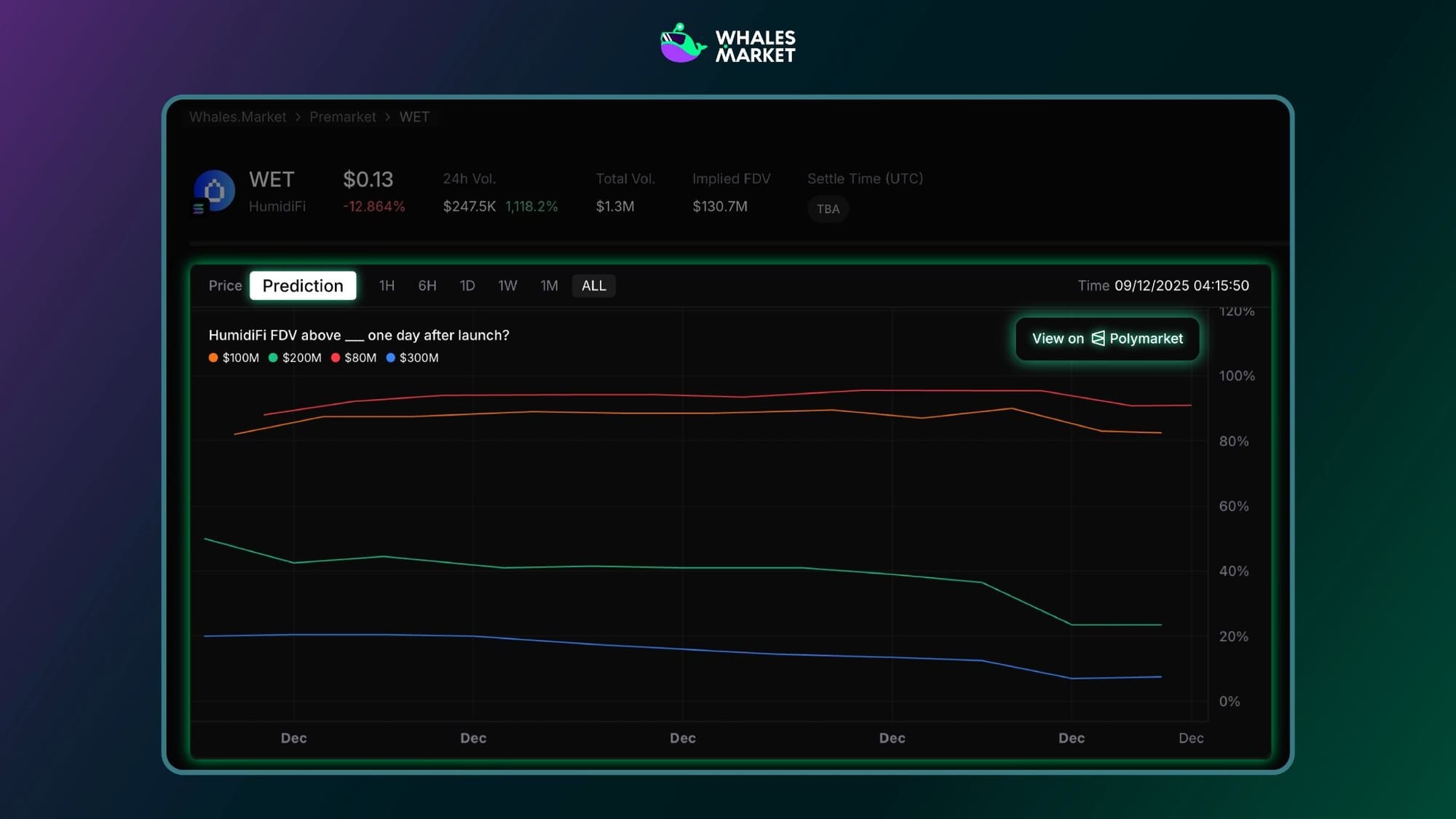
- Probability data on Polymarket acts as a price discovery tool, helping to estimate the reasonable “Expected Value” of each project. If the “Token A FDV > $1B” trade at 80 cents, it means the market is 80% inclined towards this scenario. When the Points price on Whale Market reflects a much lower FDV, it presents a clear arbitrage opportunity.
- Prediction Market also act as a sentiment gauge. The flow of money into trades related to a project shows the level of attention and FOMO (fear of missing out) within the community. When volume spikes, traders can leverage this signal to prepare listings or open positions early on the best platform for pre market trading like Whale Market.
🚨 A prediction pool on Polymarket shows that 89% believe $STABLE FDV will exceed $2B within one day after launch.
— Whales Prediction (@whalespredict) December 8, 2025
Meanwhile, 27% expect it to go above $4B FDV.
🐳Based on pre-market price data, $STABLE price just surged 837% and is now trading around $0.3. pic.twitter.com/HiPHq7T3zv
Risks & Considerations
Prediction Market offer valuable insights, but they also come with specific risks.
The biggest risk lies in liquidity, where low trading volume can distort odds or easily manipulate them, leading to probabilities that don't accurately reflect actual market expectations.
Furthermore, resolution rules in these markets are often very strict: sometimes a token has launched or an event has occurred, but it doesn't precisely match the wording described in the prediction, causing participants to lose, even though the project is "successful" in the conventional sense.
Therefore, Prediction Market should be viewed as a compass to gauge sentiment and probability. When making real trading decisions, such as buying Points, tokens, or entering a position before a listing, users should still return to highly liquid markets with clear mechanisms like Whales Market for greater safety and accuracy.
Conclusion
Pre-market within Prediction Market offers a unique window into how the crowd evaluates future events before they happen. By turning probabilities into tradable prices, it provides early signals about valuation, sentiment, and market expectations long before a token officially lists.
However, while these markets are powerful for gauging narratives and identifying potential arbitrage opportunities, their limitations, especially around liquidity and strict resolution rules, mean they’re best used as a directional compass rather than a trading battleground.
FAQs
1. How do transactions take place in the prediction market?
Users trade Yes/No shares directly with each other through an order book, where prices shift based on real-time supply and demand. This peer-to-peer structure ensures transparent price formation and allows the market to update probabilities continuously as new information emerges.
2. Why do traders use Prediction Market for crypto pre-listing events?
Prediction Market offer early insights into a project’s expected valuation, timeline, or listing probability before any official announcement. These signals help traders position themselves strategically, either for arbitrage, speculation, or hedging long before the actual token hits the market.
3. What are the main risks when using Prediction Market?
Low liquidity can cause odds to become inaccurate or easily manipulated, meaning prices may not reflect true market expectations. Additionally, strict resolution rules mean traders may lose a bet even if an event occurs but does not match the exact wording of the prediction. Because of this, Prediction Market should be treated as an informational tool rather than a primary trading venue.
4. How do Yes/No shares work?
Every prediction market question comes with two shares: Yes & No, whose combined value always equals $1.00. The price of each share represents the market’s probability estimate: the higher the Yes price, the more likely traders believe the event will occur.