

Squid Router is the cross-chain routing layer that moves value between more than 100 blockchains in a single transaction. Since its January 2023 mainnet, Squid has routed over $6 billion across roughly 4 million transactions and powers cross-chain functionality inside 1,000+ integrator apps — including MetaMask, Ripple, Ledger, Brave, and Keplr. In June 2026, Squid opened the public sale for its native token, $QUID, at a fixed $45 million fully diluted valuation ahead of a Q3 2026 token generation event. This article breaks down what Squid does, what $QUID is for, and how pre-market trading fits ahead of TGE.
What is Squid Router?
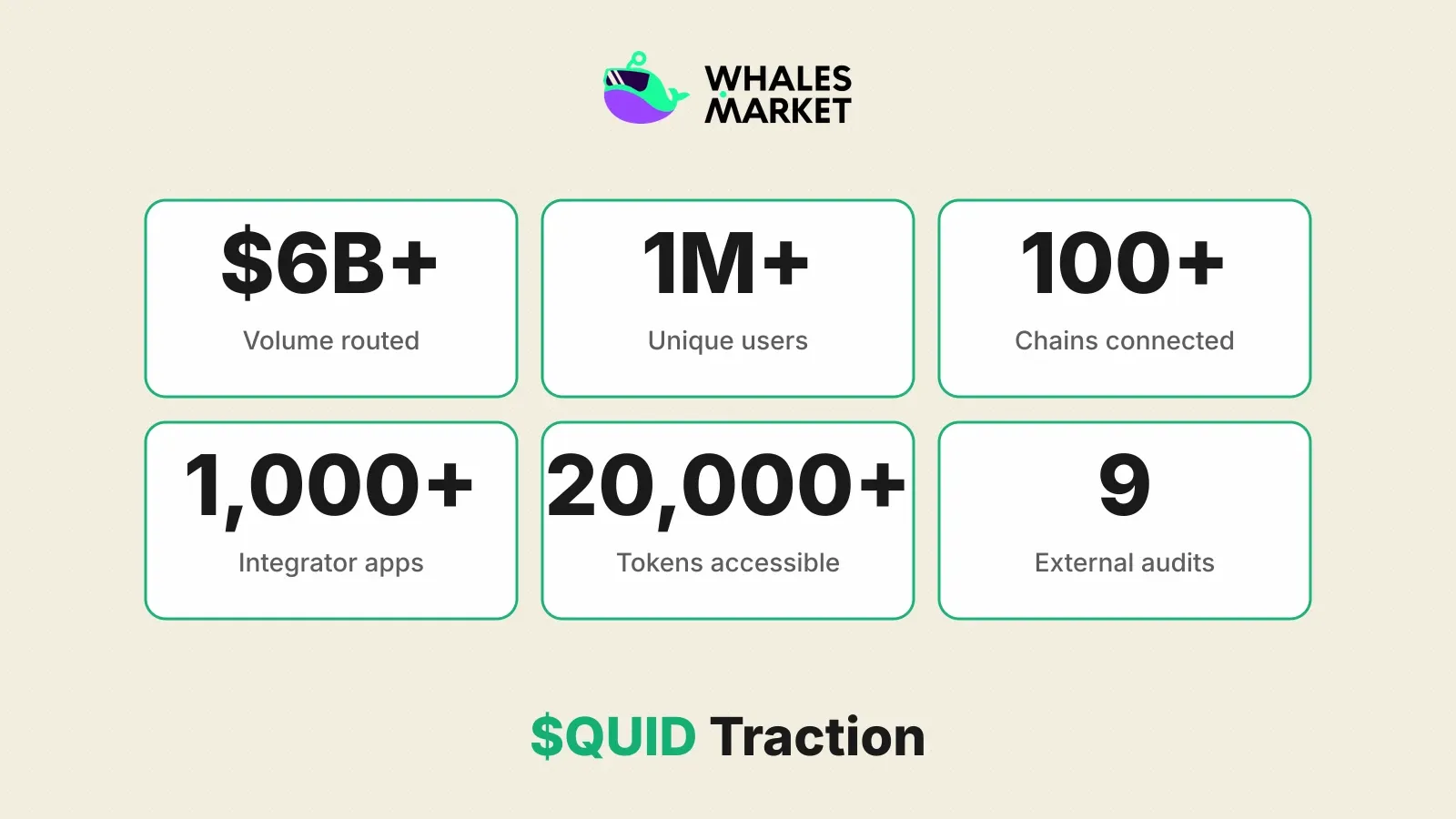
Squid Router is a cross-chain platform spanning infrastructure, developer tools, and consumer products. It lets a user — or an app plugging Squid in via SDK or API — swap, bridge, and route a token from one chain to another in one click, aggregating liquidity across 130+ DEXs and 20,000+ tokens. The Squid homepage lists over $6 billion in cumulative volume, 1 million+ users, 100+ chains supported, and 99.99% claimed uptime.
Squid was incubated in the Axelar ecosystem, where it originally settled all cross-chain messages via Axelar's General Message Passing (GMP). It has since grown into an independent cross-chain infrastructure layer with its own execution stack; Axelar is now one of several settlement paths Squid uses rather than the primary backbone. According to Squid's June 2026 State of Squid update, the team is approximately 20 people, globally distributed, and has raised $13.5 million across three rounds.
Consumer surface expanded meaningfully in 2026: Squid's Ripple USD integration enables RLUSD to move natively across XRPL, Ethereum, Base, Optimism and other networks, and its MiniPay deployment crossed 88,000 users in March 2026.
How does Squid Router work?
Squid's current settlement layer is called Squid Intents, which replaced the earlier CORAL (Cross-chain Order Routing and Auction Layer) design. The mechanism has three moving parts:
- Intent submission. A user signs a request describing the desired end state ("I want X of asset A on chain B") through Squid's
/v2/routeendpoint. The route can be an on-chain execution (EVM), a deposit address with calldata (non-EVM), or a signed deposit (non-EVM). - Solver auction. Independent solvers — market makers running the Squid solver software — compete to fill the intent. The auction is off-chain and settles on-chain only when a winning quote is chosen.
- TEE-verified settlement. Cross-chain logic is verified inside Trusted Execution Environments powered by Cubist, replacing the older GMP-based settlement path. Squid documentation cites sub-5-second execution and a ~90% gas reduction compared to traditional AMM-based routing, alongside built-in MEV protection.
Squid's documentation lists supported chains including Ethereum, Base, Arbitrum, Optimism, BNB Chain, Polygon, Celo, Linea, plus non-EVM support extending to Solana, Cosmos, Sui, XRPL, Stellar, and Hedera.
Security
Squid discloses 9 external audits on its audits and security page: six by Ackee Blockchain, one by Consensys Diligence, one by 0xKaden, and one by n-Var. Prospective participants should also be aware of the May 2026 SquidRouterModule incident: per Halborn's post-mortem, a verification flaw in the executeSameChainActions() function of a Gnosis Safe module allowed an attacker to drain approximately $3.2 million from 86 Safe wallets that had installed the module. The affected component was the Safe module — not the core Squid router contracts users interact with when swapping — but it is a material recent event worth reading in full before committing capital.
$QUID Token Information
Key Metrics
| Field | Value |
|---|---|
| Ticker | $QUID |
| Total supply | 1,000,000,000 (fixed, no further minting) |
| Sale price | $0.045 |
| FDV at sale price | $45,000,000 |
| Public allocation | 50,000,000 (5%) |
| Public sale window | 30 June 2026 13:00 UTC → 3 July 2026 13:00 UTC |
| Sale platforms | Legion (non-US/UK), Kraken (US/UK eligible) |
| TGE | Q3 2026 (specific date TBA) |
| Pre-market network | Base |
Public sale numbers, the sale window, and the platform split are from Squid's own public sale page and the $QUID Public Sale Announcement. The Q3 2026 TGE window is disclosed by Squid but a specific date and the definitive launch chain configuration have not been published as of writing — check the sale page and @squidrouter for the confirmation post before TGE. Whales Market has added $QUID to the Upcoming section of the pre-market with Base as the settlement chain; trading has not opened yet.
$QUID Token Use Case
Per Squid's Forever Token announcement, $QUID is characterised across five attributes — Whole (one token at the center of the Squid experience), Real (built by an operating business with proven usage and adoption), Yours (a role in the ecosystem), Ours (a shared ecosystem), and Forever (fixed supply, no inflation, built for the long term). Planned utility described by the team includes staking, governance, buyback mechanisms, and in-app functionality — enhanced product experiences, ecosystem features, and early access opportunities. The team notes explicitly that specific mechanics remain subject to governance decisions and product timelines.
Read the utility line the way any pre-TGE token should be read: intent, not commitment. What is committed today is the supply cap (1 billion), the sale terms, and the vesting schedule below.
$QUID Token Listing
There is no spot market for $QUID prior to TGE. $QUID has been added to the Upcoming section on Whales Market pre-market with Base as the settlement chain — the listing page is live but trading has not opened yet. Once trading goes live, buyers and sellers will commit collateral against an expected future allocation, and pre-market pricing will reflect what willing participants currently agree on for that allocation (it will not forecast the post-launch spot price). Follow @WhalesMarket or @whalespremarket for the go-live notification.
Squid Ecosystem & Tokenomics
Ecosystem traction
As of June 2026, Squid's public numbers include:
- $6B+ cumulative volume routed since January 2023
- ~4M transactions processed
- 1M+ unique users
- 100+ blockchains connected (EVM and non-EVM)
- 20,000+ tokens accessible via routing
- 130+ DEXs and off-chain market makers aggregated
- 1,000+ integrator apps (MetaMask, Ripple, Ledger, Brave, Keplr, MiniPay, LI.FI)
- ~20 person team, globally distributed
- 9 external audits
The integrator list is the load-bearing distribution moat: Squid does not need to acquire end users directly when it is the cross-chain backend inside wallets and apps that already have them.
Tokenomics
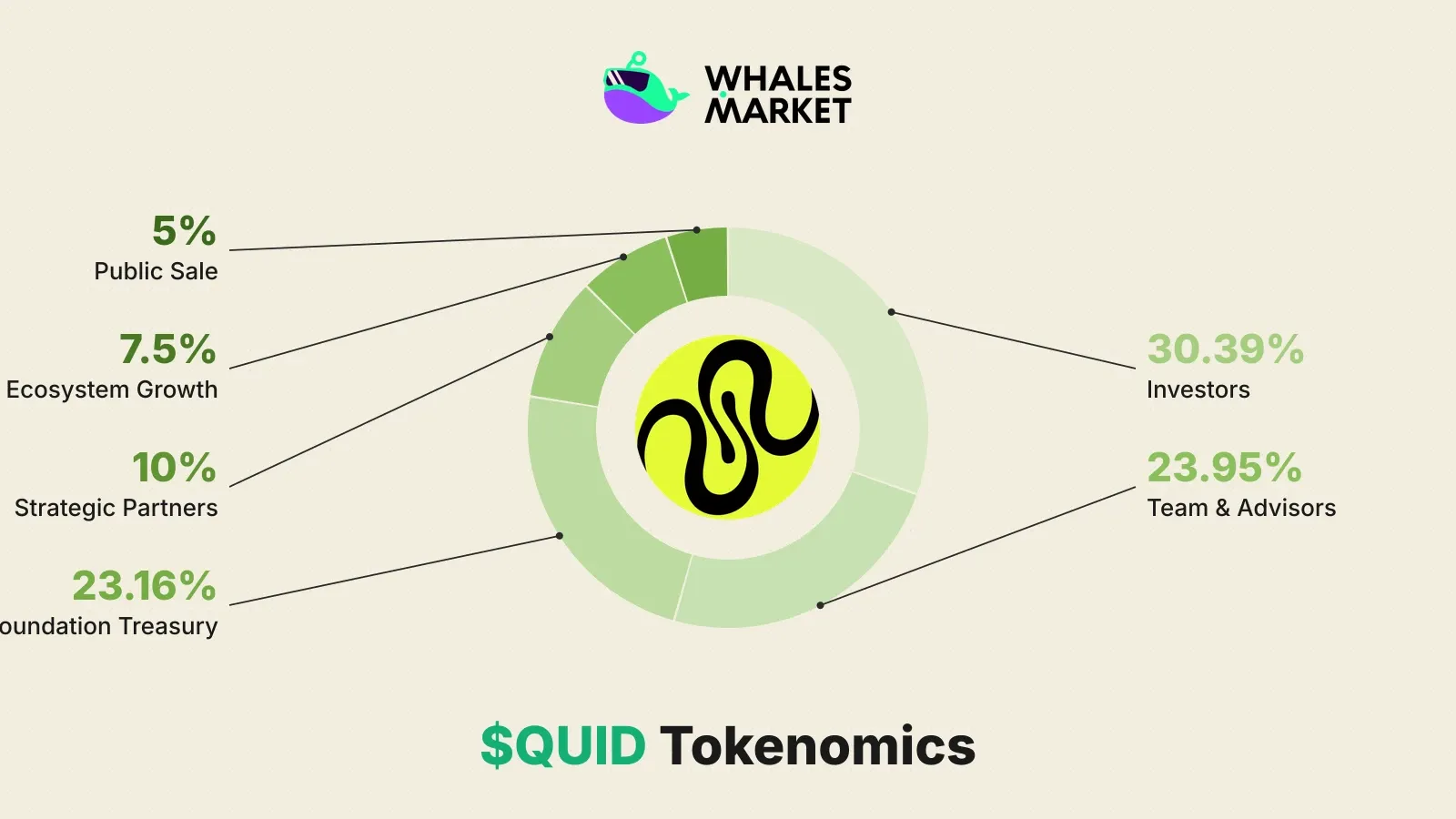
Per Squid's Public Sale — Structure & Tokenomics post, the 1 billion $QUID supply is split as follows:
| Bucket | % | Amount | Vesting |
|---|---|---|---|
| Investors | 30.39% | 303,946,126 | 12-month cliff, 25% unlock at cliff, remainder linear to Month 24 |
| Team & Advisors | 23.95% | 239,481,903 | 12-month cliff, 25% unlock at cliff, remainder linear to Month 36 |
| Foundation Treasury | 23.16% | 231,571,971 | 10% unlocked at TGE, remainder linear over 36 months |
| Strategic Partners | 10.00% | 100,000,000 | 12-month cliff, 25% unlock at cliff, remainder linear to Month 36 |
| Ecosystem Growth | 7.50% | 75,000,000 | 70M at TGE, 5M linear across Months 1–12 |
| Public Sale | 5.00% | 50,000,000 | 100% unlocked at TGE (no vesting) |
| Total | 100.00% | 1,000,000,000 | — |
The three biggest locked buckets — Investors, Team & Advisors, and Strategic Partners — together control 64.34% of supply and share a 12-month cliff with 0% TGE unlock. Roughly two-thirds of the supply is locked for the entire first post-launch year. The circulating float at TGE is dominated by the Public Sale (5% = 50M), the TGE portion of the Foundation Treasury (10% of 23.16% ≈ 23.16M), and Ecosystem Growth's 70M at TGE — giving an implied initial circulating supply near 143M $QUID (~14.3% of supply), subject to Squid's final disclosure.
Fundraising
Squid has closed three rounds totalling $13.5 million (per Squid's own June 2026 State of Squid post, cross-referenced with aggregators):
| Round | Date | Amount | Lead | Selected participants |
|---|---|---|---|---|
| Seed | Jan 2023 | $3.5M | North Island Ventures | Distributed Global, Fabric Ventures, Chapter One, Node Capital, Axelar Network, Stani Kulechov |
| Strategic | Jan 2024 | $4.0M | Polychain Capital | Nomad Capital, North Island Ventures, Maelstrom, Chorus One, Breed VC |
| Public | May 2026 | $6.0M | North Island Ventures | Ripple, Dialectic, Borderless Capital |
Investor lists here are per aggregator listings; treat individual investor tier / classification claims from third-party trackers as directional, not authoritative.
Roadmap & Team
Roadmap
Squid's public 2026 execution priorities, per State of Squid, include:
- Q3 2026 TGE for $QUID with governance activation to follow
- Tempo MPP adapter shipped and further chain integrations in progress
- Agentic payments surface — Squid's MCP integration lets AI agents execute cross-chain swaps directly
- A consumer product built on Squid's routing stack that the team says has occupied a "significant portion" of engineering for the past year (not yet publicly named)
- Variable convenience fee implementation, tying more of the routing volume back into protocol revenue
Team
Squid was founded by three co-founders — Fig, Christina, and Koda — with the project going live in 2021 and mainnet launching in January 2023. Fig serves as one of the public faces of the project; Christina previously led community and ecosystem work at Vega Protocol. The team is approximately 20 people, globally distributed. Squid runs as an independent entity following its incubation inside the Axelar ecosystem.
Conclusion
Squid Router is one of the largest and most integrated cross-chain routing layers in production — $6B routed, 1M+ users, and cross-chain plumbing inside a very long list of wallets and apps that most crypto users touch weekly. The $QUID token launches into that existing distribution rather than needing to build it from scratch.
Two things to sit with before Q3 TGE: (1) the cliff structure means ~64% of supply does not begin to unlock until Month 12 — good for early holders in the short term, but the Month-12 shelf is real and predictable; (2) the May 2026 SquidRouterModule incident is worth reading in full alongside the audit page, since it defines the current security posture more sharply than a total audit count does. Whales Market has already added $QUID to the Upcoming section on Base — once trading opens, the pre-market venue will be the cleanest way to express directional conviction ahead of the exact TGE date and launch chain being posted.
FAQs
Can I buy $QUID today?
Not yet on spot markets. Squid opened the $QUID public sale on 30 June 2026 at 13:00 UTC via Legion (non-US/UK) and Kraken (US/UK eligible), closing 3 July 2026 at 13:00 UTC. The token generation event is scheduled for Q3 2026 with the specific date TBA. Whales Market pre-market has $QUID listed as Upcoming on Base; trading has not opened yet, but the listing page is live so eligible participants can watch for the go-live notification and prepare collateral.
What is $QUID actually for?
Per Squid's public communications, $QUID is a "forever token" that supports participation and engagement with the Squid ecosystem. Planned utility includes staking, governance, buyback mechanisms, and in-app utility such as enhanced product experiences and early access opportunities. Specific mechanics remain subject to governance decisions and product timelines, so the utility set should be treated as intended direction rather than committed spec.
What is the FDV and public sale price?
The public sale price is $0.045 per $QUID, on a fixed total supply of 1,000,000,000. That implies a fully diluted valuation of $45,000,000 at sale price. The public allocation is 50,000,000 tokens (5% of supply), with a hard cap on public raise of $2.25 million.
Is there a lockup on the public sale allocation?
No. Public sale tokens unlock 100% at TGE with no vesting or cliff. In contrast, Investors (30.39%), Team & Advisors (23.95%), and Strategic Partners (10.00%) share a 12-month cliff with 0% unlocked at TGE, meaning roughly 64% of total supply is fully locked for the first post-launch year.
What was the SquidRouterModule hack, and does it affect me?
In May 2026, an attacker exploited a verification flaw in executeSameChainActions() inside a Gnosis Safe module related to Squid, draining approximately $3.2 million from 86 Safe wallets that had installed the module. Halborn's post-mortem attributes the root cause to a hardcoded verification string embedded in publicly verified code. The affected component was the Safe module — not the core routing contracts users touch when swapping through the Squid app or SDK — but the incident is material and should be read in full before adding new Safe modules or committing large capital.
Where can I trade $QUID before TGE?
$QUID has been added to Whales Market pre-market in the Upcoming section at https://whales.market/en/premarket/QUID, with Base as the settlement chain. Trading has not opened yet — the page is live so users can bookmark it and prepare collateral, but no buy/sell orders can be placed until Whales Market flips the listing from Upcoming to Live. Once open, pre-market pricing will reflect what willing buyers and sellers currently agree on for an expected allocation and will not predict the post-launch spot price.
This article is for informational purposes only and does not constitute financial advice. Pre-market trading involves counterparty and settlement risk; participants should read Whales Market's terms and the underlying project's disclosures before committing capital.