

MagicBlock is a Solana-native real-time execution engine that uses Ephemeral Rollups — temporary, just-in-time SVM runtimes — to deliver sub-50 millisecond latency and gasless transactions while keeping state and composability anchored to Solana mainnet. Founded in 2023 by Andrea Fortugno and Gabriele Picco, the project has raised approximately $10.5 million across pre-seed and seed rounds led by a16z Crypto Startup Accelerator and Lightspeed Faction. The $BLOCK token generation event remains officially undated as of May 2026, with pre-market trading now live on Whales Market.
What is MagicBlock?
MagicBlock addresses a structural bottleneck in Solana's product surface: while Solana's ~400 millisecond block time is fast by L1 standards, it is still too slow for the most demanding categories — high-frequency DeFi, fully on-chain games, DePIN sensor networks, private payments, and on-chain AI agent execution. Rather than spin up a separate L2 or app-chain, MagicBlock keeps programs and assets on Solana mainnet and extends the network with horizontally scalable execution shards called Ephemeral Rollups.
The project positions itself today as "The Real-time Engine for Solana Apps" — a backend layer applications can opt into for the parts of their workload that need millisecond-grade execution, without bridging assets or fragmenting liquidity. The broader stack includes the Magic Router for transaction routing, a Solana VRF program for verifiable randomness, the BOLT entity-component framework for on-chain games, and a Private Payments API that ships confidential SPL transfers inside Intel TDX trusted execution environments.
How does MagicBlock work?
The Ephemeral Rollup model has three core mechanics.
- State delegation. Application accounts are delegated to MagicBlock's on-chain Delegation Program. Once delegated, an account can be cloned just-in-time into an Ephemeral Rollup — a temporary SVM runtime — for fast read/write access.
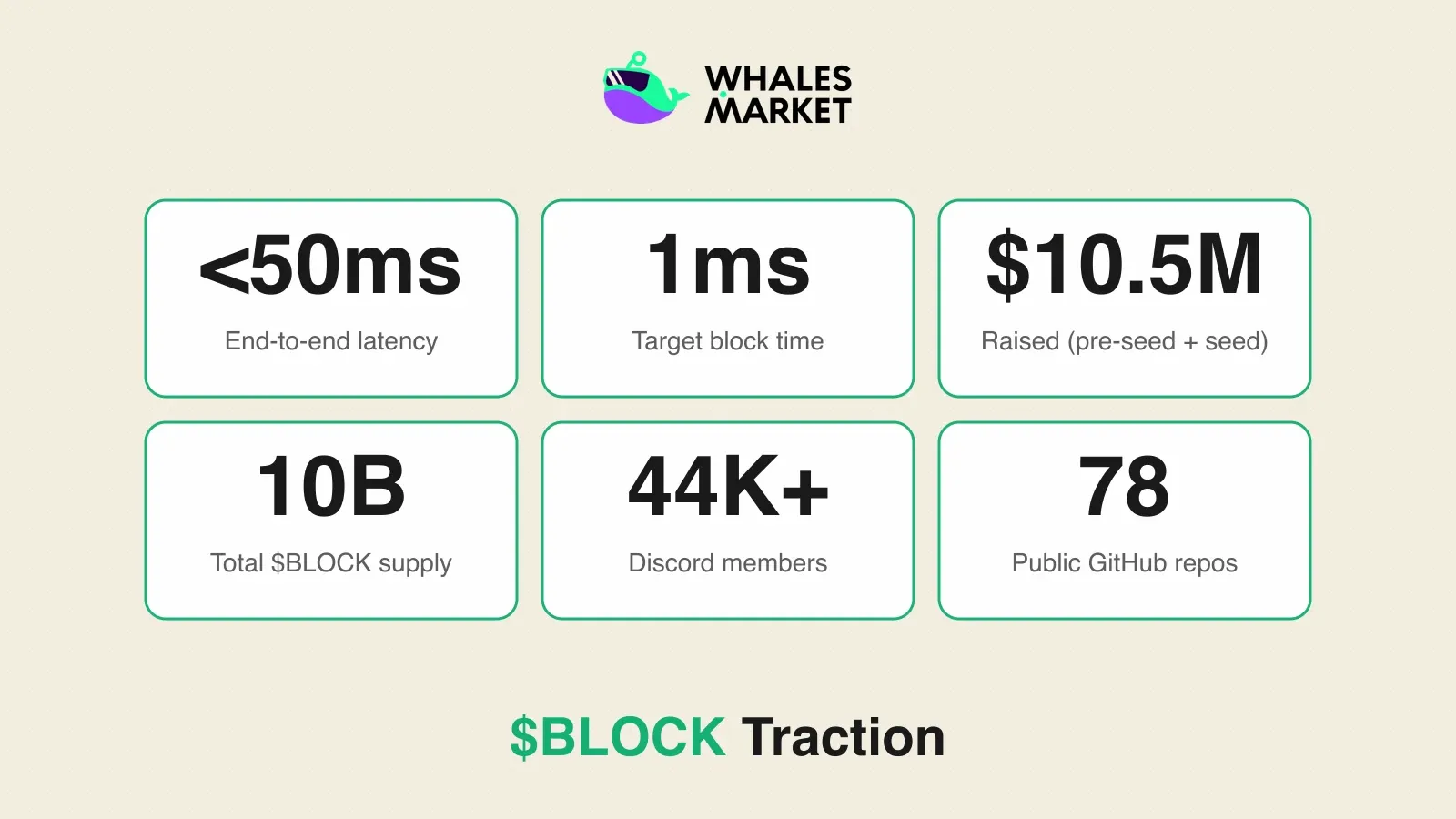
- Co-located execution. A specialised, non-voting MagicBlock validator executes transactions inside the ER. The team publishes a 1 millisecond block time target and end-to-end latency of under 50 milliseconds when applications co-locate with regional validator nodes. Validator deployments are live in four regions — Asia, EU, US, and a TEE-backed region — available on both mainnet and devnet.
- Commit and undelegate. State changes are committed back to Solana mainnet periodically or on demand, with finality handled by an optimistic model and fraud-proof adjudication. The MagicBlock validator is open-sourced under Business Source License 1.1 with the latest release, v0.8.8, shipped on 17 April 2026.
Beyond the base ER, MagicBlock has added Private Ephemeral Rollups (PERs) that run inside Intel TDX TEEs for confidential execution. The Private Payments API built on PERs went live on Solana mainnet in March 2026 and underpins integrations such as Loyal, an agent execution layer for Solana.
$BLOCK Token Information
Key Metrics
| Field | Value |
|---|---|
| Token ticker | $BLOCK |
| Total supply | 10,000,000,000 BLOCK |
| TGE | Originally targeted late Q1 / early Q2 2026 in February's tokenomics post; as of mid-May 2026 no public update has rescheduled the date |
| Network | Solana |
| Presale platform | presale.magicblock.app (self-hosted, 5–8 February 2026) |
| Disclosed funding | ~$10.5M across pre-seed and seed |
$BLOCK Token Use Case
According to MagicBlock's official tokenomics post published on 2 February 2026, $BLOCK has three core functions.
Staking and slashing. Node operators stake $BLOCK to run Ephemeral Rollup sessions and are slashable for uptime or performance failures. Users can also delegate to operators.
Programmatic incentives. Emissions reward measurable on-chain contributions such as delegations, with an adaptive issuance schedule — inflation rises when delegations are below target and falls when above.
Protocol-fee buybacks. Ephemeral Rollup commits and undelegations capture a SOL-denominated protocol fee. A portion of that fee feeds buybacks of $BLOCK from the open market.
$BLOCK Token Listing
$BLOCK has not launched on any centralised exchange. The token is currently available on Whales Market pre-market, where eligible participants can buy or sell expected $BLOCK allocations before the official token generation event. Pre-market pricing reflects what willing buyers and sellers currently agree on for an expected allocation; it does not forecast the post-launch token price.
$BLOCK Tokenomics & Fundraising
Tokenomics
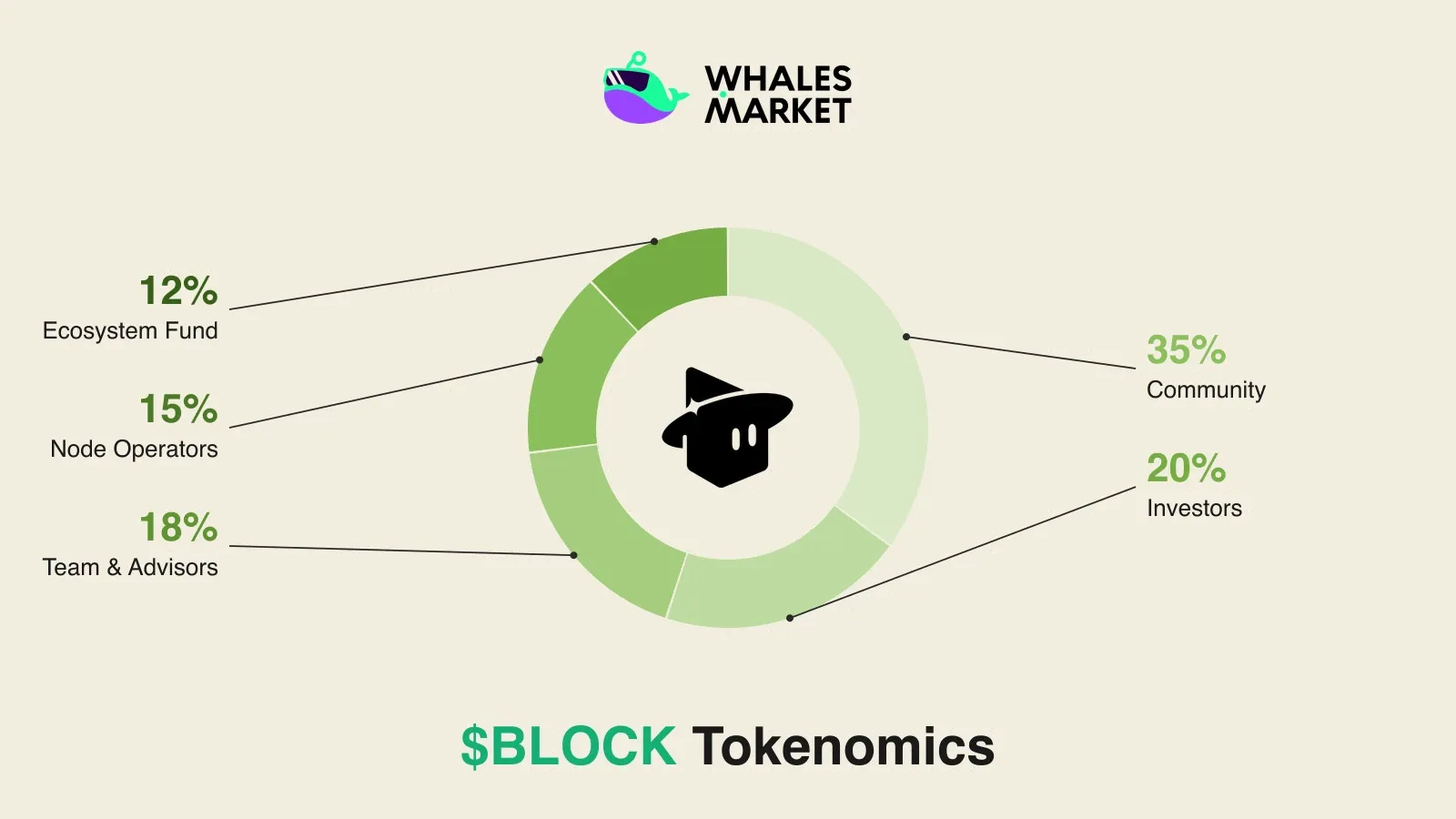
MagicBlock's published allocation across a 10 billion fixed supply:
- Community (users and developers) — 35%. Programmatic distribution tied to on-chain contributions.
- Investors — 20%. Vesting per investor agreements.
- Team and advisors — 18%. Locked for three years, then unlocking based on ecosystem-growth milestones.
- Node operators — 15%. Earned by running and securing Ephemeral Rollup infrastructure.
- Ecosystem fund — 12%. Grants, integrations, and partnerships.
The official summary phrases the design as "50% of the supply goes directly to community and node operators" — combining the 35% community share with the 15% node operator share. Community and node-operator unlocks are programmatic rather than time-vested, scaling with measurable on-chain activity.
Fundraising
- Pre-seed — September 2024, $3M via a16z's Crypto Startup Accelerator (CSX), Spring 2024 cohort.
- Seed — April 2025, $7.5M led by Lightspeed Faction with participation from Maven11, Delphi Digital, Robot Ventures, Mechanism Capital, Equilibrium, Pivot Global, and angels including Anatoly Yakovenko, Mert Mumtaz, and Tristan Yver.
- Public presale — February 2026 at presale.magicblock.app, offering two purchase paths: an FCFS elastic bonding curve with no lock-up at TGE, or a fixed-price option at $100 million FDV with a 1-year lock post-TGE. Total amount raised has not been disclosed officially.
Cumulative disclosed funding stands at approximately $10.5 million between the pre-seed and seed rounds.
MagicBlock Roadmap & Team
Roadmap
Per the official tokenomics post and monthly product recaps, four priorities define MagicBlock's 2026 execution.
- Token Generation Event for $BLOCK. Originally targeted late Q1 or early Q2 2026 in the official tokenomics post; as of mid-May 2026 no rescheduled date has been confirmed.
- Private Ephemeral Rollups expansion. The Private Payments API shipped on Solana mainnet in March 2026, with confidential SPL transfers via Intel TDX TEEs. Continued case-study rollout through partners such as Loyal is on the roadmap.
- Validator decentralisation. The MagicBlock validator is open-sourced under BSL 1.1, with v0.8.8 released on 17 April 2026 and additional audits pending — the Delegation Program has been audited by Halborn and the Solana VRF program by Zenith, while the Permission Program audit remains scheduled.
- Ecosystem and developer growth. The team has run four Solana Blitz hackathons in 2026 alone — including 32 projects shipped in the agentic-themed v4 over a single weekend — and seeded a 47-project track in the Solana Privacy Hackathon.
Team
MagicBlock was founded in 2023 by Andrea Fortugno and Gabriele Picco, who pivoted to building Ephemeral Rollups after hitting the latency limits of a fully on-chain game they were prototyping.
- Andrea Fortugno — Co-Founder.
- Gabriele Picco — Co-Founder.
The wider organisation operates as MagicBlock Labs with 78 public repositories on GitHub. Community footprint includes more than 44,000 Discord members and more than 45,000 followers on X.
Conclusion
MagicBlock has positioned itself as the real-time backend for Solana — not a sidechain, not a bridge, not an alt-L1. Live applications already span perpetuals (Flash Trade), fully on-chain games (Supersize, Colony on Solana Mobile Seeker), decentralised voice and video (dTelecom), and millisecond-grade price feeds (Pyth Lazer). With $10.5 million in disclosed funding from a16z CSX and Lightspeed Faction, and Private Payments live on Solana mainnet, the open question is the $BLOCK TGE itself — still officially undated as of May 2026. For builders, the validator and SDKs are already in production; for retail readers, Whales Market is now the price discovery venue ahead of any official launch.
FAQs
Is $BLOCK a token I can buy today?
Not on a centralised exchange. As of May 2026, no TGE date has been officially announced by MagicBlock, and $BLOCK is not listed on any major CEX. The token is currently available on Whales Market pre-market for participants who want to express directional conviction ahead of an eventual launch.
How much has MagicBlock raised, and from which investors?
MagicBlock has disclosed approximately $10.5 million across two rounds: a $3 million pre-seed in September 2024 via a16z's Crypto Startup Accelerator (Spring 2024 cohort), and a $7.5 million seed in April 2025 led by Lightspeed Faction with participation from Maven11, Delphi Digital, Robot Ventures, Mechanism Capital, Equilibrium, Pivot Global, and angels including Anatoly Yakovenko, Mert Mumtaz, and Tristan Yver. A self-hosted public presale ran 5–8 February 2026; the total raised has not been officially disclosed.
Is MagicBlock its own L1?
No. MagicBlock is not a separate chain. Ephemeral Rollups are SVM-based execution shards that delegate Solana mainnet accounts just-in-time, execute at sub-50 millisecond latency on a specialised validator, and commit state back to Solana. Programs and assets remain on Solana mainnet.
What is the $BLOCK total supply and how is it allocated?
Total supply is 10 billion $BLOCK. Allocations are 35% to community (users and developers), 20% to investors, 18% to team and advisors, 15% to node operators, and 12% to the ecosystem fund. Team tokens are locked for three years with unlocks tied to ecosystem-growth milestones; community and node-operator unlocks are programmatic and scale with measurable on-chain contributions.
Where can I trade $BLOCK before TGE?
$BLOCK is listed on Whales Market pre-market, where eligible participants can buy or sell expected $BLOCK allocations before any official token generation event. Pre-market pricing reflects what willing buyers and sellers currently agree on for an expected allocation and does not forecast the post-launch token price.