

Back in January, prediction markets placed a 61% probability on Backpack reaching a $1B FDV on its first day after launch. By March, that number had fallen to just 9%. The same exchange, the same valuation milestone, but market confidence evaporated by more than 80% in only two months.
Data from Polymarket recorded the total trading volume in this prediction market increasing from about $580K to $3.2M, nearly a 6x increase. This means the market did not only become more pessimistic, but more participants also entered and placed real bets on that outcome. This is not a random shift in low attention data. It is a serious market signal.
This article analyzes the numbers step by step, traces the causes, and explains what changed in the way the market now views Backpack.
What the Data Shows: A Direct Comparison
To understand the scale of the shift, the FDV milestones need to be placed side by side.
January prediction market expectations
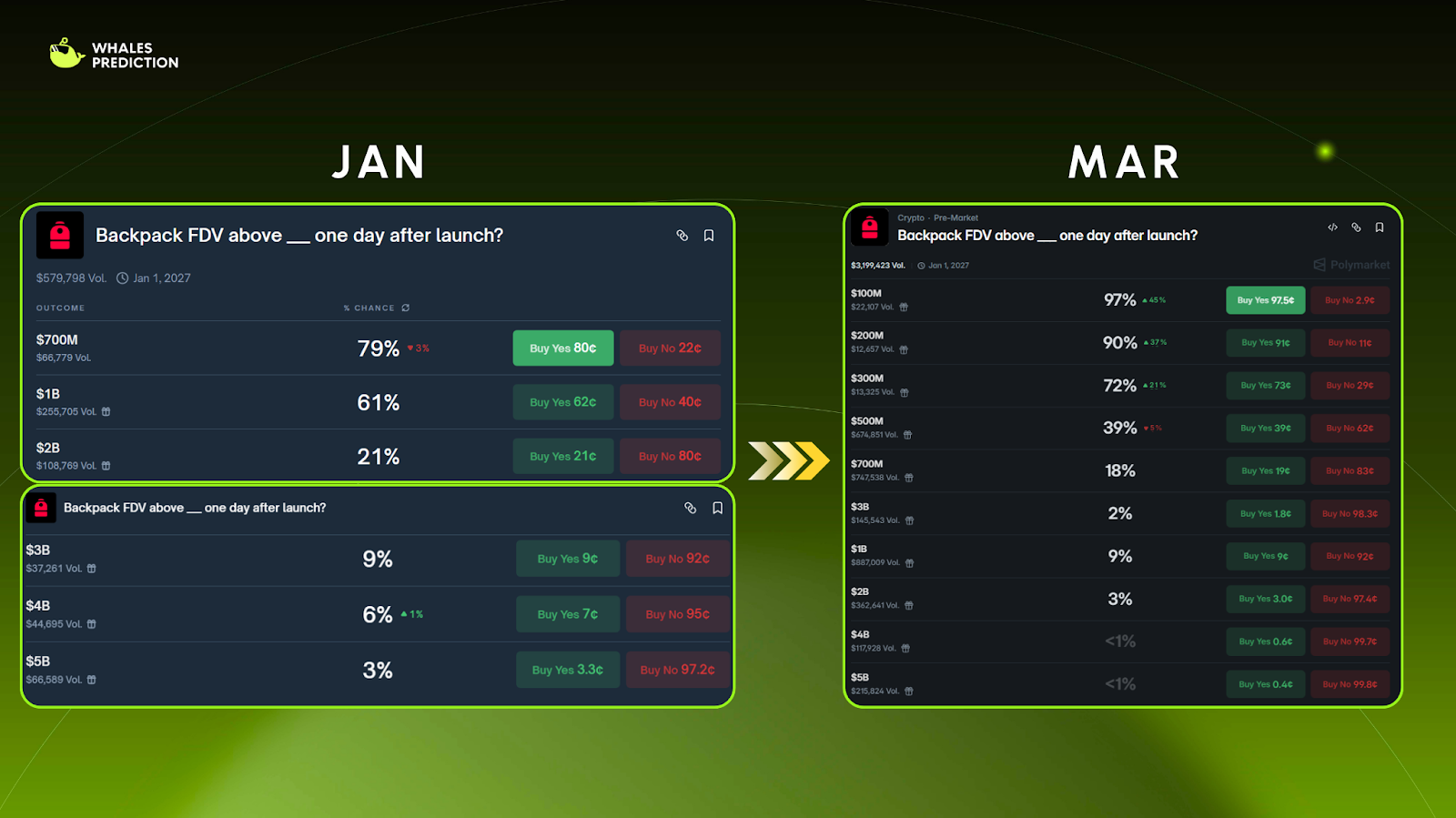
- The probability of FDV exceeding $700M was 79%.
- The probability of FDV exceeding $1B was 61%.
- The probability of FDV exceeding $2B was 21%.
- The probability of FDV exceeding $3B was 9%.
March prediction market expectations
By March, the numbers had changed dramatically.
- The probability of FDV exceeding $700M fell to just 18%, a drop of 61 percentage points.
- The probability of FDV exceeding $1B fell to 9%, a drop of 52 percentage points.
- The probability of FDV exceeding $2B fell to 3%.
- The probability of FDV exceeding $3B fell to 2%.
- The $500M threshold, which did not appear in January data, now stands at only 39%.
The most notable point is not only the decline itself, but where the market is now placing its expectations. As of March 2026, Polymarket has added lower thresholds such as $100M at 97%, $200M at 90%, and $300M at 72%.
When prediction markets begin pricing heavily around lower thresholds, it becomes a clear sign that the crowd is adjusting expectations downward, not upward.
Another important detail is that trading volume increased from about $580K to $3.2M. When a prediction market has thin liquidity, probabilities can easily be distorted by a few large orders. When liquidity grows 6x, it means more participants, with more information, are placing real bets on outcomes they believe are correct.
In other words, the March market is more reliable than the January market. And that market is clearly signaling that expectations for Backpack have fallen sharply.
Why Expectations Fell: Analysis of Four Key Factors
Macro Pressure and the Altcoin Market Adjustment
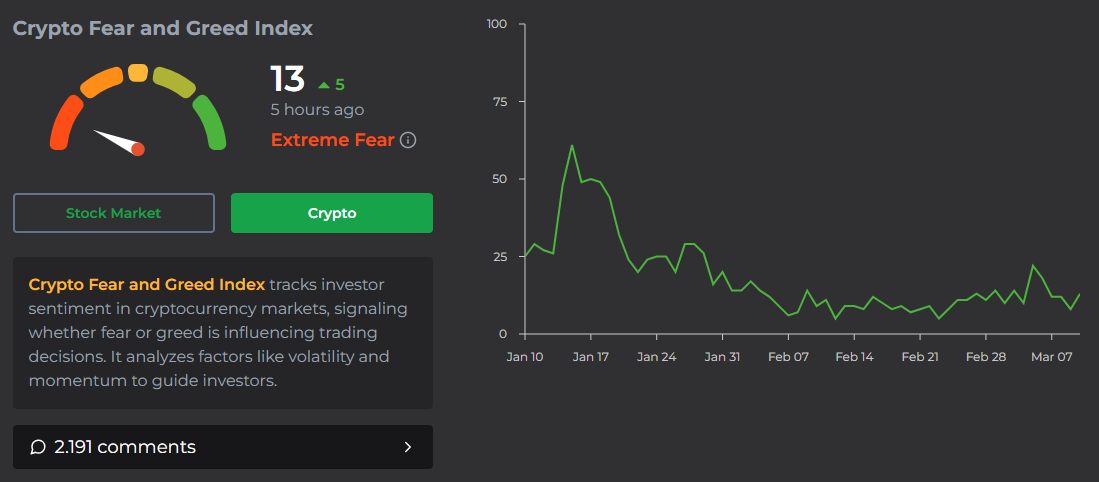
From January to March 2025, the crypto market went through a significant sentiment correction. The Crypto Fear and Greed Index reached 8 out of 100 on January 31, 2025. It was the first time the index fell to a single digit since February of the previous year. By March 2025, the index was still at 13 out of 100, deep inside the Extreme Fear zone.
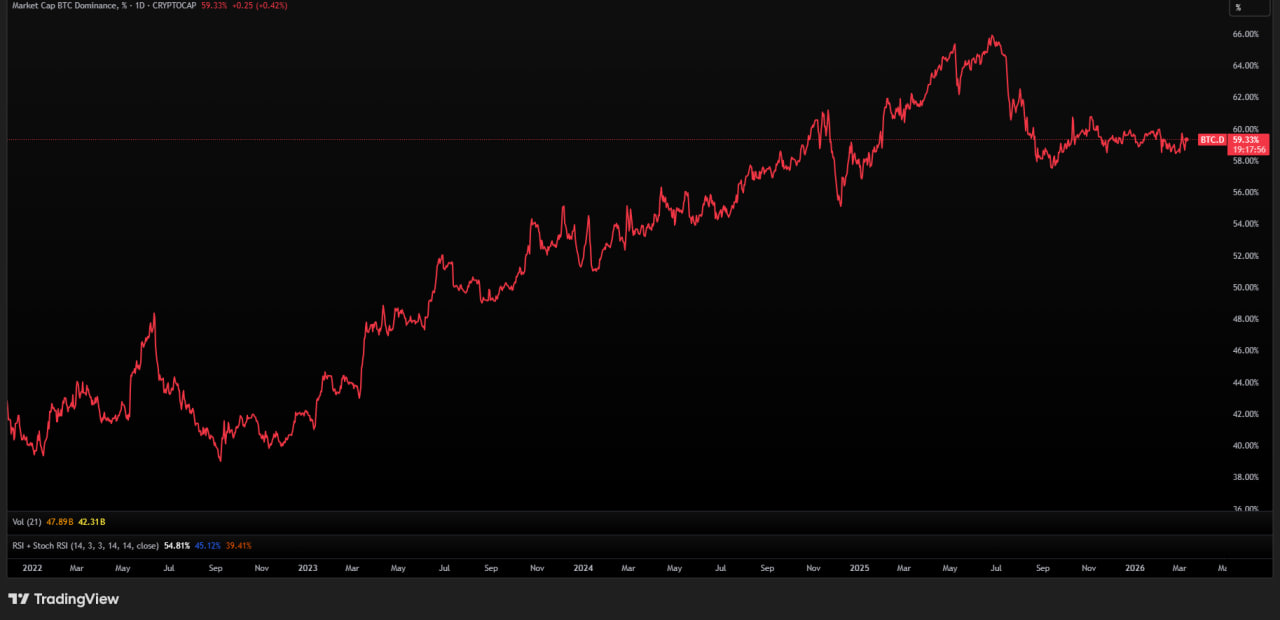
At the same time, Bitcoin dominance rose to nearly 60% in February 2025, the highest level since early 2024. Historical data shows that altcoins typically recover strongly only when Bitcoin dominance falls below 50%. With dominance staying around 60%, capital continued concentrating in Bitcoin instead of rotating into new tokens. This made investors evaluate every upcoming launch more cautiously.
This created a harsh valuation environment. Tokens that have not yet fully circulated depend entirely on market sentiment at launch. When the overall market sits in the Extreme Fear zone, participants naturally become more cautious toward any new token.
Lessons From Tokens That Launched Before Backpack
The early months of 2025 delivered an expensive lesson for the market. Tokens launching with high FDV struggled to maintain those valuations.
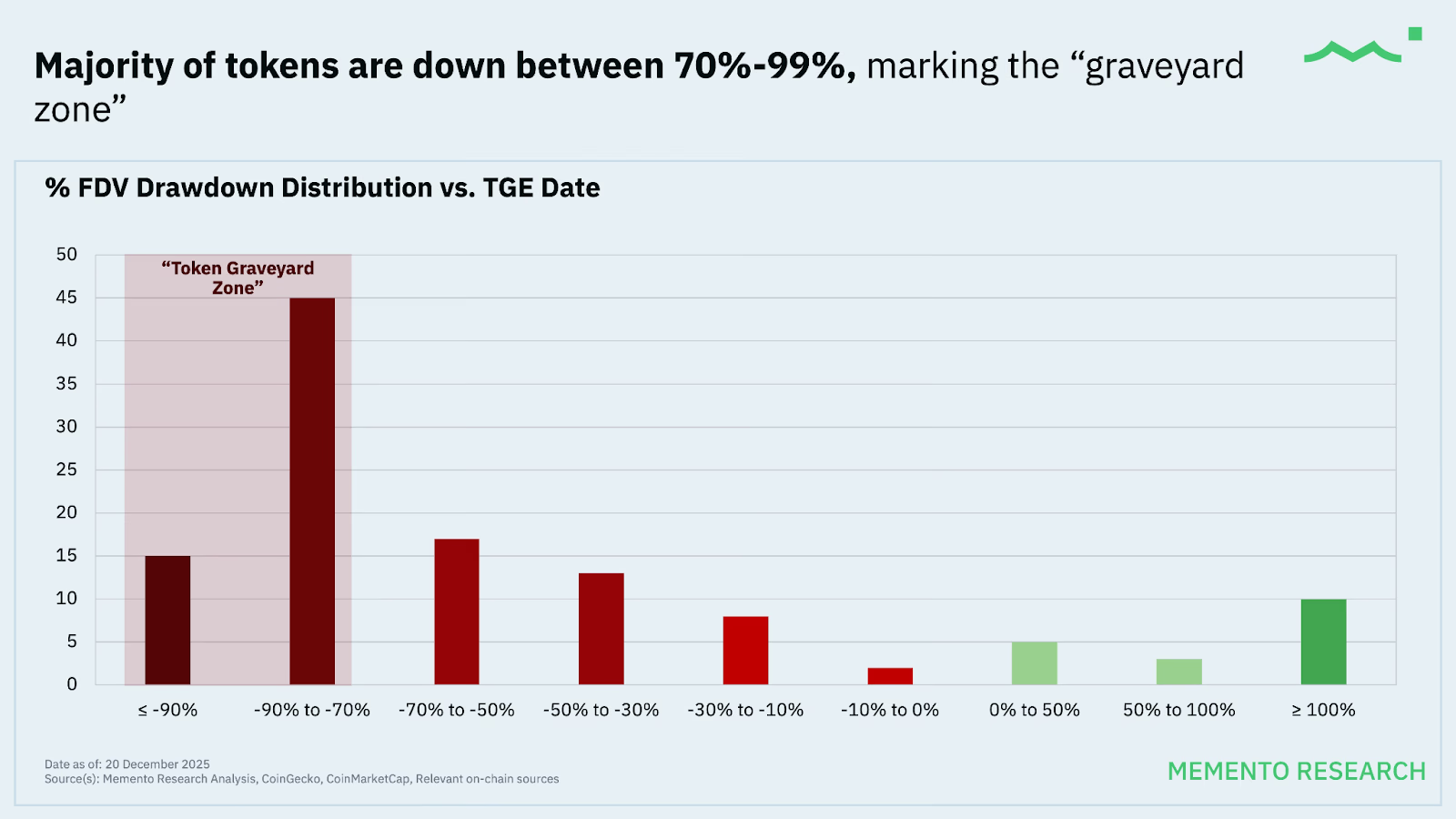
According to research from Memento Research tracking 118 token launches in 2025, more than 84% of tokens are now trading below their initial TGE valuation, with a median loss exceeding 70%.
More importantly, among 28 tokens that launched with an initial FDV above $1B, none are still trading above their launch price, and the median drawdown reached 81%.
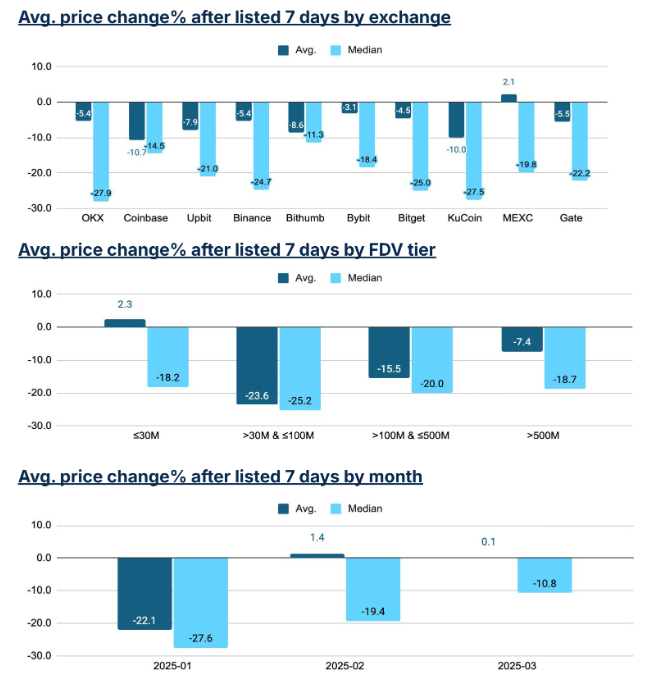
Data from Animoca Brands’ Q1 2025 report, which tracked 770 listing events across 10 major exchanges, confirmed this trend.
January recorded 364 listings, boosted by the momentum from late 2024. However, by March even high FDV tokens experienced sharply lower interest after listing, with price performance during the first seven days described as flat or slightly negative.
Competition From the New Generation of DEX
One factor that receives less attention but plays an important role in the valuation of centralized exchanges like Backpack is the rapid rise of perpetual DEX platforms.
According to a CoinGecko report in 2025, the market share of DEX platforms in derivatives trading increased from 2.7% at the end of 2023 to 26% by mid 2025. This represents nearly a 10x increase in about 18 months.
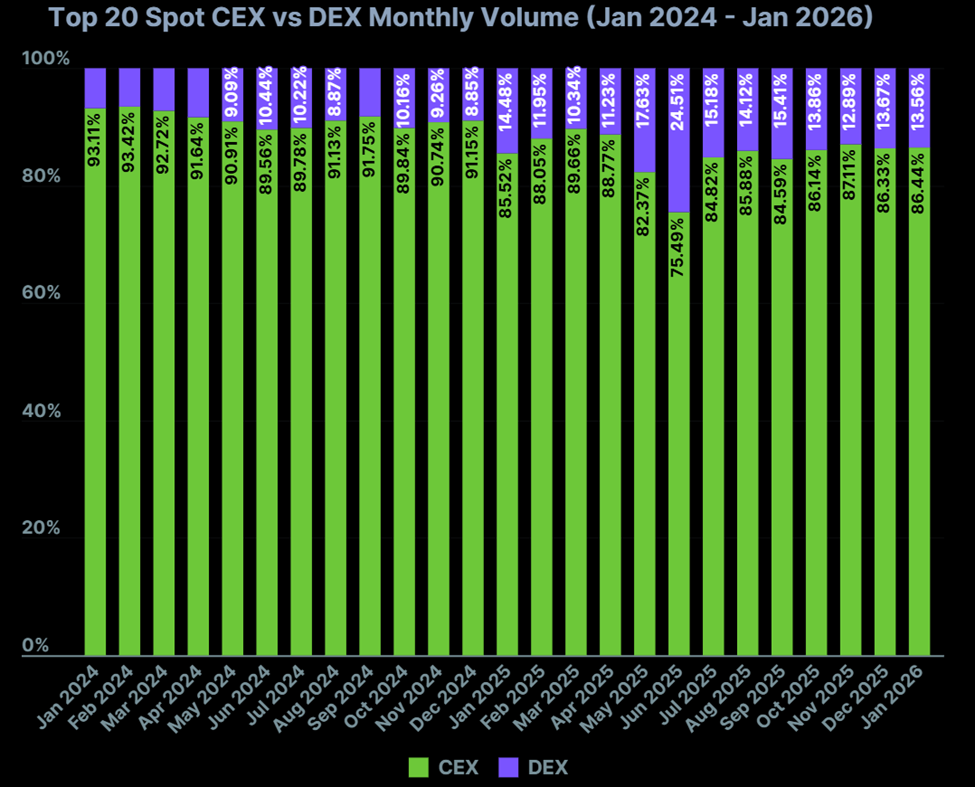
Hyperliquid has been at the center of this shift. The platform reached a peak of 73% market share in the perpetual DEX sector during Q2 2025 and accumulated more than $3T in trading volume throughout 2025.
As professional traders begin to recognize that DEX platforms can compete directly with centralized exchanges in speed and liquidity, the question of how much a CEX token should be worth becomes more complicated.
Backpack, despite having accumulated more than $400B in trading volume and users across more than 150 countries, still operates in an environment where the entire CEX model faces challenges from on chain platforms.
This dynamic naturally lowers the market willingness to assign very high valuations to centralized exchange tokens.
Tokenomics and Token Structure: Potential Selling Pressure
According to official information from Backpack, 25% of the total token supply will unlock at TGE. Within this allocation, 24% will be distributed to users who accumulated points, while 1% will go to Mad Lads NFT holders.
This means a large amount of tokens will be distributed widely to hundreds of thousands of users who farmed points across multiple seasons. That structure creates meaningful potential selling pressure starting from the very first trading day.
In short, the decline in expectations is not a sudden event. It is a continuous adjustment process as the market absorbs more information.
25% on day one.
— Armani Ferrante (@armaniferrante) January 30, 2026
As we approach TGE, we'll be releasing our tokenomics, one step at a time.
It's unclear if "token" will even be the right way to describe our TGE. It'll be a token in form, but everything about it will be different from the status quo. The distribution will be… https://t.co/e68mSt9zgO
Conclusion
The drop from 61% to 9% in the probability of Backpack reaching a $1B FDV is not necessarily bad news for the project.
It is a sign that the prediction market is functioning as intended. The probabilities continuously update based on real macro conditions, historical token data from 2025, and the increasing competition from DEX platforms.
Following Polymarket during the final weeks before launch will likely provide a more realistic view than any analysis built purely on hype.
FAQs
Q1. How does the Backpack FDV prediction market work?
Prediction markets like Polymarket let users trade binary contracts. If the outcome happens, the contract pays $1. The contract price reflects the market probability, such as $0.09 meaning 9%.
Q2. Why is the increase in trading volume important in this analysis?
Higher trading volume means more capital and more participants shaping the odds. This reduces distortion from a few large trades and makes the probabilities closer to the market consensus.
Q3. What is the difference between FDV and market cap for newly launched tokens?
FDV represents the valuation if all tokens are circulating. Market cap counts only circulating supply. If 25% supply unlocks at TGE, FDV can be about 4x higher than market cap.
Q4. Can Polymarket data be wrong?
Prediction markets reflect collective expectations, not guaranteed outcomes. However, when liquidity increases, the probabilities usually become more accurate as more participants contribute information and capital.
Q5. What scenarios could push Backpack FDV above current expectations?
Unexpected positive catalysts could shift sentiment. Examples include improved tokenomics, major partnerships announced before launch, or a strong crypto market recovery increasing demand for new tokens