

In the autumn of 1971, a man known only as D.B. Cooper hijacked a flight, extorted a fortune, and leaped into the void, leaving behind nothing but a legend. Fast forward to 2009: a new phantom appeared on the global stage. This figure didn't hijack a plane; they hijacked the world’s concept of money.
Under the alias Satoshi Nakamoto, they released a protocol for a "Digital Gold" that would eventually challenge the hegemony of central banks. But just as Bitcoin began its meteoric rise, its creator performed the ultimate vanishing act, leaving the world to wonder: Who really held the pen that wrote the code?
Who is Satoshi Nakamoto?
Satoshi Nakamoto is the pseudonymous entity, whether an individual or a collective, responsible for authoring the Bitcoin whitepaper and deploying the world's first functional blockchain. Active during the project’s infancy, Nakamoto spearheaded development until abruptly stepping away in late 2010.
While the creator claimed to be a Japanese man, many digital sleuths remain skeptical. Given the flawless English used in his correspondence and the specific time stamps of his forum posts, the prevailing theory is that "Satoshi" is a mask for one or more cryptography experts based in the West.
Satoshi Nakamoto: The Alchemist of the Digital Age
Why did Satoshi Nakamoto create bitcoin?
Most people trade their time for money; Satoshi Nakamoto simply manifested it out of logic and math. On January 3, 2009, he birthed a currency that existed neither in paper nor metal, but in 31,000 lines of uncompromising code.
- The concept of scarcity: By capping the supply at 21 million units, Satoshi created a deflationary asset often compared to gold.
- A historic slice: The abstract value of Bitcoin became "real" in 2010 when 10,000 BTC were exchanged for two pizzas—a transaction now immortalized as "Bitcoin Pizza Day," marking the moment code became commerce.
A manifesto written in blocks
Bitcoin was not a random invention; it was a surgical response to the 2008 financial meltdown. When the collapse of Lehman Brothers proved that traditional institutions were fallible, Satoshi Nakamoto proposed a system that replaced "trust" in humans with "proof" in math.
"The root problem with conventional currency is all the trust that’s required to make it work," Satoshi famously noted. "The central bank must be trusted not to debase the currency, but the history of fiat currencies is full of breaches of that trust."
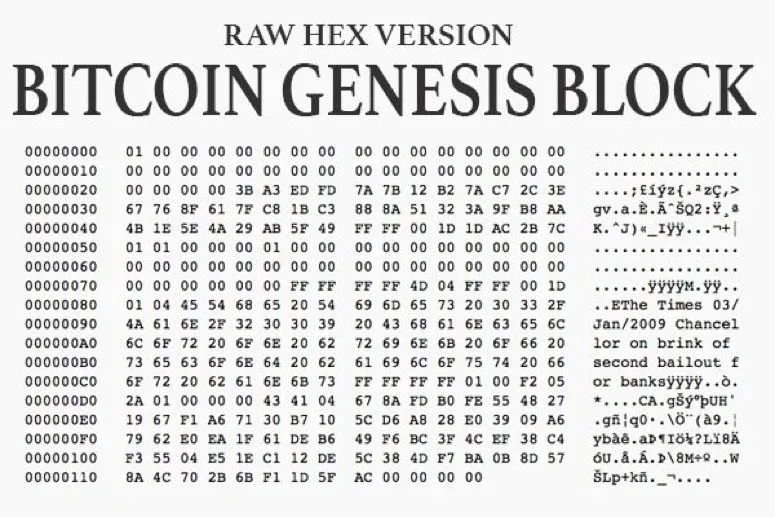
To ensure his motive was never forgotten, Satoshi embedded a message in the very first block of the chain (the Genesis Block), referencing a Times headline about bank bailouts. It was a digital "middle finger" to the failing status quo.
The code that couldn't be broken
The true genius of Satoshi Nakamoto wasn't just in the idea, but in its execution. In 2011, elite security researcher Dan Kaminsky, famous for finding a "kill switch" flaw in the Internet, set his sights on Bitcoin. He expected to dismantle it in days.
Instead, he found himself in a digital maze. Every time Kaminsky identified a potential vulnerability, he discovered that Satoshi had already anticipated the move and neutralized it.
- "Attack Removed": Kaminsky described finding lines of code specifically designed to thwart his exact hacking methods.
- The Verdict: He concluded that Satoshi was a "paranoiac genius" or a world-class team, possessing a mastery of C++ and peer-to-peer networking that was simply unprecedented.
Satoshi Nakamoto’s Philosophy of Disappearance
In an era where tech founders often become cult-like celebrities, Satoshi Nakamoto’s decision to vanish in April 2011, sending a final, terse note stating he had "moved on to other things", is perhaps his most brilliant stroke of genius. This wasn't just a personal choice; it was a strategic necessity for the survival of his creation.

Avoiding the "Single Point of Failure"
Satoshi Nakamoto understood a fundamental truth about decentralization: as long as a creator exists, the system has a "neck" for the authorities to wring. History is a graveyard of private currency experiments.
- The Ghost of Liberty Dollars: In 1998, Bernard von NotHaus created "Liberty Dollars." By 2011, he was convicted of "conspiracy against the United States."
- The Fall of e-Gold: Similarly, the founders of e-Gold were pursued by the Department of Justice for operating an unlicensed money-transmitting business.
By dissolving into the shadows, Satoshi ensured there was no office to raid, no server to unplug, and no "leader" to subpoena. He killed the creator so the protocol could become an unstoppable public utility.
The Power of Anonymity in a Trustless System
If Satoshi Nakamoto had stayed, the world would have spent the last decade obsessing over his personal life, his political leanings, or his coffee preferences. By remaining a ghost, he forced the world to focus on the code rather than the man.
- Math over Myth: Bitcoin’s core value is that it requires no trust in individuals. Had Satoshi stayed, he would have become a central authority by default, a "benevolent dictator" whose every tweet could crash the market.
- The Kaito Kid Effect: His disappearance turned Bitcoin into a global myth. It transformed a piece of software into a movement that belongs to everyone because it belongs to no one.
Escaping the "Gray Area" of Legality
Satoshi Nakamoto was well aware that he was "desecrating" the sacred ground of sovereign nations: the right to print money. By building Bitcoin using the same peer-to-peer technology used by "pirate" sites like Napster or BitTorrent, he created a system that lives everywhere and nowhere at once.
While legal scholars like Lewis Solomon argue that Bitcoin exists in a "gray area", somewhere between a commodity and a currency, gray areas are dangerous places for individuals. Satoshi’s invisibility was his ultimate suit of armor, protecting him from the fate of those who dared to compete with the U.S. Dollar.
Satoshi Nakamoto’s Net Worth
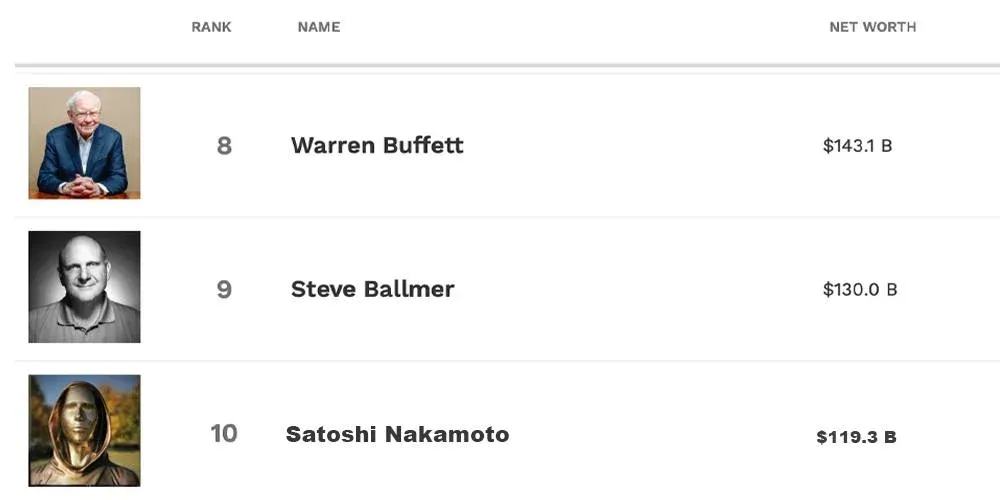
While Satoshi remains invisible, his wealth is perfectly transparent on the public blockchain. As the first miner of the network, Satoshi accumulated a fortune that has transformed him from a cypherpunk developer into one of the wealthiest entities on the planet.
Blockchain forensics, specifically through the tracking of the Patoshi Pattern, has identified 1,096,358 BTC scattered across thousands of addresses created between 2009 and 2010. Meaning Satoshi Nakamoto’s Bitcoin holdings are about 1.1M BTC.
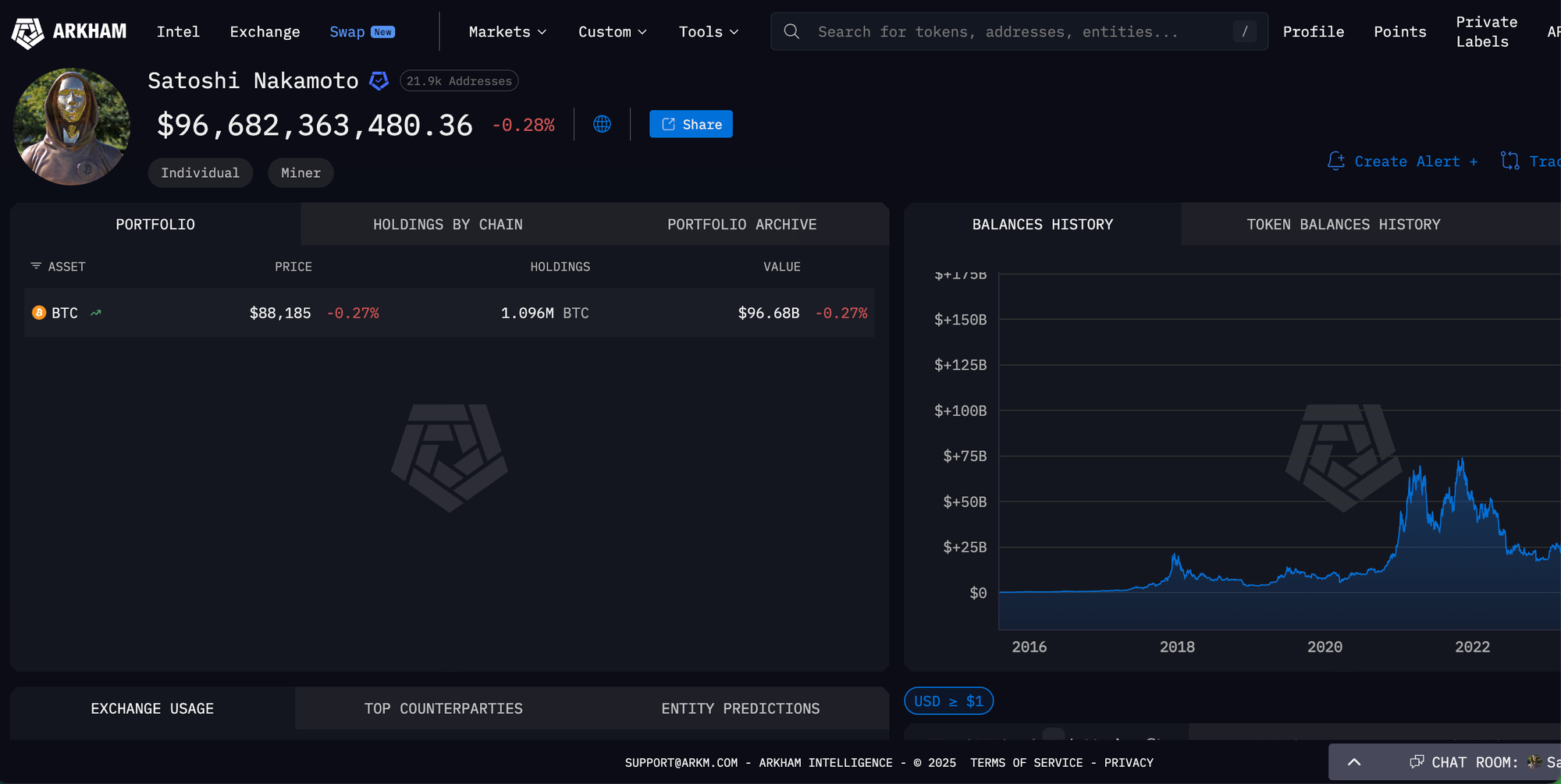
With Bitcoin reaching new heights in 2025, trading near $124,000, Satoshi’s estimated net worth has peaked at approximately $134 billion, according to Arkham, a blockchain analytics platform.
In late 2024, Satoshi consistently ranked among the Top 10 richest people in the world, often rivaling or surpassing titans like Amancio Ortega or Michael Bloomberg.
FAQs
What does Satoshi Nakamoto mean in Japanese?
The Satoshi Nakamoto name is composed of three Japanese kanji: Satoshi (wise/intelligent), Naka (inside/middle), and Moto (origin/foundation). Together, the name loosely translates to "Wise Origin" or "Intelligent Foundation," reflecting the creator's role as the architect of the first decentralized financial system.
Is Satoshi Nakamoto a real person?
It is currently unknown if Satoshi Nakamoto is one person or a group of people. Technical experts, such as the late security researcher Dan Kaminsky, have argued that the Bitcoin code was so "painstakingly" perfect and complex that it may have required a world-class team of developers rather than a single individual.
Is Satoshi Nakamoto alive?
There is no verified evidence to confirm if Satoshi is still alive, as his last digital activity was in April 2011. While some believe he remains a silent observer, others speculate he may have passed away, notably citing the late Hal Finney as a candidate, or purposefully destroying his private keys to ensure the network remains leaderless forever.
How many Bitcoins does Satoshi Nakamoto own?
It is estimated that Satoshi Nakamoto owns approximately 1.1 million BTC, stored in the earliest "wallets" ever created. As of 2025, these coins remain untouched. If Satoshi were to move these coins, it would likely cause massive volatility in the global crypto markets.
How rich is Satoshi Nakamoto?
As of late 2025, with Bitcoin trading at around $88,000, Satoshi Nakamoto’s net worth is estimated at $96B. Owning roughly 1.1 million BTC, he used to consistently rank among the Top 10 richest people on Earth in December 20224 according to Forbes real-time billionaires list, holding more wealth than industrial titans like Amancio Ortega or Michael Bloomberg.