

As data privacy becomes a critical challenge in blockchain adoption, new architectures are emerging to protect sensitive information without sacrificing decentralization. Octra built from the ground up to support FHE. So what is Octra? Let’s dive into this article.
What is Octra?
Octra is a blockchain designed to support Fully Homomorphic Encryption (FHE), an advanced encryption technology that allows operations to be performed on data without decryption. This ensures high security and privacy for decentralized applications (DApps), especially in the financial, healthcare, and data-sensitive sectors.
The Octra network is built with independent execution environments, allowing applications to run in an isolated space, avoiding data leakage risks and enhancing security. The system uses multiple programming languages, with ReasonML being the primary language for developing smart contracts and applications that interact with the blockchain.
How does Octra work?
Octra's operating mechanism follows these steps:
- Transaction initiation and validation: Users send encrypted transactions on the Octra Blockchain. Transactions are processed using FHE without decrypting the data. Validators validate transactions based on encrypted data, ensuring privacy.
- Data storage and processing on IrminDB: Blockchain data is stored in IrminDB. IrminDB is optimized for Validators and vector data processing.
- Application execution in an isolated environment: DApps run in Isolated Execution Environments to ensure data security. These environments are completely separate, preventing unauthorized access.
- Smartcontract development with ReasonML: Developers can write Smartcontracts using ReasonML. Smartcontracts are executed on Octra with FHE support, ensuring privacy.
- Extending and integrating Hypergraph FHE: The Hypergraph FHE library can be integrated into other projects. Bootstrap support enhances encryption performance while maintaining security.
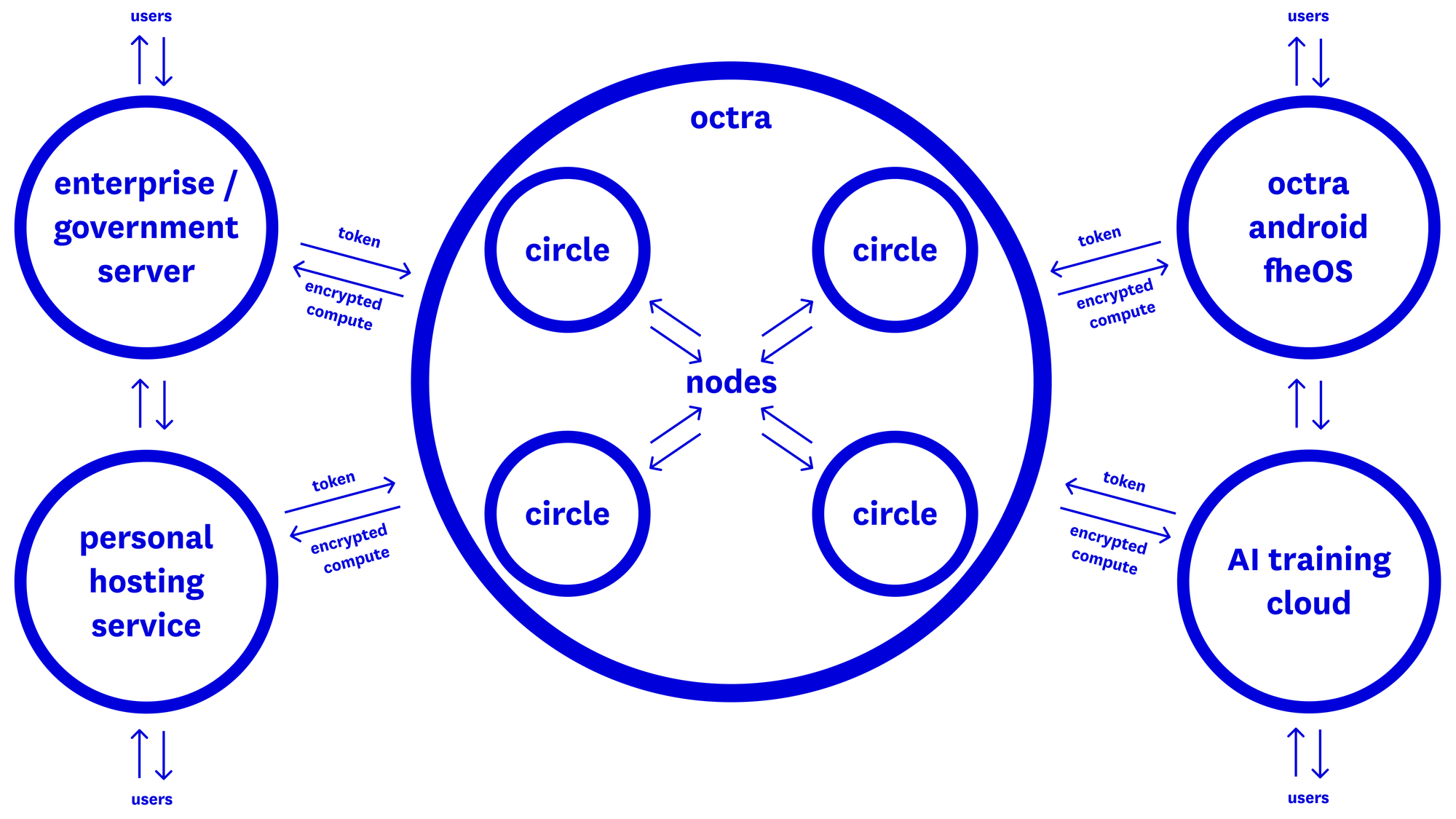
Octra Technology
HFHE
HFHE (Hypergraph Fully Homomorphic Encryption) is a solution that implements fully homomorphic encryption (FHE) using hypergraphs. This technology allows for efficient execution of binary logic operations through hyperedges:
- AND: Creates a new hyperedge that only works when both original hyperedges are active.
- OR: The new hyperedge will work if at least one of the original hyperedges is active.
- XOR: Activates when only one original hyperedge is active.
- NOT: Inverts the state of the hyperedge, activated when the original hyperedge is inactive.
- NAND: Combines AND and NOT, activated when AND is inactive.
- NOR: Combines OR and NOT, activated when OR is inactive.
- XNOR: Combines XOR and NOT, activated when XOR is inactive.
Thanks to the use of hypergraphs, HFHE supports parallel computation, allowing for simultaneous processing of independent nodes and hyperedges. This opens up great potential for applications requiring high security and complex data processing in a decentralized environment.
Octra's ML Consensus
Octra introduces ML Consensus, a consensus mechanism based on machine learning (ML). This system uses actor nodes and a support vector machine (SVM) to manage load, selecting validation paths based on experience from previous validations. This process helps validate results and ensures that external interference is impossible.
ML Consensus offers several notable benefits such as:
- Eliminating or reducing reliance on proof-of-stake (PoS) mechanisms and limiting the centralization of validating nodes.
- Lightweight nodes that can run on devices such as Raspberry Pi or smartphones.
- Optimized for a large number of validators, making the network more decentralized and democratic than PoS blockchains.
Thanks to this mechanism, Octra creates a robust, accessible, and sustainable blockchain infrastructure, fostering broad community participation.
Octra's Isolated Environment
Octra deploys subnets and modular applications with their own separate blockchain branch. This allows each application or subnet to operate independently, creating an isolated environment that ensures:
- Higher security, as separate subnets do not affect each other.
- Optimized performance thanks to flexible adjustments for each specific application.
- Easy scalability through adding modules or subnets without disrupting the entire network.
This mechanism helps Octra meet the diverse needs of projects, increasing customization and maintaining stability as the ecosystem grows.
$OCT Token Information
$OCT Key Metrics
Here is the information of $OCT
- Token Name: Octra
- Ticker: $OCT
- Token Type: TBA
- Total Supply: 1B $OCT
- Contract address (CA): TBA
$OCT Use Case
Currently, Octra has not announced any official use case of $OCT for the project. Whales Market will update immediately when the official Octra website announces.
$OCT Listing
Here are important details revealed to $OCT:
- Listing time: TBA
- Confirmed CEX Listings: TBA
- Pre-market Price (Whales Market): TBA
Octra Tokenomics & Fundraising
Tokenomics
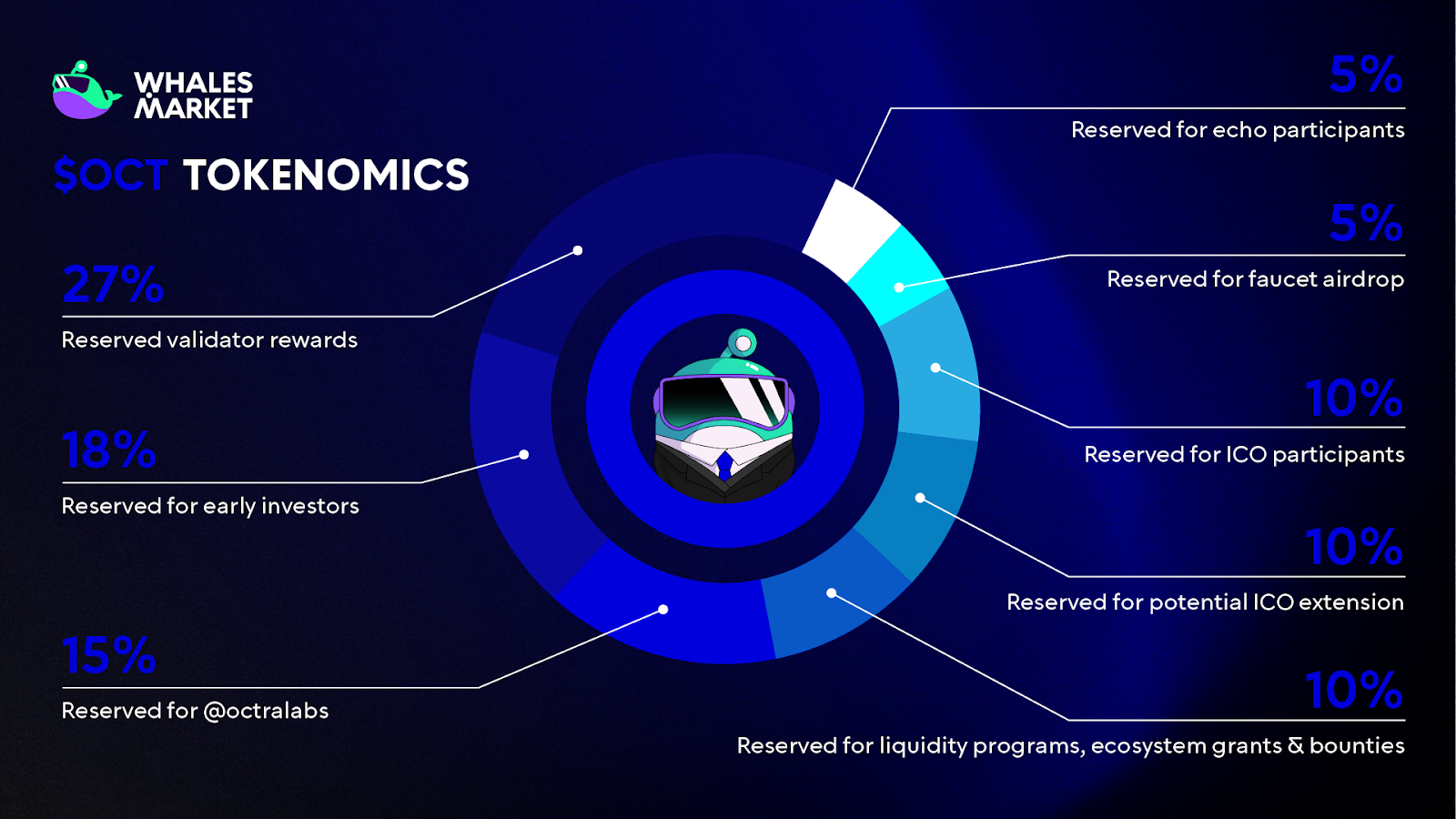
- Total Supply: 1B $OCT
- Token Allocation:
- Early investors: 18%
- Team: 15%
- ICO participants: 10%
- Potential ICO extension (or burn): 10%
- Liquidity programs, ecosystem grants & bounties: 10%
- Echo participants: 5%
- Faucet airdrop: 5%
- Validator rewards: 27%
Fundraising
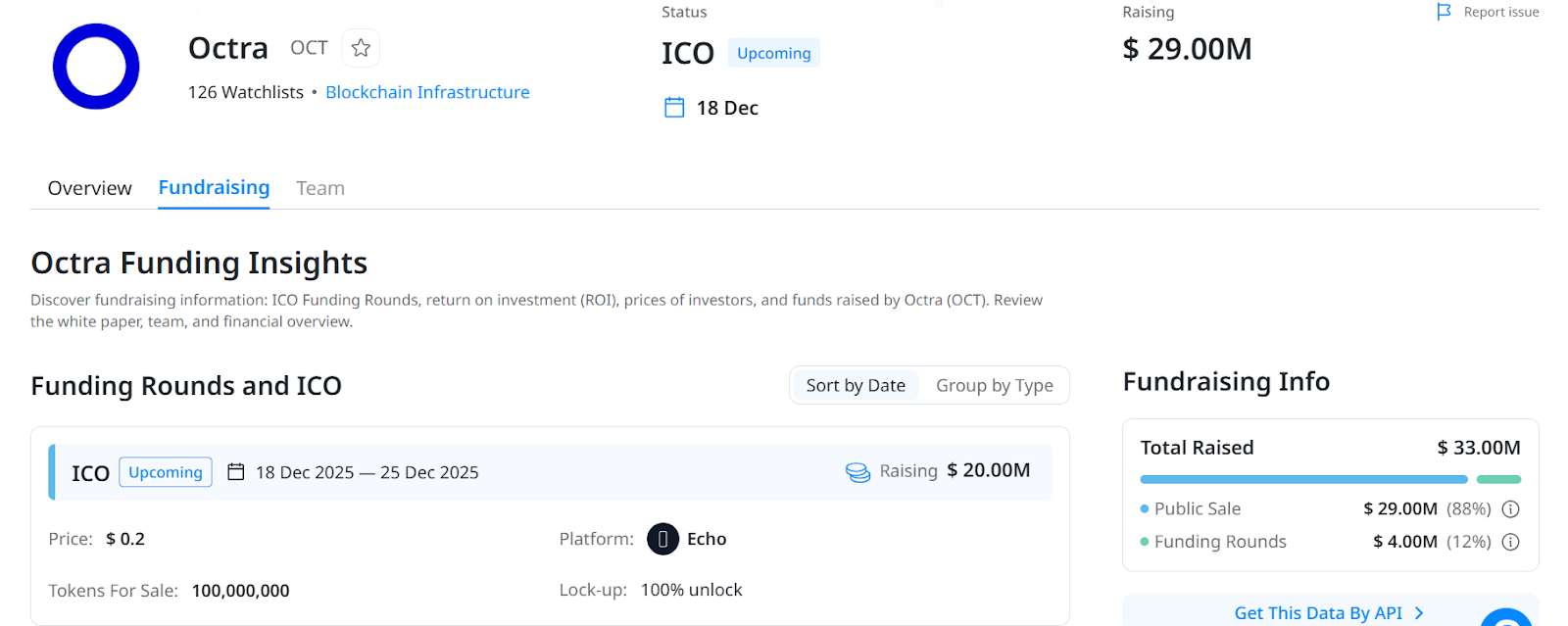
Octra has raised successfully total of $33M in the funding rounds, led by Finality Capital Partners.
Octra Roadmap & Team
Roadmap
Currently, Octra has not announced any official roadmap for the project. Whales Market will update immediately when the official Octra website announces.
Team
Currently, Octra has not announced any official team for the project. Whales Market will update immediately when the official Octra website announces.
Conclusion
Octra represents a forward-looking approach to blockchain design, combining Fully Homomorphic Encryption, isolated execution environments, and an innovative ML-based consensus mechanism. With technologies like HFHE and modular subnets, Octra offers strong privacy guarantees, scalable performance, and broad validator participation.
Disclaimer: This article is for informational purposes only, not investment advice, and Whales Market is not responsible for any of your investment decisions.
FAQs
1. What is the native token of Octra?
The native token of Octra is $OCT, used to facilitate coordination across the ecosystem.
2. What is the price of Octra ($OCT) today?
While Octra ($OCT) hasn't been listed yet, users can trade $OCT pre-market on Whales Market before the TGE. Here you can trade $OCT before the asset gets listed on leading CEXes like Binance, Bybit or OKX.
3.What is Octra ($OCT) pre-market price?
Currently, $OCT is trading on Whales Market. Whales Market is the leading pre-market DEX platform to trade pre-TGE tokens and allocations, with over $300 million in volume, no middlemen, trustless and on-chain.
4. How much has Octra ($OCT) raised?
Octra has raised successfully total of $33M in the funding rounds, led by Finality Capital Partners.
5. What is $OCT allocation?
Token allocation is distributed as follows: validator rewards account for 27%, early investors 18%, team 15%, ICO participants 10%, liquidity programs & ecosystem incentives 10%, potential ICO extension or burn 10%, echo participants 5% and faucet airdrop 5%.
6. How can I trade $OCT before official listing?
You can buy or sell pre-TGE $OCT on Whales Market by creating or filling orders with collateral-based settlement.