


As blockchain networks continue to grow, data size expands rapidly and hardware requirements become more demanding. Not everyone has the resources to run a full node and independently verify the entire network. In that context, light nodes emerge as a practical balance between verification capability and resource efficiency, offering a more accessible way to interact with blockchain.
What is a Light Node?
A light node is a type of node in a blockchain network that stores only block headers instead of the full transaction history. Light node can be known as a lightweight node, light client, or SPV node, short for Simple Payment Verification.
What is a block header? Simply put, each block on a blockchain contains a header section with summary information such as the hash of the previous block, timestamp, nonce, and Merkle root. A block header can be compared to a book cover. By looking at it, readers understand the core content without reading every page inside.
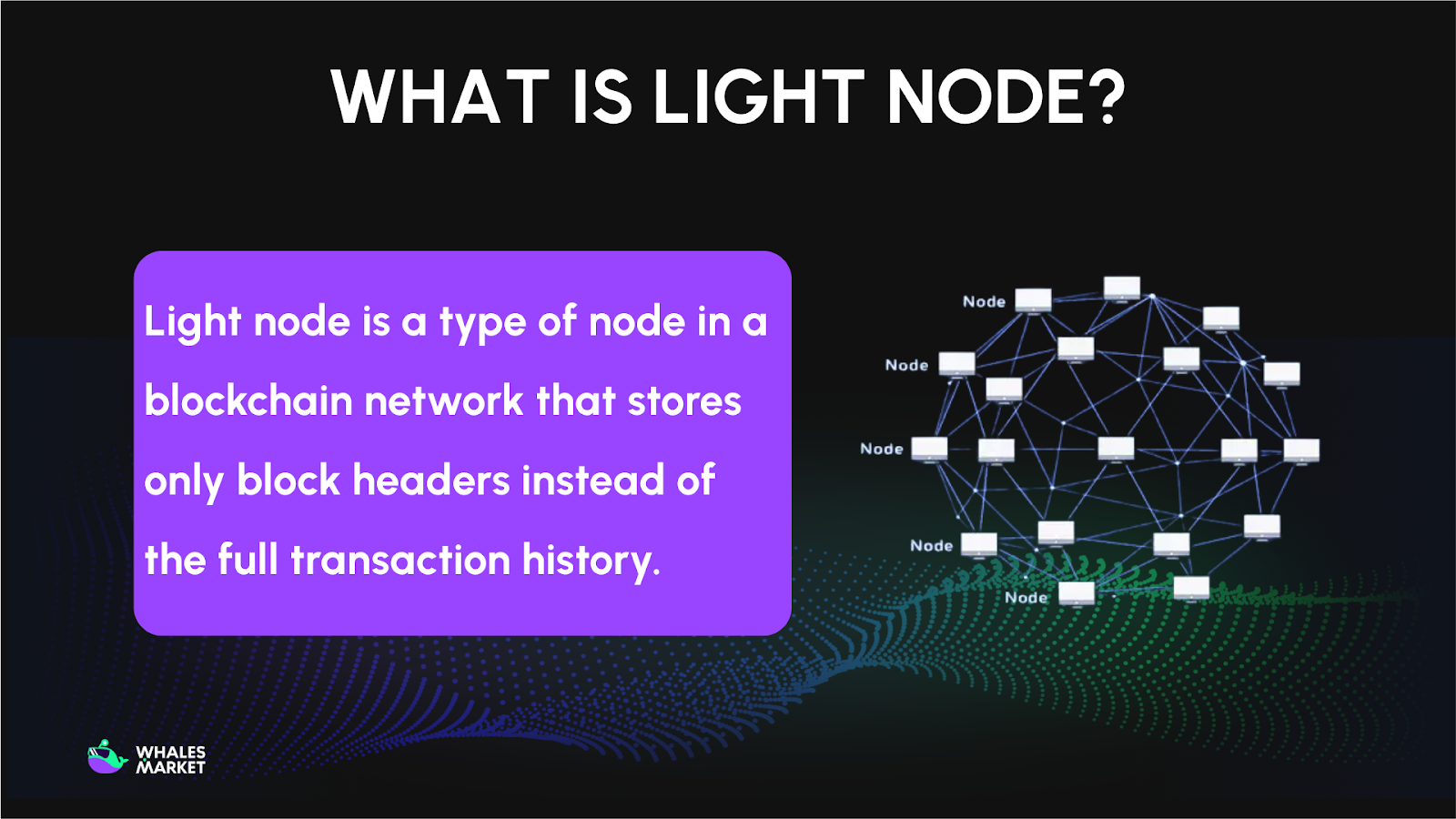
Because it stores only block headers, a light node consumes very few resources. Disk usage is minimal, RAM requirements are low, and bandwidth consumption is light. Users can run a light node on a personal laptop or even on a mobile phone without significant difficulty.
The concept of SPV nodes was introduced by Satoshi Nakamoto in the original Bitcoin whitepaper, specifically in section 8 titled Simplified Payment Verification. This shows that the idea of light nodes was not a later innovation, but part of blockchain’s foundation from the very beginning.
How a Light Node Works
A light node operates by requesting and receiving responses from full nodes. Instead of storing and processing all data independently, it retrieves only what is necessary at a given time. The basic process works as follows:
Step 1. Download block headers: When starting up, a light node downloads only the chain of block headers rather than the entire blockchain data. This process is significantly faster than syncing a full chain.
Step 2. Send a verification request: When a specific transaction needs to be verified, the light node sends a request to a full node to obtain relevant data such as transaction details, transaction receipts, and Merkle proof, a cryptographic proof derived from the Merkle tree structure.
Step 3. Verify using Merkle proof: This is the most critical step. The light node uses the Merkle root in the block header to verify whether the transaction is actually included in the block, without downloading the entire block data. Merkle proof allows verification of a leaf’s existence in a tree using only a limited number of intermediate hashes.
Step 4. Continuous synchronization: The light node continues to track new block headers to maintain the latest state of the network.
Full Node vs Light Node: What’s the Difference?
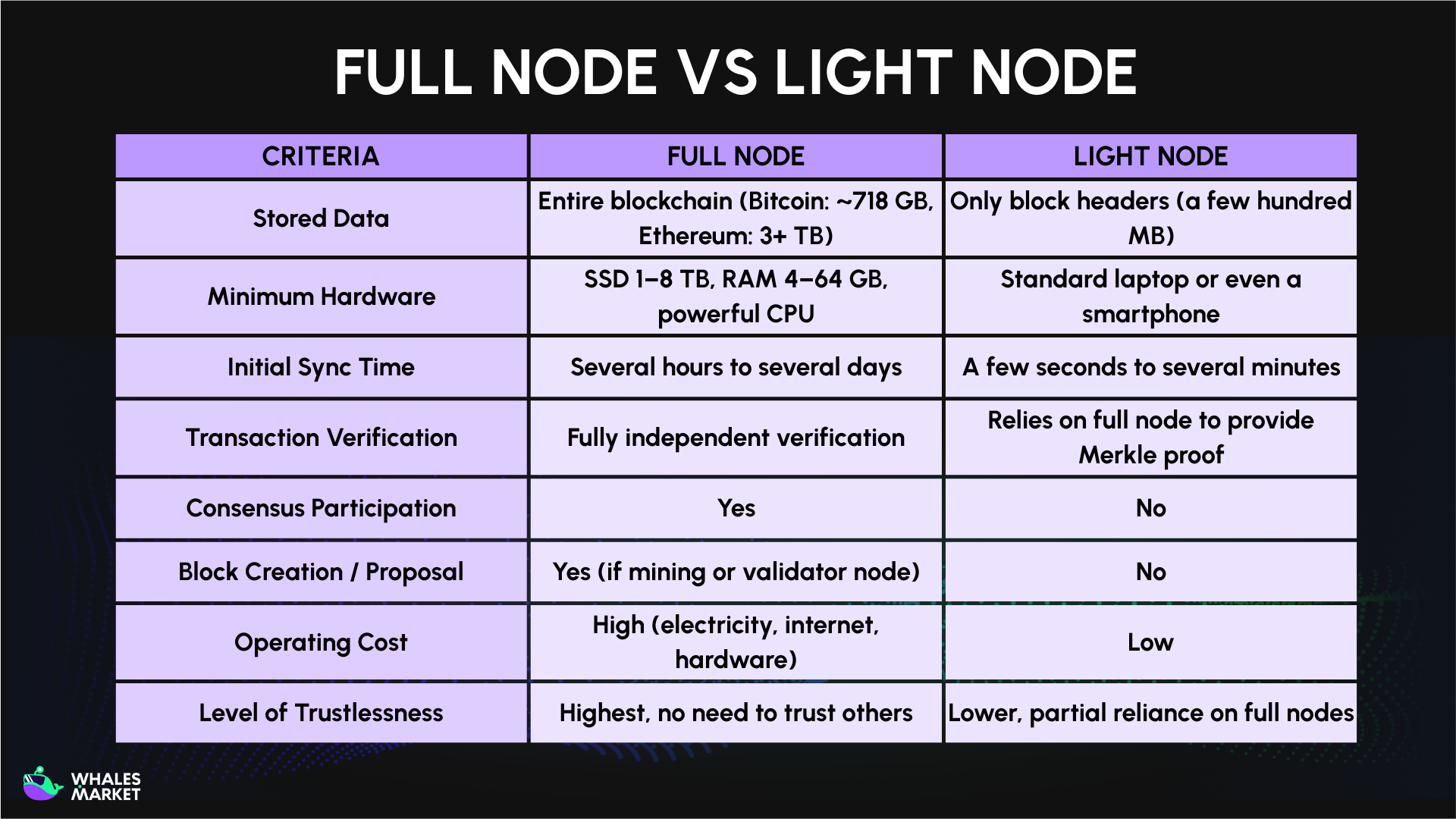
After understanding how light nodes operate and where they fit in the blockchain ecosystem, the next step is to clearly distinguish them from full nodes. While both contribute to network access and verification, their architecture, resource requirements, and level of independence differ significantly.
The comparison below highlights these differences in a structured and practical way.
Notable Light Clients
The light client ecosystem is developing rapidly, especially on Ethereum after the transition to Proof of Stake. The demand for lighter and more flexible blockchain access is driving many projects in this area. Below are several notable names:
- Helios (a16z): Helios is a light client that integrates both the execution layer and the consensus layer, written in Rust. It can complete synchronization in about 2 seconds, does not require long-term data storage, and is lightweight enough to run on mobile devices. The binary size is around 5.3 MB and can be compiled to WebAssembly for direct integration into wallets or dApps.
- Lodestar (ChainSafe): Lodestar is a consensus light client written in TypeScript and can run directly in a web browser. It leverages the sync committee introduced in the Altair hard fork to synchronize more efficiently with the network.
- Nimbus: Nimbus is a consensus client written in Nim and optimized for low-resource devices. Its goal is to bring Ethereum closer to mobile environments and compact hardware systems.
However, according to documentation from ethereum.org, no Ethereum light client is currently considered fully production ready. Future upgrades such as Verkle trees and statelessness are expected to improve light client security closer to full clients, opening a new phase for lightweight and decentralized blockchain experiences.
Benefits of Running a Light Node
- Easy setup, low cost: Hardware barriers are significantly reduced. There is no need to invest hundreds of dollars in specialized systems. A laptop with a few GB of RAM and a stable internet connection is sufficient. With Helios, light clients can even run directly on mobile devices, expanding access to more users.
- Extremely fast synchronization: Because only block headers are downloaded, the sync process happens almost instantly. Instead of waiting hours or even days when running a full node on Ethereum, a light node can sync within seconds. Helios, according to a16z Crypto, takes around 2 seconds to complete synchronization.
- Enhanced decentralization: When participation costs decrease, the number of nodes can increase. This leads to a more distributed and resilient network. Light nodes serve as an open gateway, allowing everyday users to participate and contribute to the blockchain ecosystem.
- Verify data instead of blind trust: Rather than fully relying on centralized RPC providers such as Infura or Alchemy, a light node allows basic on-chain data verification. While not as comprehensive as a full node, this approach still aligns with blockchain’s core principle of independent verification.
- Support for scalability: Without requiring the full blockchain to be downloaded, light nodes reduce storage and bandwidth pressure across the network. Some projects such as Sophon combine light nodes with Data Availability Sampling on Avail to enable everyday users to participate in securing the network without specialized hardware. This represents an important step toward long-term scalability.
Limitations of Light Nodes
- Dependence on full nodes: Despite their convenience, light nodes cannot operate entirely independently. At least one full node is required to query and receive data. If a full node provides incorrect information or if trustworthy full nodes are scarce, verification quality is affected. A 2025 study on ScienceDirect also indicated that lightweight clients rely almost entirely on full nodes for transaction verification.
- No participation in consensus: Since light nodes do not store the full blockchain, they cannot participate in consensus. They cannot vote, propose blocks, or act as validators. In other words, light nodes verify but do not directly maintain network order.
- Functional limitations: Light nodes are suitable for basic transaction verification. More complex tasks such as deep historical queries, advanced on-chain data analysis, or sophisticated smart contract execution still require full nodes or archive nodes.
- Lower security level: Although Merkle proof reduces risk, reliance on full nodes makes light nodes less trustless than full clients. In theoretical scenarios where malicious actors control the connected full nodes, data manipulation risks still exist.
- More complex data retrieval process: Each time data is needed, a light node must send a request, wait for a response, and then perform verification. This multi-step process can be slower compared to full nodes, where all data is already available locally.
Conclusion
A light node is not designed to replace a full node but to complement it within the overall blockchain structure. It preserves basic transaction verification while removing most storage and infrastructure burdens. As a result, network participation becomes more feasible for a broader range of users, from individuals to developers.
As blockchain data size continues to grow and hardware requirements increase, light nodes represent a balanced approach between resource efficiency and decentralization. While security and functionality limitations remain, this model shows that blockchain can expand accessibility without abandoning its core principles of verification and transparency.
FAQs
1. What does a Light Node mean? How does it differ from a Full Node?
A light node is a type of blockchain node that stores only block headers instead of the full transaction history. Unlike full nodes, which require significant hardware to process the entire chain, light nodes consume minimal disk space, RAM, and bandwidth, making them accessible for laptops or mobile phones.
2. How does a Light Node verify transactions without downloading the full blockchain?
Light nodes use cryptographic proofs called Merkle proofs in combination with the Merkle root found in the block header. This allows the node to confirm a specific transaction exists within a block without needing to store or process the entire block's data.
3. What are the main benefits of running a Light Node?
The primary benefits include easy setup on low-resource hardware, near-instant synchronization (often within seconds), and enhanced decentralization. Additionally, it allows users to verify on-chain data independently rather than relying entirely on centralized RPC providers.
4. Can I participate in network consensus by running a Light Node?
No, light nodes cannot participate in consensus because they do not store the full state of the blockchain. They are unable to vote on proposals, propose new blocks, or act as validators; their role is strictly for verification.
5. What are the limitations and security trade-offs of using a Light Node?
Light nodes depend on full nodes to provide data for verification, which creates a slight reliance on external sources. They are also limited in function, making them unsuitable for deep historical data queries or complex smart contract executions compared to full or archive nodes.