

As more people step into the blockchain world, Layer 1 networks such as Ethereum and Bitcoin gradually become overloaded. Transaction fees rise, speeds slow down, and congestion becomes unavoidable. To expand without sacrificing security, Layer 2 emerges as the natural next step. So what exactly is Layer 2? The breakdown below explains it clearly.
What Is Layer 2 (L2)?
Layer 2 is a scaling framework designed to increase throughput, reduce transaction fees, and improve user experience without compromising the base chain’s security.
A layer 2 acts as a blockchain built on top of a Layer 1 blockchain. It execute transactions separately and periodically submit proofs or bundled results back to Layer 1, allowing the system to scale while maintaining decentralization.
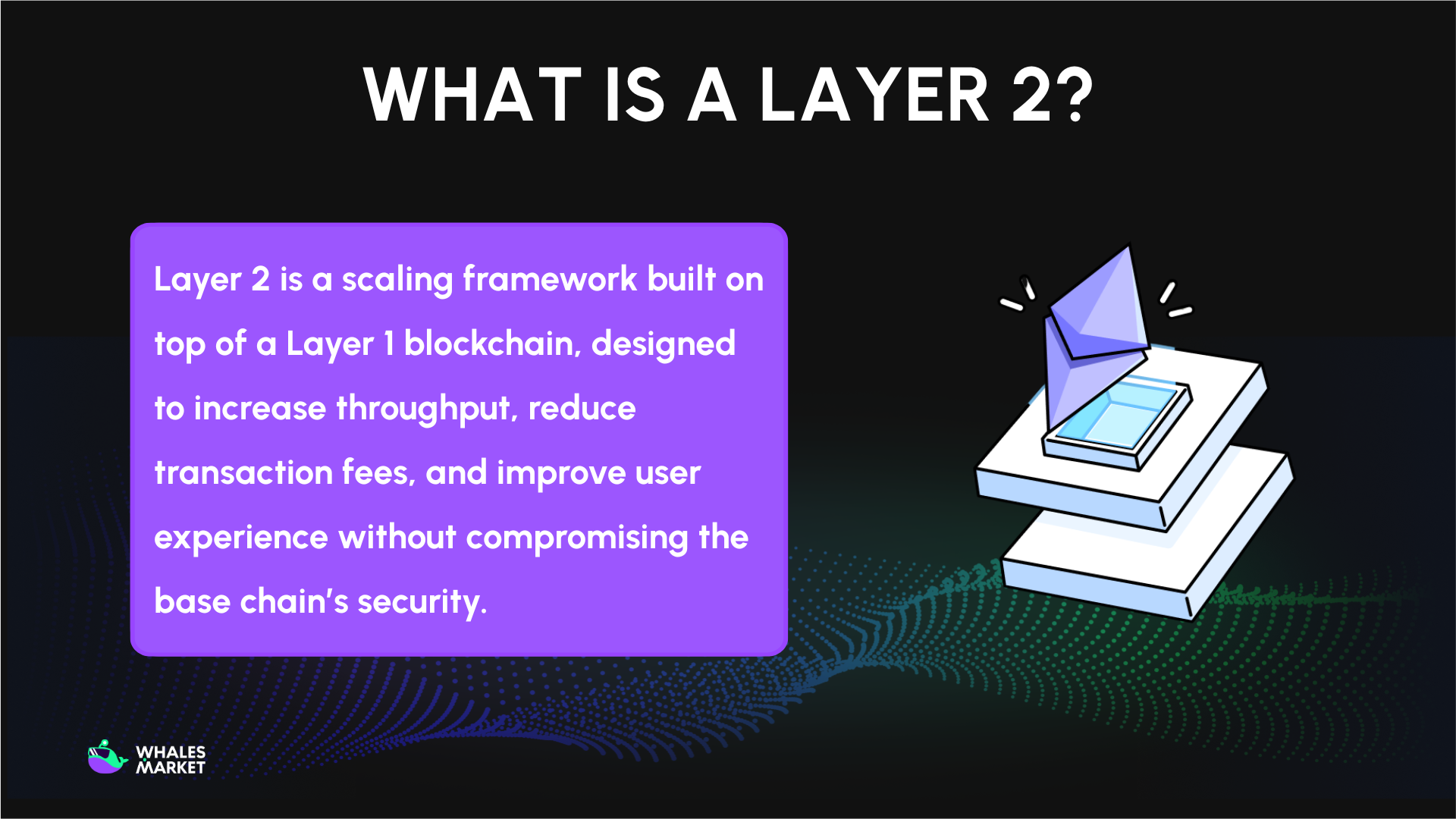
To put it simply, a blockchain can be imagined as a tall building with smaller blockchains inside:
- Layer 1 (L1) blockchain is the solid foundation that secures the entire structure, like Ethereum or Bitcoin. It is built for security and decentralization, but when too many users interact at once, this “foundation” becomes congested.
- Layer 2 blockchain works like additional “floors” constructed above the base. These layers process transactions quickly and cheaply off-chain, then send the finalized results back to L1. L2 does not replace L1; it reinforces it by absorbing workload and expanding usable capacity.
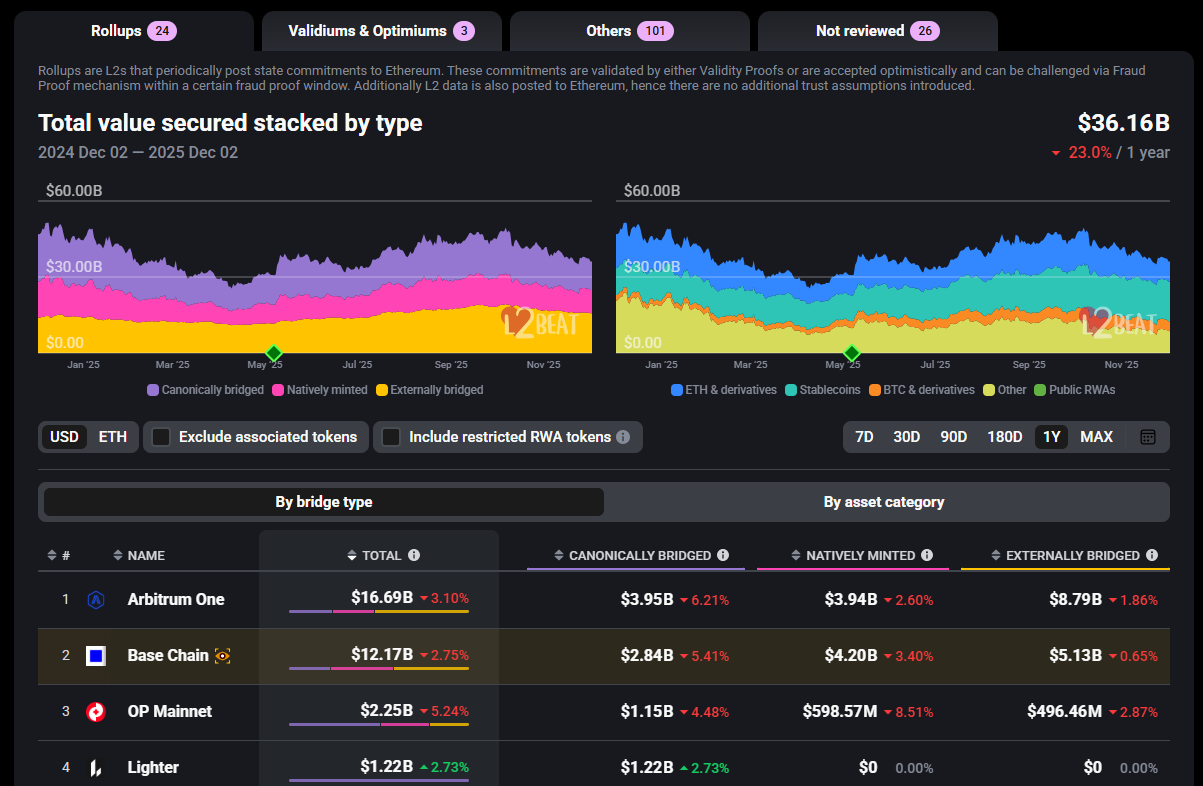
According to L2Beat (December 2025), total value locked across Ethereum Layer 2 networks has surpassed $36B, underscoring how essential L2 has become for scaling the crypto ecosystem.
Types of Layer 2 Network
Layer 2 is not a single kind of technology. Different designs exist, each with its own trade-offs in speed, security, and developer experience. Below are the main categories that appear most often in the ecosystem.
Rollups
Rollups are the most widely adopted Layer 2 model, accounting for more than 80% of Layer 2 TVL. They bundle many transactions into a single batch, execute them off-chain, and then post compressed data plus proofs back to Layer 1. This reduces costs while still inheriting Ethereum’s security.
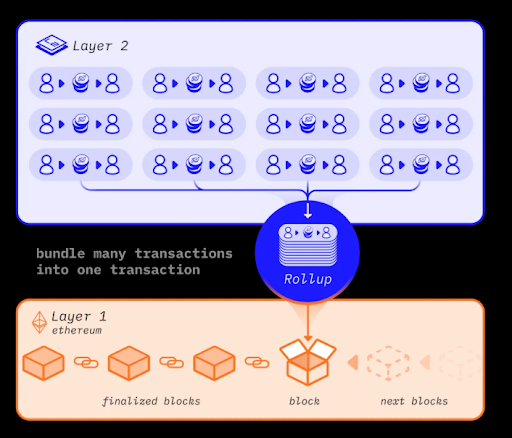
There are two types of Layer 2 rollup:
Optimistic Rollups
Optimistic Rollups assume that all transactions are valid by default and only run expensive checks if someone submits a fraud proof. This model follows a “trust first, verify if needed” approach.
Arbitrum, Base, and Optimism are well known examples. The main advantages are high compatibility with existing Ethereum tools and relatively simple development for teams building applications.
ZK Rollups
ZK Rollups (or Zero Knowledge Rollups) use advanced cryptography to generate validity proofs that show a batch of transactions is correct without revealing sensitive details, called zero-knowledge proof (ZKP). These proofs are verified on Layer 1, allowing instant finality without dispute windows.
Projects such as zkSync and Starknet follow this design. ZK Rollups offer strong security and high performance, although building and maintaining them is more complex and resource intensive.
State chains
State chains act like private lanes between a small group of participants. Most interactions happen off-chain, and only the opening and closing states are recorded on Layer 1. This makes them ideal for use cases with frequent, repeated transactions such as gaming sessions or recurring payments.
A well known example in the Bitcoin world is the Lightning Network.
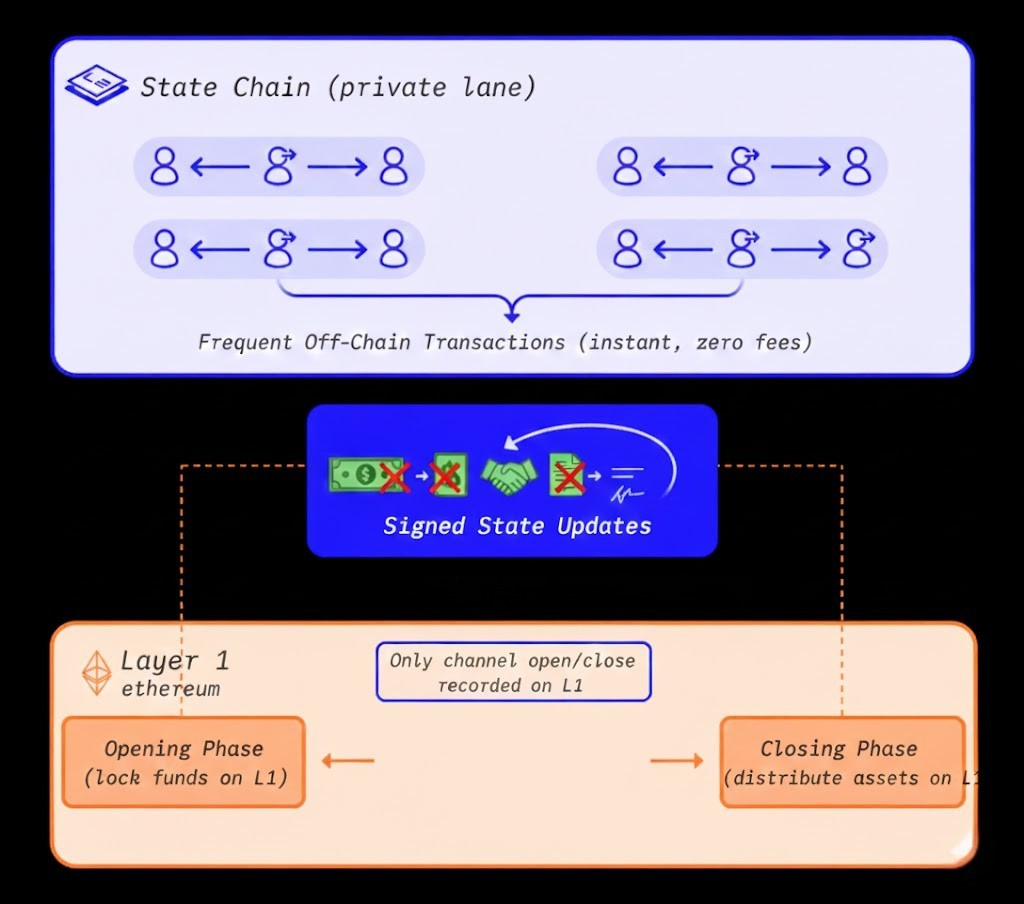
Three-Phase Workflow:
- Opening Phase: Participants lock funds into a multisig smart contract on the main chain. This "state deposit" can be ETH, ERC20 tokens, NFTs, or any blockchain-native asset. The deposit serves as collateral to guarantee honest behavior.
- Off-Chain Transaction Phase: Participants freely exchange signed state updates without touching the blockchain. Each new state cryptographically invalidates the previous one. Transactions happen instantly with zero fees since they never hit the main chain.
- Closing Phase: When finished, participants submit the final agreed-upon state to the smart contract. The contract validates signatures and distributes assets accordingly. If there's a dispute, a challenge period allows parties to submit proof of a more recent valid state.
State chains conduct all transactions fully off-chain between a fixed group of participants, only recording channel open/close on L1. They offer instant finality, near-zero fees, and strong privacy, but require participants to stay online (or use watchtowers) to watch for fraud and don’t support open, public interactions like Rollups do.
Plasma chains
Plasma creates child chains that handle transactions separately, periodically sending summaries back to Layer 1. This reduces load on the main chain but introduces additional complexity around exits and data availability.
Because of these challenges and security risks, Plasma is less common today, although some ideas from it continue to influence research and newer designs.
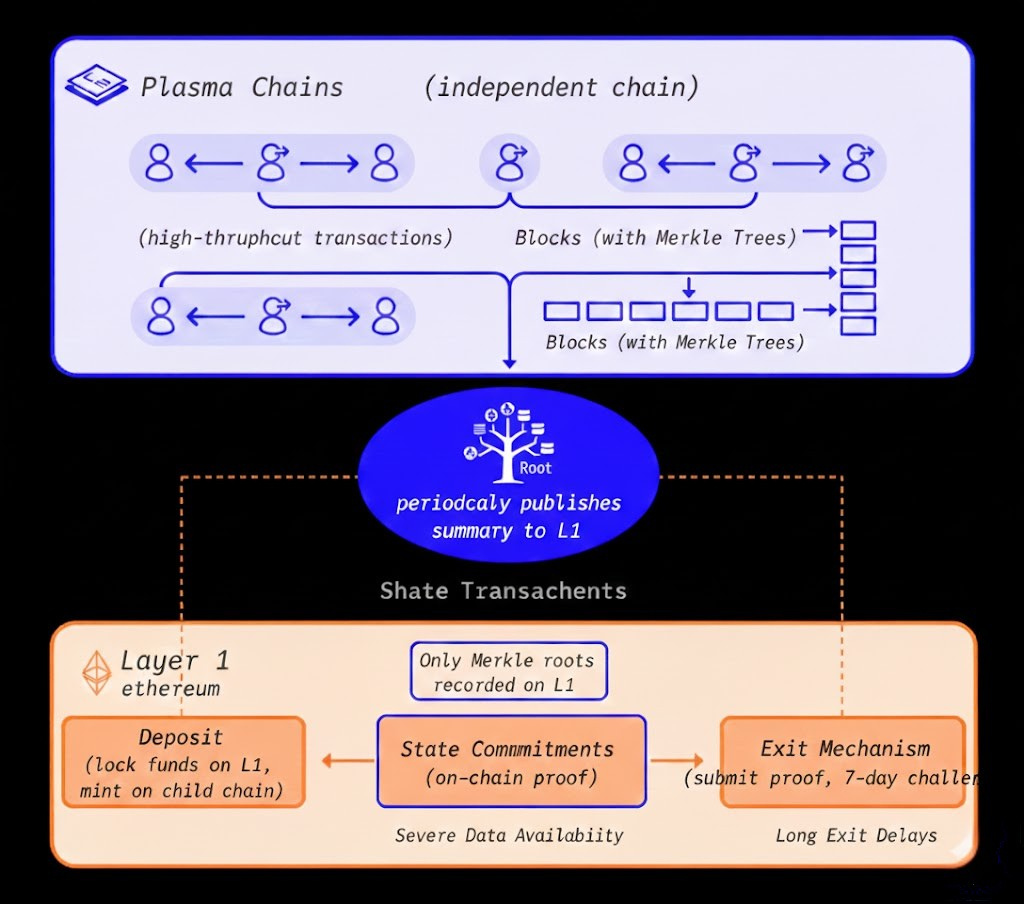
How Plasma works:
- Deposit: Users send assets to a smart contract on Ethereum (root chain). The contract locks these assets and creates corresponding representations on the Plasma child chain.
- Off-Chain Processing: Transactions execute on the Plasma chain with high throughput and low fees. An Operator collects transactions, creates blocks, and builds Merkle trees of all activity.
- State Commitments: The Operator periodically publishes Merkle roots to the root chain. This creates an on-chain proof of the child chain's state without posting all transaction data.
- Exit Mechanism: To withdraw assets, users submit an exit request with a Merkle proof demonstrating ownership. A challenge period (typically 7 days) allows others to dispute invalid exits using fraud proofs.
Plasma runs independent child chains that submit only Merkle roots/summaries to L1, enabling massive theoretical throughput and custom rules. However, it suffers from severe data availability problems, long exit delays, and mass-exit congestion risks.
Rollups solve these by posting full transaction data or zk-proofs directly on L1, providing stronger security and becoming the dominant Layer 2 approach.
Challenges of Layer 2 blockchains
Despite strong benefits, Layer 2 blockchains face several limitations that hinder their full potential in scaling blockchains like Ethereum.
Dependence on Layer 1
Layer 2 blockchains must submit data and proofs to Layer 1 for final settlement, meaning high L1 congestion or expensive gas fees, such as during peak times when Ethereum processes only ~30 transactions per second (TPS), still inflate transaction costs, extend withdrawal times, and reduce overall network responsiveness.
Over 98% of Layer 2 security is anchored to Layer 1 blockchains, tying their fate to Ethereum's infrastructure and capabilities.
Security risks during dispute windows
Optimistic Rollups rely on fraud proofs, introducing challenge periods (typically averaging 7 days for withdrawals) where undetected malicious behavior could occur if participants fail to actively monitor and dispute invalid transactions.
Sequencer centralization affects 45% of Layer 2 ecosystems according to CoinLaw. In December 2023, Arbitrum's single sequencer went offline for 78 minutes, halting the entire network. This demonstrates the critical vulnerability of single points of failure.
Liquidity fragmentation
The rapid growth of Layer 2 networks in 2024–2025 has spread liquidity across multiple ecosystems. This leads to several challenges:
- Increased reliance on bridges, which remain highly vulnerable
- DeFi becomes harder to operate efficiently due to the loss of unified liquidity pools
- Average liquidity depth across L2s has declined by 40%
Example: Ethereum pools are often oversubscribed. A pool with roughly $219k TVL may generate only ~3% returns, while some L2s like Optimism can offer ~22% returns. If liquidity continues shifting unevenly, the market could face growing inefficiencies and imbalances.
Conclusion
Layer 2 is not a temporary trend but the future of blockchain adoption. With lower costs, faster speeds, and security maintained from Layer 1, Layer 2 solutions open the door for mass-scale users.
The real question becomes: Which Layer 2 best fits each user’s needs? Optimistic Rollups offer stability and a mature ecosystem, while ZK Rollups deliver cutting-edge performance. Either way, Layer 2 is shaping how blockchain will be used in the years ahead.
FAQs
Q1. What is the current state of Layer 2 solutions?
Layer 2 solutions have matured into the primary execution environment for Ethereum, dominated by Optimistic and Zero-Knowledge rollups that significantly reduce gas fees and increase transaction throughput. The ecosystem currently features a thriving, albeit fragmented, landscape where major players like Arbitrum, Base, and Optimism command the majority of Total Value Locked (TVL).
Innovation is now shifting from pure scalability towards solving interoperability challenges and developing specific "Layer 3" chains for dedicated applications.
Q2. Does Layer 2 affect Ethereum’s decentralization?
Layer 2 maintains Ethereum’s decentralization because all critical data and final state commitments are anchored to Layer 1, ensuring shared security and preventing centralized control from appearing on L2.
Q3. Do beginners need deep technical knowledge to use Layer 2?
Most Layer 2 networks integrate seamlessly with popular wallets, allowing users to interact through simple interface switches without needing technical skills or blockchain development knowledge.
Q4. What does a rising Layer 2 TVL signal?
Higher TVL indicates growing user confidence, more assets migrating to faster networks, increased developer activity, and strong adoption momentum within the overall Ethereum ecosystem.
Q5. Is Layer 2 suitable for gaming and payments?
Layer 2 offers low fees, fast confirmation times, and stable performance, making it ideal for real-time gaming, micro-transactions, and applications requiring smooth, uninterrupted interaction.
Q6. Can Layer 2 replace Layer 1?
Layer 2 cannot replace Layer 1 because security, consensus, and settlement depend on Ethereum; L2 simply enhances scalability and reduces costs while inheriting L1 protections.
Q7. How can users evaluate whether a Layer 2 is safe?
Safety can be assessed by reviewing L2Beat data, examining rollup type, decentralization level, upgrade permissions, TVL strength, and the maturity of the project’s security audits.