

In crypto, a token launch is not only a product launch event. For many projects, it is also a way to raise funds, distribute tokens, and create liquidity so the token can start having a market price.
Among many terms, ICO and IDO are two of the most discussed models, alongside IEO and IFO. They may sound similar because both involve selling tokens early in a project’s lifecycle, but how they operate and the real risks for users and traders can be very different.
What is an ICO in Crypto?
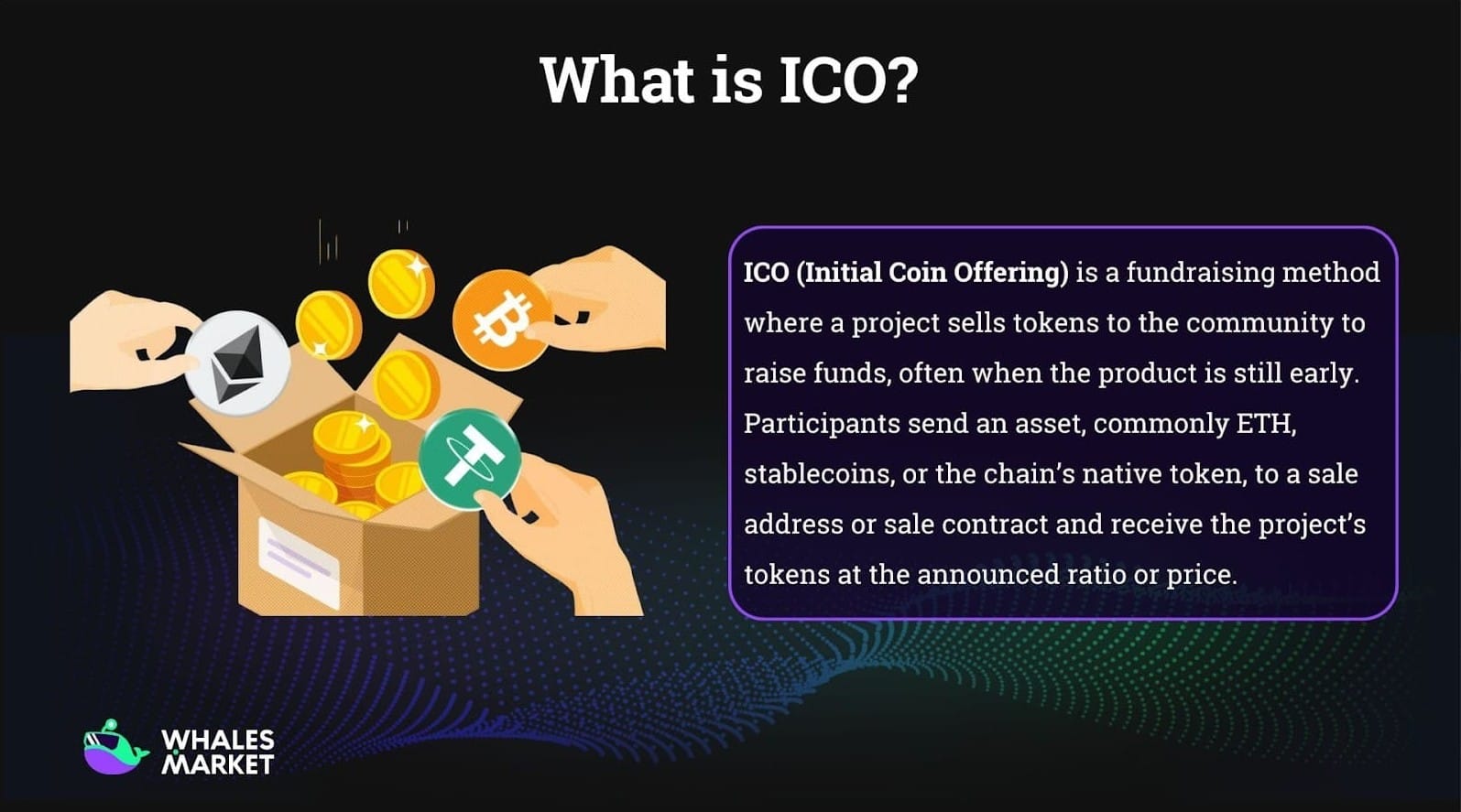
ICO (Initial Coin Offering) is a fundraising method in crypto, where a project sells tokens to the community to raise funds, often when the product is still early. Participants send an asset, commonly ETH, stablecoins, or the chain’s native token, to a sale address or sale contract and receive the project’s tokens at the announced ratio or price.
The core of ICO is the word “Offering”: the project sets the sale terms, while secondary trading usually comes later. Many ICOs used a fixed price model, round-based bonuses, or whitelists. After that, the token would be listed on exchanges for public trading.
A very common misunderstanding is that buying in a crypto ICO equals buying equity. In reality, most ICO tokens are not shared. Tokens are often described as:
- Utility token: Used to pay fees, access services, staking, governance
- Payment token: Used as a medium of exchange inside an ecosystem
- Asset-like token: Tied to certain financial rights, which is rarer and more legally sensitive
Because the token is not equity, investor protection can be much lower than in traditional stock markets. This is one reason ICOs became popular, but it was also a period when many participants got burned due to poor transparency, excessive marketing, or scams.
The history of Crypto ICO
The term ICO appeared around 2013, but it became widely recognized in 2014 with Ethereum’s ICO and then became more popular in the broader community after that.
In the early days, crypto ICO projects were mainly promoted on forum sites for communities who strongly believed in cryptocurrencies. Later, as blockchain platforms and crypto technology developed, online sales and ICO platforms were created, allowing ICO projects to attract meaningful investment from a global community.

From 2017, ICO became a widespread trend, gaining attention from investors and the public due to promising projects and high potential returns. Many blockchain startups conducted ICOs and raised large amounts of money, but many cases also failed, creating fear and uncertainty for investors.
From 2018, due to hidden risks and unclear legal issues, the number of ICO projects declined and investors became more cautious.
Some notable ICO projects include:
- Ethereum (ETH) in 2014: launched via the Ethereum Foundation’s ICO, initial price $0.31, ATH $4,946.05 (Aug 24, 2025).
- IOTA in 2015: launched via a self-organized ICO, initial price $0.000001, ATH $5.25 (Dec 19, 2017).
- NEO in 2016: launched via an ICO (initially Antshares), initial price $0.036, ATH $198.38 (Jan 15, 2018).
- Cardano (ADA) in 2017: launched via an ICO by IOHK, initial price $0.0024, ATH $3.09 (Sep 02, 2021).
What is an IDO in crypto?
IDO (Initial DEX Offering) is a model where a crypto project sells tokens through a decentralized exchange (DEX) or launchpad, and it often creates liquidity directly on the DEX so the token can trade soon after the sale.
Thanks to AMM (automated market maker) and liquidity pools, the token can start having a market price almost immediately after the IDO sale opens, or even while the sale is ongoing, depending on the mechanism.
In terms of experience, IDO often feels more transparent than ICO because everything can be tracked on-chain, such as pools, liquidity, volume, and buyer addresses. The downside is that on-chain markets also mean dealing with MEV (maximal extractable value), bots, front-running, and extreme volatility in the first minutes.
- MEV (Maximal Extractable Value): This refers to profit that can be extracted by reordering transactions within a block, or inserting transactions, to gain an advantage.
- Bot: An automated program that monitors the mempool or on-chain activity and submits transactions very quickly to capture opportunities such as arbitrage, liquidations, or MEV.
- Front-run: This is when a bot or actor sees a trader’s transaction and submits their own transaction first to benefit from the price movement caused by the trader’s transaction.
The history of Crypto IDO
Compared to other fundraising methods, IDO is relatively new. It appeared around 2020 and grew with the DeFi summer boom. With blockchain support, IDOs are considered transparent because users can check key information of a sale such as funds raised and the number of participants.
IDOs grew strongly because returns could reach hundreds or even thousands of times compared to the sale price, so many users rushed to hunt for crypto IDO projects. However, because of limited screening, some projects exploited users’ trust and committed fraud.
Some notable IDO projects include:
- Bloktopia (BLOK) in 2021: launched via an IDO on Seedify, initial price $0.00025, ATH $0.1783 (Oct 31, 2021).
- My Neighbor Alice (ALICE) in 2021: launched via an IDO on DAO Maker, initial price $0.125, ATH $40.93 (Mar 15, 2021).
- Wilder World (WILD) in 2021: launched via an IDO on Polkastarter, initial price $0.05, ATH $7.44 (Nov 27, 2021).
- BitOrbit (BITORB) in 2021: launched via an IDO on VelasPad, initial price $0.01, ATH $1.43 (Nov 05, 2021).

Different between Crypto ICO and IDO
The most important difference between IDO and ICO in crypto is the timing of liquidity and how price is formed.
If ICO is like selling the token first and then dealing with exchange listing later, IDO is like selling the token and building the path for market trading in the same package.
Risks of Crypto ICO and IDO
Whether it is ICO or IDO, many strong sell-offs often come from very basic factors:
- Token unlock.
- Allocation structure.
If the percentage of tokens unlocked at TGE is too large, or the unlock schedule is concentrated into a few short milestones (for example 30, 60, 90 days), the market can face heavy selling pressure. In that case, even when a project executes seriously, the token price can still decline because supply grows faster than demand.
A project can launch well, have a clear product story, and have a large community, but still show negative price action if tokenomics is not designed properly, such as a very low cost basis for private rounds, short vesting, or limited initial liquidity.
Therefore, for users and traders, tokenomics is not a filler section. It is a key factor that determines price behavior in the first months after the token enters the market.
In 2025, as ICO/IDO became the trend, investors could stopped waiting for official launches. A layer emerged, where tokens can be traded even before TGE, pre-market trading apps (such as Whales Market, the leading premarket crypto trading hub) act as a buffer zone between expectation and reality.
Traders, who understand money flow, could move ahead and capture profits before the market opens on pre-market.
Learn more: Pre-Market Opportunities in the ICO/IDO Wave
Conclusion
ICO and IDO are both ways for projects to bring tokens to market and raise funds, but each model has different operational risks. ICO often exposes users and traders to risks related to transparency and centralized control, while IDO often shifts risk toward smart contracts and market structure.
In addition, IDO and ICO are only two among many ways users can make money in the market. Instead of focusing only on how a project launches its token, the project’s internal quality is what users should prioritize before investing.
Disclaimer: This article is for informational purposes only, not investment advice, and Whales Market is not responsible for any of your investment decisions.
FAQs
Q1. What is the difference between ICO and IDO in crypto?
ICO means project-run token sale where the price is often set in advance and public trading may come later, while an IDO sells tokens via a DEX or launchpad and often enables faster on-chain price discovery.
Q2. What does IDO mean in crypto?
IDO stands for Initial DEX Offering. It is a token sale that happens through a decentralized exchange (DEX) or a launchpad, and it often adds liquidity on the DEX so the token can start trading quickly with on-chain price discovery.
Q3. What does ICO mean in crypto?
ICO stands for Initial Coin Offering. It is a project-run token sale where the team sells tokens directly to participants, usually at a price or ratio announced in advance, and secondary market trading often happens later after listings and liquidity are in place.
Q4. How do ICOs and IDOs work step by step?
In an ICO, participants usually send ETH, stablecoins, or the chain’s native token to a sale address or sale contract, and they receive the project token based on the announced price or ratio. In an IDO, participants join through a DEX or launchpad, and the token often becomes tradable shortly after the sale because liquidity is added on the DEX and trading opens with market-based pricing.
Q5. Is an ICO the same as buying equity or shares?
An ICO is usually not the same as buying equity because most ICO tokens are not shares and are often positioned as utility tokens, payment tokens, or asset-like tokens.