

What is Funding Rate?
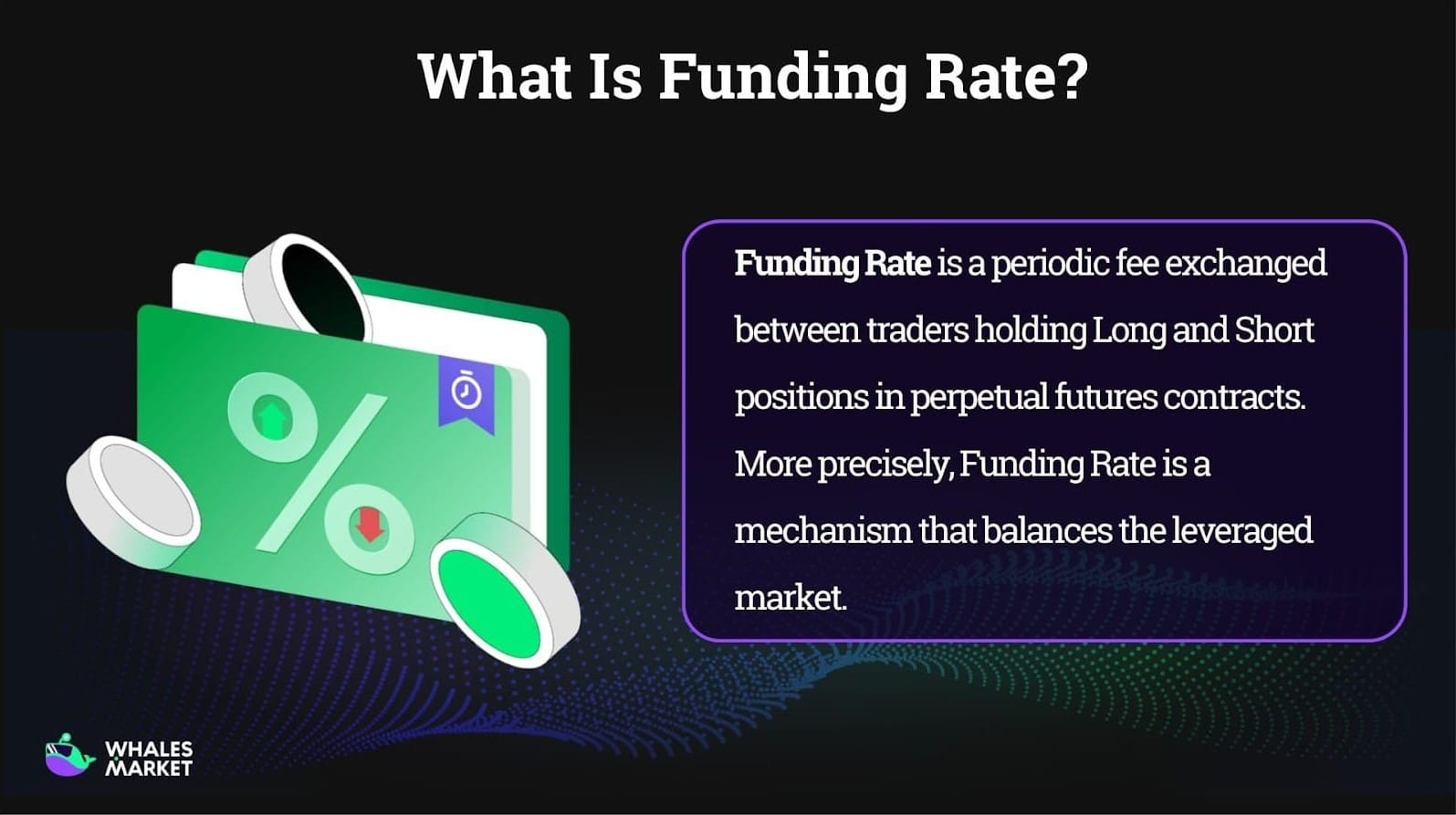
Funding rate is a periodic fee exchanged between traders holding Long and Short positions in perpetual futures contracts. More precisely, funding rate can be known as a mechanism that balances the leveraged market.
Unlike traditional futures contracts with an expiration date, perpetual futures have no expiration. Traders can hold positions indefinitely. This creates an important issue: there is no natural mechanism forcing the futures price to converge with the spot price.
Funding rate is designed to solve this issue. The mechanism works as follows:
- If funding rate is positive, Long positions pay fees to Short positions.
- If funding rate is negative, Short positions pay fees to Long positions.
This fee is not paid to the exchange. The exchange only calculates and distributes it. Funding is a direct transfer of value between traders and exists to prevent futures prices from deviating too far from spot.
Why is Funding Rate necessary?
In traditional futures markets such as commodities or equities, contract prices automatically converge to the spot price at expiration. If futures trade above spot, traders can sell futures and buy spot to capture arbitrage, gradually eliminating the gap.
Perpetual futures do not have expiration. Without an adjustment mechanism, contract prices may:
- Trade above spot for an extended period during strong uptrends.
- Trade below spot for prolonged periods during deep downtrends.
This distorts pricing and increases systemic risk. Funding rate acts as a holding cost. When one side becomes overcrowded and pushes futures away from spot, that side must pay funding. The higher the cost, the weaker the incentive to maintain the position, helping the market return to balance.
In other words, funding rate is a self-adjusting supply and demand mechanism between Long and Short positions in derivatives markets.
How to Calculate Funding Fee
Funding fees are calculated using a simple formula:
Funding fee = Position value × Funding Rate
The important point is that funding is calculated on the total position value, not the initial margin.
Example:
- You have $20 and use 25x leverage to open a Short position.
- The total position value is 20 × 25 = $500.
- If funding rate is -0.005%, this means Short positions must pay Long positions.
- The funding fee you must pay is: 500 × 0.005% = $0.025 per funding interval.
This amount is small when viewed individually. However, funding is typically charged three times per day. If you hold a position for multiple days and the position size is large, the cost will accumulate significantly.
At what level does Funding become Dangerous?
There is no fixed number that applies to every situation. Funding becomes dangerous when combined with holding time and leverage.
In practice, a level around ±0.01% every 8 hours is already worth attention. This equals approximately 0.03% per day. Individually, it appears small, but over time its impact becomes meaningful.
Example:
- You hold a $50,000 position with positive funding of 0.01% every 8 hours.
- Fee per interval: 50,000 × 0.01% = $5
- Three intervals per day equal $15.
- Holding for 30 days results in approximately $450 in funding fees.
If the market moves sideways, this cost can erase a significant portion of profits.
Funding fees eating your profits? Let’s put that into perspective👇
— Jetstream trading platform (@Jetstreamtrade) October 23, 2024
Picture this: you open a long position on SOL/USDC with a $50,000 margin and 10x leverage. On a major CEX, you’d lose $3,430 in funding fees after just one month. On CVEX? You lose nothing. That’s nearly 7% of… pic.twitter.com/7AMYThtPtt
Important notes when calculating Funding Fee
Funding rarely causes immediate losses. It does not resemble a sudden liquidation or a sharp price drop. Its impact is gradual and erodes profits over time.
If you focus only on price-based PnL and ignore funding, you may not notice profits decreasing after each funding cycle. This is especially evident during sideways markets, when volatility is small but funding is still charged three times per day.
Example: A whale on Hyperliquid once held a Long position for one month and paid up to $1M in funding fees.
As the market fell further, this whale who was long $BTC on #Hyperliquid has lost ~$7M!
— Lookonchain (@lookonchain) January 13, 2025
He's been holding on for one month and has incurred more than $1M funding fees.https://t.co/7LK4HQxxb3 pic.twitter.com/qhe4zUZ0ja
Funding is not constant. If the market recovers strongly and funding turns positive at high levels for several consecutive days, costs will accumulate for Long holders. With highly leveraged positions, funding can quickly become a significant drag on performance.
Therefore, before holding a position long term, you should evaluate three key factors.
- First, how current funding compares with recent averages.
- Second, how long the current funding condition has persisted and whether it is likely to continue.
- Third, the actual size of your position, since funding applies to total exposure rather than margin.
Understanding how funding is calculated and how it accumulates over time helps prevent silent profit erosion when trading with leverage. In derivatives markets, small recurring costs often have a larger impact than traders initially expect.
How Funding Rate differs between CEX & DEX
The growth of DeFi in recent years means perpetual futures are no longer limited to centralized exchanges. In addition to CEX platforms, decentralized platforms such as Lighter, edgeX, Aster and Hyperliquid also offer perpetual contracts with their own funding mechanisms. Although both are called funding rate, their operation differs significantly.
On centralized exchanges, funding is usually calculated on a fixed cycle, most commonly every 8 hours. The mechanism is relatively straightforward:
- If Long dominance pushes futures above spot, Longs pay Shorts, and vice versa.
- Funding on CEX primarily reflects the imbalance between Long and Short positions. Thanks to deep liquidity and large trading volume, funding on CEX reacts quickly to market sentiment.
- During strong FOMO, funding can increase rapidly; during panic, funding can turn deeply negative within a short time.
Key characteristics of funding on CEX:
- Fixed calculation cycle, typically every 8 hours.
- Direct reflection of Long versus Short positioning.
- High volatility during extreme market conditions.
On DEX platforms, funding structure is more complex because it is tied to liquidity pools. Instead of being purely a transfer between Long and Short traders, funding on many DEX platforms also involves borrowing costs from liquidity pools. This means funding reflects not only position imbalance but also capital utilization within the system.
Key characteristics of funding on DEX:
- More flexible calculation, sometimes hourly or near real time
- Integration of borrow fees from liquidity pools
- Dependence on oracle pricing and pool structure
Because of these structural differences, funding between CEX and DEX can diverge significantly at times. Funding on CEX mainly reflects market sentiment, while funding on DEX also reflects liquidity structure and internal capital costs.
Understanding these differences helps traders better interpret sentiment and identify opportunities when funding spreads appear between different trading environments.
Opportunities to Profit from Funding Rate
Funding Rate is not merely a cost to avoid. When properly understood, it can become a tool to optimize trading strategies. Broadly speaking, funding can be used in three main ways: managing holding costs, structural arbitrage, and assessing market risk.
Managing Holding Costs
The most basic but important use of funding is controlling costs when holding positions for extended periods.
If you hold a position for only a few hours, funding impact is minimal. However, if you hold a position for multiple days or weeks, funding can materially affect trading performance.
Specifically:
- Holding Long when funding is highly positive means you continuously pay fees, and profits may erode even if price does not move significantly against you
- Holding Short when funding is deeply negative leads to similar cumulative costs over time
Therefore, checking current funding levels and recent funding trends should become a mandatory habit before committing to longer-term positions.
Funding Arbitrage Cash and Carry
A more advanced strategy is using funding as an independent profit source separate from price direction. The essence of funding arbitrage is neutralizing price risk and capturing periodic funding payments.
In February 2026, BTC funding was around -0.006%. This means Shorts were paying Longs.
A trader can:
- Open Long futures to collect funding.
- At the same time Short spot or futures on another market to hedge price exposure.
In this setup, profit mainly comes from funding rather than directional prediction. However, this strategy is not risk free. Important factors include:
- Funding may change quickly if market structure shifts.
- Strong volatility can cause liquidation if leverage is high.
- Trading fees and capital costs may reduce actual profit.
Funding arbitrage is most effective when markets are relatively stable and funding imbalance persists long enough.
Long demand in the system is getting frothy.
— Willy Woo (@willywoo) January 4, 2024
The basis trade*** on BTC perpetuals is earning 75% right now, a level unseen since the 2021 bull market.
*** buying spot BTC while shorting perpetual futures in a hedged trade to collect the funding rate paid by bullish speculators pic.twitter.com/upNkrU6iSu
Funding as a Risk Signal
Beyond cost and profit opportunities, funding is also a structural market signal.
- Extremely high positive funding often appears during strong FOMO phases when Long dominance is excessive.
- Deep negative funding often appears during panic phases or when Shorts become overcrowded.
Funding does not precisely predict tops or bottoms. However, when funding remains extreme for multiple consecutive cycles, it indicates strong market imbalance. In such conditions, liquidation cascades or squeeze events become significantly more likely.
Understanding funding in this way helps assess systemic risk rather than focusing only on short-term price movement.
Example: 9/2020, BTC increased from around $10K to $11-12K, with the funding rate turning extremely positive. Shortly after that, the price dumped 20-25%, dropping from $12K to around $9K.
A great example of this was September 2020. We moved up initially to 11-12K, funding went insane, then had a 20-25% correction because the liquidity was there.
— Will (@WClemente) December 5, 2021
Then created a period of mixed funding/disbelief which allowed us to move higher in Q4. Want to see something similar.
Tools to Track Funding Rate
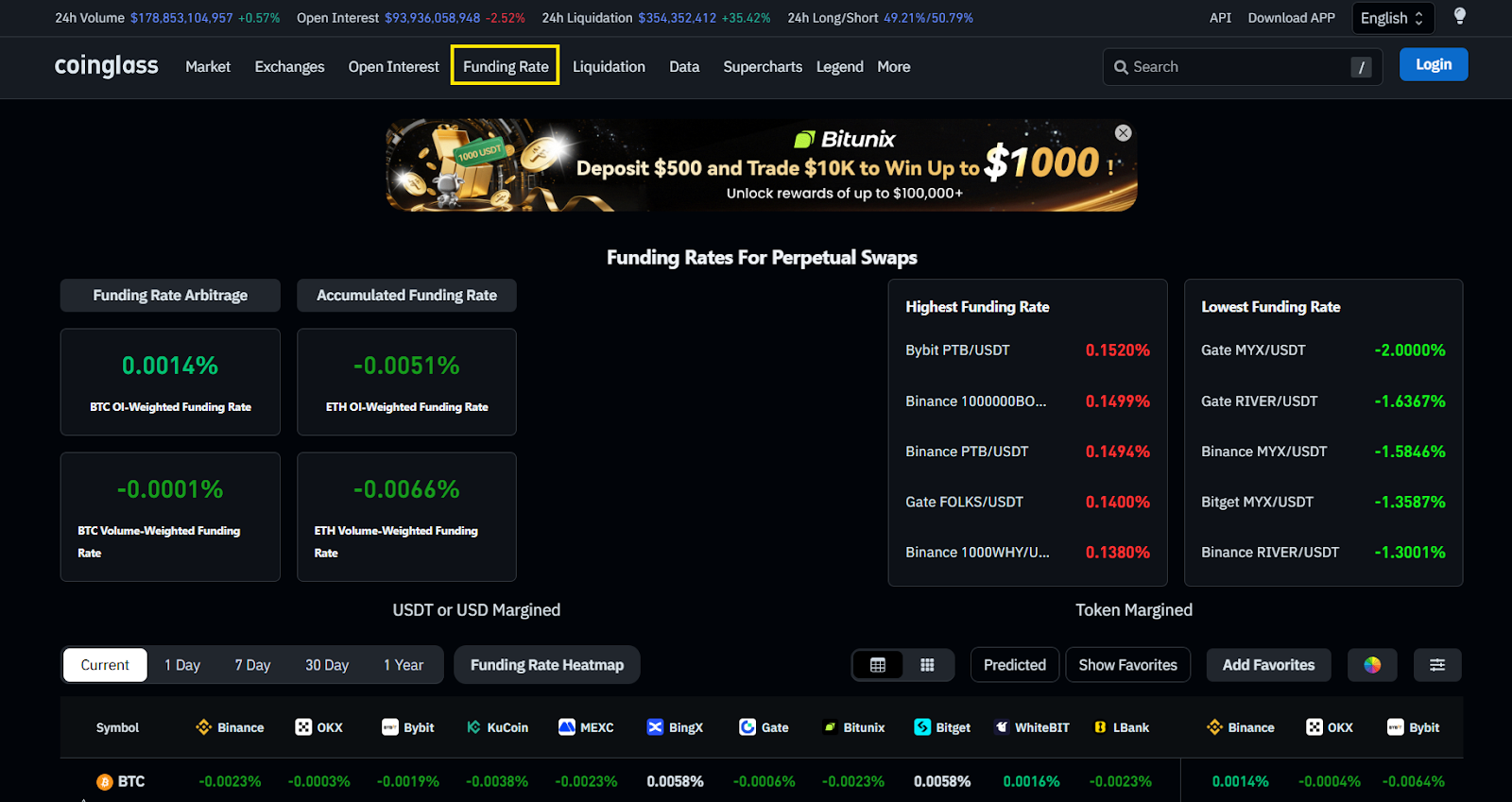
To use funding effectively, tracking aggregated data is necessary. Observing funding on a single exchange may not reflect the full market picture.
Common data sources include:
- Aggregated funding platforms such as Coinglass
- Open Interest data to evaluate leverage levels
- Historical funding data for comparison with recent averages
When analyzing funding, it should be placed in broader context rather than viewed in isolation. Three important questions to consider are:
- Is current funding high or low compared to historical averages
- Is funding accompanied by rising or falling Open Interest
- How long has the current funding condition persisted
Funding alone can be misleading. Funding combined with Open Interest and trading volume more accurately reflects leverage structure and market sentiment
Conclusion
Funding rate is a core mechanism that allows perpetual futures to function efficiently. More importantly, it is a structural indicator of leveraged market conditions.
Understanding funding rate will not help you precisely predict price direction. However, it helps you understand how stretched the market is, and in leveraged markets, that insight is often more important than attempting to forecast short-term price movements.
FAQ
Q1. Does funding rate affect liquidation price?
Funding rate does not directly change your liquidation price. However, if funding is consistently negative or positive against your position, the accumulated fees reduce your margin over time, which can indirectly bring your position closer to liquidation.
Q2. Can funding rate stay positive or negative for a long time?
Yes. During strong bullish or bearish trends, funding rate can remain positive or negative for multiple consecutive cycles. This usually reflects sustained imbalance between Long and Short positions.
Q3. Is funding rate the same across all exchanges?
No. Funding rate varies across exchanges because it depends on each platform’s order flow, liquidity, and open interest structure. Differences can create temporary spreads between platforms.
Q4. How does funding rate impact long term traders?
For long term traders using leverage, funding rate can significantly affect overall returns. Even small percentages, when charged repeatedly, can accumulate into meaningful costs over weeks or months.
Q5. Can funding rate be used as a contrarian indicator?
Some traders use extreme funding rate levels as a contrarian signal. When funding becomes excessively positive or negative for an extended period, it may indicate crowded positioning and increased risk of reversals or squeezes.