

AI agents can now execute trades, hire other agents, and manage on-chain portfolios autonomously. The missing piece was a shared standard for trust. ERC-8004, officially titled "Trustless Agents", is Ethereum's answer to that gap. It went live on mainnet on January 29, 2026.
What is ERC-8004?
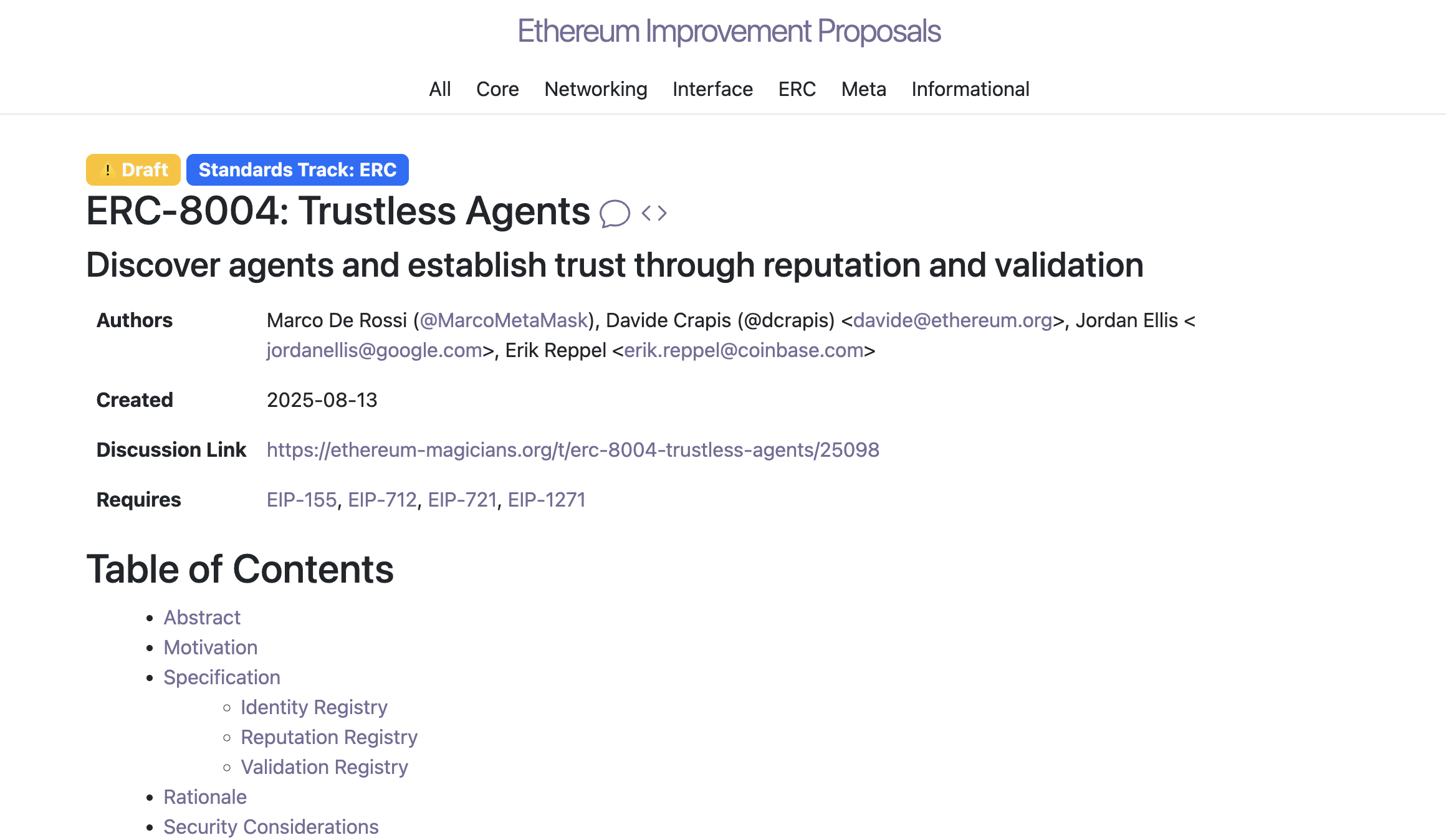
ERC-8004 is an Ethereum standard that gives AI agents a verifiable on-chain identity, a reputation system, and a mechanism for independent task validation. The full name of the proposal is EIP-8004: Trustless Agents.
The standard was authored by Marco De Rossi (MetaMask), Davide Crapis (Ethereum Foundation), Jordan Ellis (Google), and Erik Reppel (Coinbase).
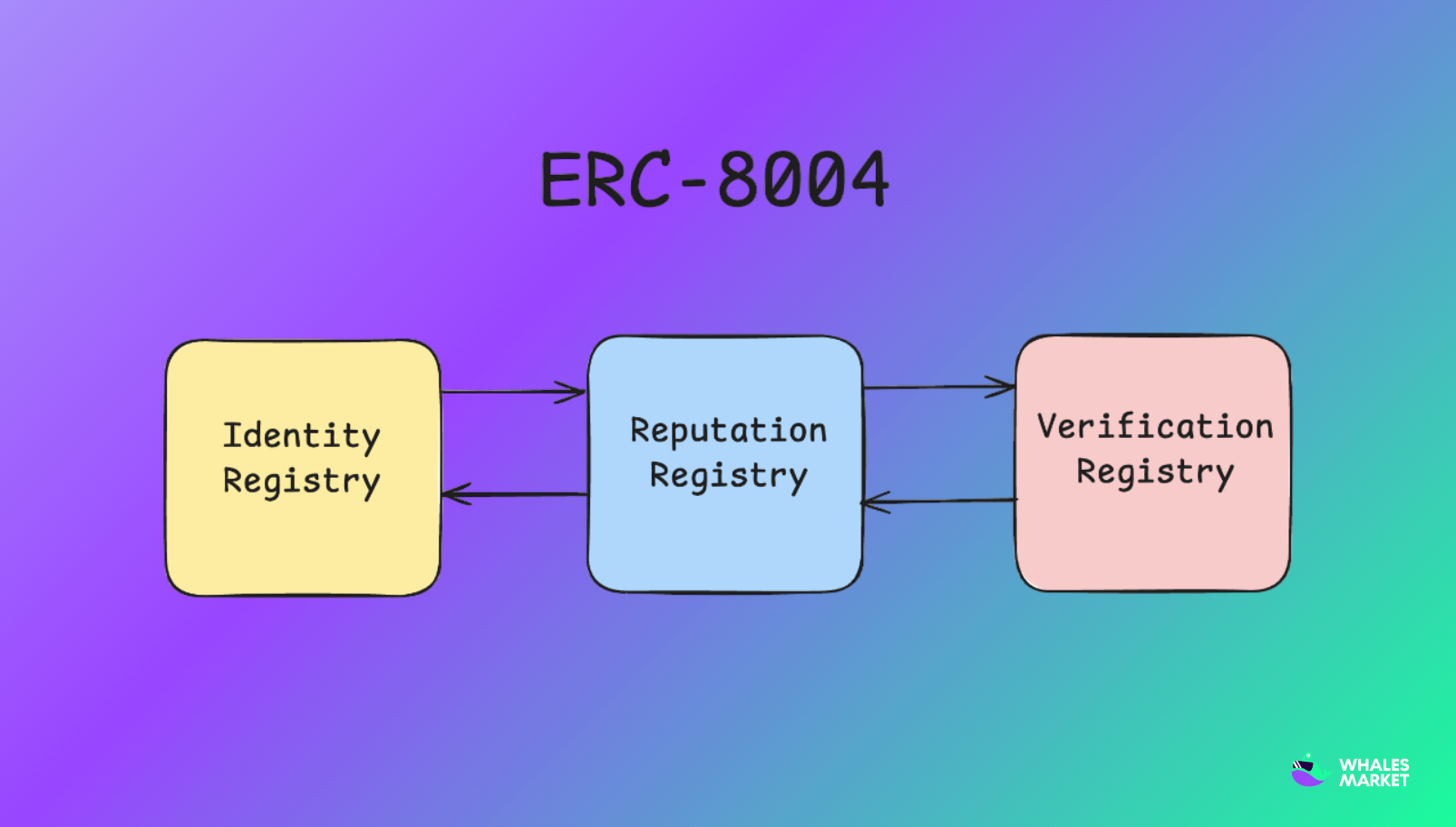
One thing to remember is that ERC-8004 is not a new token. It is a set of three lightweight on-chain registries that allow agents to identify themselves, build a track record, and have their work independently verified. The protocol deliberately leaves payments out of scope, so developers can combine it with any payment layer they prefer.
Why do we need ERC-8004?
Before ERC-8004, there was no unified standard for trust between autonomous AI agents on Ethereum. Each system relied on isolated logic, private APIs, or custom smart contracts to handle identity and verification. That approach does not scale when agents from different organizations need to work together.
Take a concrete example, an AI agent managing a DeFi portfolio wants to hire a specialist agent for market analysis. Without a shared trust framework, the hiring agent has no way to verify who the specialist is, whether it has a track record of completing jobs reliably, or whether its outputs can be trusted. Every interaction requires pre-established business relationships or centralized intermediaries to fill that gap.
Google's Agent-to-Agent (A2A) protocol solves the communication layer, defining how agents talk to each other. MCP (Model Context Protocol) solves the tool access layer. Neither solves discovery and trust in open, untrusted environments.
ERC-8004 is specifically designed for that remaining gap.
How ERC-8004 Works: The Three Registries
ERC-8004 introduces three on-chain registries. Together they form the complete trust stack for any AI agent operating on Ethereum or any EVM-compatible chain.
Identity Registry
The Identity Registry gives each agent a portable, censorship-resistant on-chain identifier.
Technically, it is implemented as an ERC-721 NFT with URI storage. Each agent receives a unique token that points to an off-chain JSON file called an Agent Card.
The Agent Card contains the agent's name, description, capabilities, service endpoints (such as A2A, MCP, or web), and payment addresses. Because the identity is anchored on-chain but the metadata lives off-chain, the design stays lean. Ownership of the ERC-721 token equals ownership of the agent, and that ownership can be transferred.
Reputation Registry
The Reputation Registry records feedback signals against an agent's identity. Authorized users and other agents can post structured feedback. This includes numerical scores and categorical tags covering attributes like response time, uptime, task completion rate.
ERC-8004 treats reputation as a signal layer rather than a single universal score. The registry standardizes how feedback is posted and retrieved, but scoring and aggregation can happen both on-chain for composability, as well as off-chain for more complex algorithms.
A DeFi marketplace might optimize for execution speed, while an insurance protocol might weight dispute history more heavily. Both read the same underlying data and derive different rankings.
Validation Registry
The Validation Registry provides generic hooks for requesting and recording independent verification of completed tasks. Validators can include stakers who re-run a job, zero-knowledge machine learning verifiers, trusted execution environment oracles, or trusted human judges.
This layer closes a critical loop:
- An agent can claim it completed a task.
- The Reputation Registry records the feedback.
- And the Validation Registry provides cryptographic or independent confirmation that the work actually happened as described.
That combination makes the trust stack auditable end to end.
Relationship between ERC-8004 and the x402 Payment Protocol
ERC-8004 deliberately leaves payments out of scope, but it is designed to work alongside Coinbase and Cloudflare's x402 payment protocol. The x402 standard revives the HTTP status code 402 Payment Required to enable instant stablecoin micropayments directly over HTTP between agents.
When combined, ERC-8004 handles who an agent is and whether it can be trusted, while x402 handles how agents pay each other. Feedback from completed x402 transactions can feed directly into the Reputation Registry. This creates a feedback loop where real payment history strengthens an agent's on-chain trust score.
Who is behind ERC-8004?
The four co-authors represent a cross-section of the Ethereum ecosystem.
- Marco De Rossi leads from MetaMask, bringing wallet infrastructure expertise.
- Davide Crapis is the AI lead at the Ethereum Foundation and heads the dAI team that has incorporated ERC-8004 into the 2026 strategic roadmap.
- Jordan Ellis represents Google, reflecting the standard's alignment with the Agent-to-Agent protocol.
- Erik Reppel from Coinbase connects ERC-8004 to the x402 payment layer.
The initial draft was created on August 13, 2025, opened for public discussion on Ethereum Magicians on August 14, and formally launched on August 21. By October 2025, the Ethereum Foundation's newly established decentralized AI team, referred to as dAI, had formally endorsed ERC-8004 as a key component of its 2026 roadmap.
Beyond the core authors, ERC-8004 has been refined with input from over 100 contributors including teams from ENS, EigenLayer, The Graph, and Taiko. Between one and two thousand builders joined development groups after the specification was published.
Taiko, an Ethereum Layer 2, has formally endorsed ERC-8004 as core infrastructure for the next generation agent economy.
ERC-8004 vs Other Ethereum Standards
ERC-8004 is part of a long lineage of Ethereum standards, each expanding what the network can represent and coordinate.
ERC-8004 uses ERC-721 internally for the Identity Registry, so it builds on existing infrastructure rather than replacing it. The key difference is purpose: where ERC-721 represents objects, ERC-8004 represents actors. Every agent identity token is immediately compatible with existing NFT marketplaces, wallets, and token-bound account frameworks.
What ERC-8004 means for the broader ecosystem
The most immediate use cases are in DeFi, where trading agents can build verifiable track records and hire specialist agents for analysis, compliance checking, or settlement verification.
Gaming is another active area, with agents that carry reputation across different game environments.
Longer term, ERC-8004 enables specialized insurance markets for agent reliability. An insurer could analyze an agent's reputation data, validation history, and stake levels to price coverage, with claims referencing on-chain evidence from the registries. Prediction markets on agent reliability are also a natural extension once enough reputation data accumulates.
BNB Chain published support messaging around ERC-8004-compatible agent identity in February 2026, signaling that adoption may extend well beyond Ethereum mainnet. The standard is deployable on any EVM-compatible chain, and Layer 2 networks are the most likely venue for high-volume agent activity given lower gas costs.
How the community responded to ERC-8004
The launch of ERC-8004 in August 2025 generated a response that surprised even its own authors.
According to Marco De Rossi, thousands of people began resharing the proposal in over ten languages within days of publication, creating memes, debating philosophical frameworks, and proposing use cases the core team had not anticipated.
Davide Crapis noted that over 2,000 community members had viewed and discussed the proposal on the public Ethereum Magicians forum within the first three weeks. And that 75 or more projects had reached out or signaled interest in building on top of the standard.
Prominent Ethereum figures amplified the proposal quickly.
- Ben Jones (@binji_x) published a detailed technical analysis.
- Sreeram Kannan (@sreeramkannan) of EigenLayer engaged publicly with the trust model.
- Ryan Sean Adams (@RyanSAdams) shared the standard with his audience.
- Developer educator Nader Dabit produced an educational video that accelerated awareness among builders new to the specification.
By November 2025, ERC-8004 had enough momentum to anchor a full day at Devconnect Buenos Aires. Trustless Agents Day, held on November 21, 2025, showcased live prototypes spanning DeFi trading agents, code review services, and gaming implementations.
A curated GitHub repository, awesome-erc8004, began collecting reference implementations, tutorials, and third-party analyses, reflecting an ecosystem taking ownership of the standard beyond its original authors.
Not all responses were uncritical. Security researchers flagged potential attack surfaces specific to the standard's minimalism. This includes MEV-style attacks on domain registration, feedback manipulation through missing authorization checks, and storage exhaustion from unbounded validation requests.
The ERC-8004 team acknowledged these in the v2 specification roadmap, noting that the tiered trust model is designed to let implementations calibrate security to their specific risk profile.
Conclusion
ERC-8004 establishes the foundational trust layer that the emerging agent economy has been missing. By standardizing identity, reputation, and validation across Ethereum and EVM-compatible chains, it enables AI agents to operate as independent economic actors without relying on centralized platforms or pre-established business relationships. The standard went live on mainnet in January 2026 and is actively being built on by teams across DeFi, gaming, and infrastructure.
For anyone tracking the intersection of AI and crypto, ERC-8004 is one of the most concrete developments to understand in 2026.
Frequently Asked Questions (FAQs)
What does ERC-8004 stand for?
ERC-8004 is the number assigned to this Ethereum Request for Comments proposal. Its official title is "Trustless Agents." ERC and EIP refer to the same document depending on context: EIP stands for Ethereum Improvement Proposal, while ERC refers specifically to application-layer standards within that system.
Is ERC-8004 a token?
No. ERC-8004 is a protocol standard, not a fungible token. There are no ERC-8004 tokens to trade. The Identity Registry does use ERC-721 NFTs to represent agent identities, so each agent's identity token is technically transferable, but that represents ownership of the agent itself rather than a tradable currency.
When did ERC-8004 go live?
ERC-8004 was proposed on August 13, 2025 and went live on Ethereum mainnet on January 29, 2026.
How is ERC-8004 different from A2A or MCP?
A2A (Agent-to-Agent) and MCP (Model Context Protocol) solve communication and tool access between agents. ERC-8004 solves discovery and trust, specifically the question of how an agent verifies the identity and track record of an unknown counterpart before working with it. The three standards are designed to be complementary.
Which blockchains support ERC-8004?
ERC-8004 is native to Ethereum but can be deployed on any EVM-compatible chain. Layer 2 networks such as Arbitrum, Optimism, and Base are the most likely venues for high-volume agent activity due to lower transaction costs. Taiko has formally endorsed the standard, and BNB Chain has signaled compatibility interest.
What is the ERC-8004 v2 specification?
The v2 specification is in active development as of early 2026. Planned improvements include enhanced MCP protocol support for broader tool compatibility, NFT-based agent ownership refinements, more flexible on-chain data storage for reputation data, and tighter integration with the x402 payment protocol.