

As ZK proofs and AI workloads grow heavier, many teams are looking for ways to source compute that is both verifiable and priced on-chain. Cysic positions itself in this ComputerFi direction by treating compute as a measurable resource that can be supplied, matched with demand, and settled via a dedicated network.
This article outlines what Cysic is, how its architecture is structured, how the network operates in practice, and the role of the $CYS token in this model.
What is Cysic?
Cysic Network is a full-stack compute infrastructure designed to support verifiable AI, zero-knowledge (ZK) proofs, and decentralized compute systems. It combines hardware, on-chain coordination, and tokenized compute units to link conventional cloud computing with blockchain-based verification, treating compute as an asset that can be tracked, exchanged, and used to generate returns.
The project introduces a new narrative called ComputerFi. In this model, computing power is treated as workload-specific units:
- GPU capacity, measured in FLOPs (floating-point operations)
- ASIC capacity, measured in hashes per second
- Proof generation, measured in cycles within a zkVM
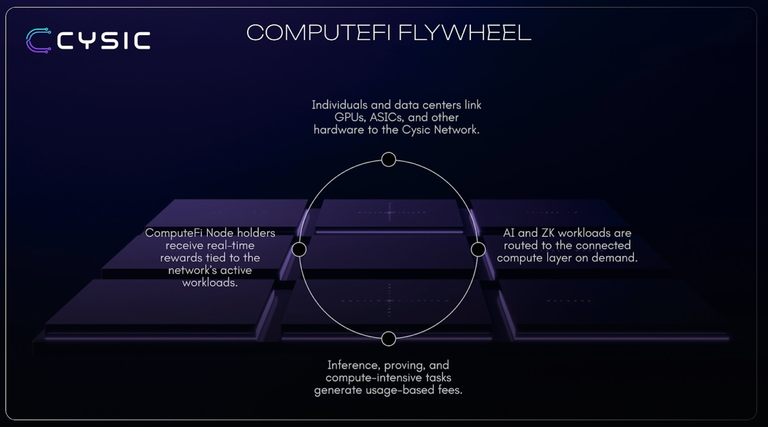
Architecture of Cysic Network
Cysic Network is organized as a modular stack, aiming to keep the system flexible while maintaining consistency across different components. It is implemented as a layer-1 blockchain using Cosmos CDK. From bottom to top, the architecture can be outlined as follows:
- Hardware Layer: This is the physical foundation of the network. It includes CPU/GPU/FPGA servers, mining rigs, and portable or edge devices such as smartphones and consumer miners. All of these contribute raw compute capacity to the Cysic Network.
- Consensus Layer: Because Cysic Network is built with Cosmos CDK, it relies on the CometBFT consensus engine, which follows a Byzantine Fault Tolerant (BFT) model. On top of this, Cysic introduces a Proof-of-Compute consensus design, where not only staked tokens but also pledged computational capacity are factored into the consensus process.
- Execution Layer: This layer coordinates how work flows through the network. It handles job scheduling, routing workloads, cross-system bridging, voting, and other core operations. These functions are implemented through smart contracts deployed on an EVM-compatible blockchain.
- Product Layer: The product layer is where users and applications directly interact with the network’s services. At the moment, it includes a ZK proof marketplace, an AI inference framework, a crypto mining framework, and additional domain-specific modules for tasks such as ZK proving, AI inference, mining, and high-performance computing workloads.
How does Cycis Network work?
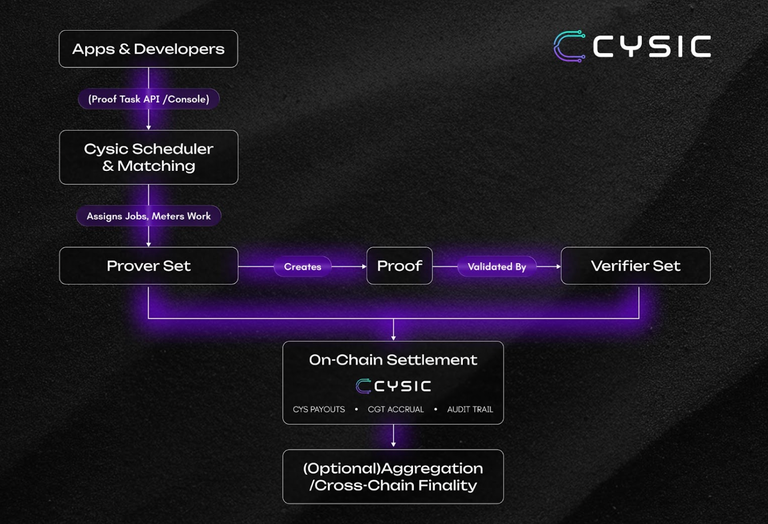
Cysic connects four main pieces:
- Compute Contributors: Anyone can supply compute for ZK and AI workloads and receive CYS (native token) and CGT (governance token). These contributors form the compute backbone of the network, providing capacity for verifiable ZK and AI workloads.
- Compute Client: Developer teams send ZK/AI tasks, choose budget and latency targets, and receive verifiable results. Over time, the network also intends to serve smaller teams, startups, and individual users who need affordable, performant compute for ZK and AI.
- Cysic Network: A low-latency EVM Layer-1 built with Cosmos CDK. Uses a Proof-of-Compute (PoC) consensus model that combines staking with contributed compute.
- Cysic Hardware RWA: Physical compute devices are linked to on-chain assets. This connects real hardware capacity with tokenized representations, making it easier to plug new devices into the network’s compute and reward flows.
Together, they match on-chain demand for ZK & AI computation with open, distributed supply.
$CYS Token Information
$CYS Key Metrics
- Token Name: Cysic (CYS)
- Ticker: $CYS
- Token Type: Utility & Governance
- Total Supply: 1B $CYS
- Contract Address (CA): TBA
$CYS Token Use Case
CYS is the core asset of the Cysic ecosystem and grants holders three primary rights:
- Governance
- Compute: CYS lets compute providers access jobs permissionlessly. They lock CYS to run provers, AI nodes, and other services. Task priority is shaped by both stake and performance, while incentives adjust according to actual workloads such as ZK proofs and AI inference.
- Financial: CYS is the network’s reward asset, distributing yield to compute providers, Proof-of-Compute stakers, and contributors to mainnet, campaigns, and community growth
$CYS Token Listing
- Listing time: 11/12/2025
- Confirmed CEX listings: Binance Alpha
- Pre-market price: Whales Market
$CYS Tokenomics & Fundraising
Tokenomics
Total Supply: 1B $CYS
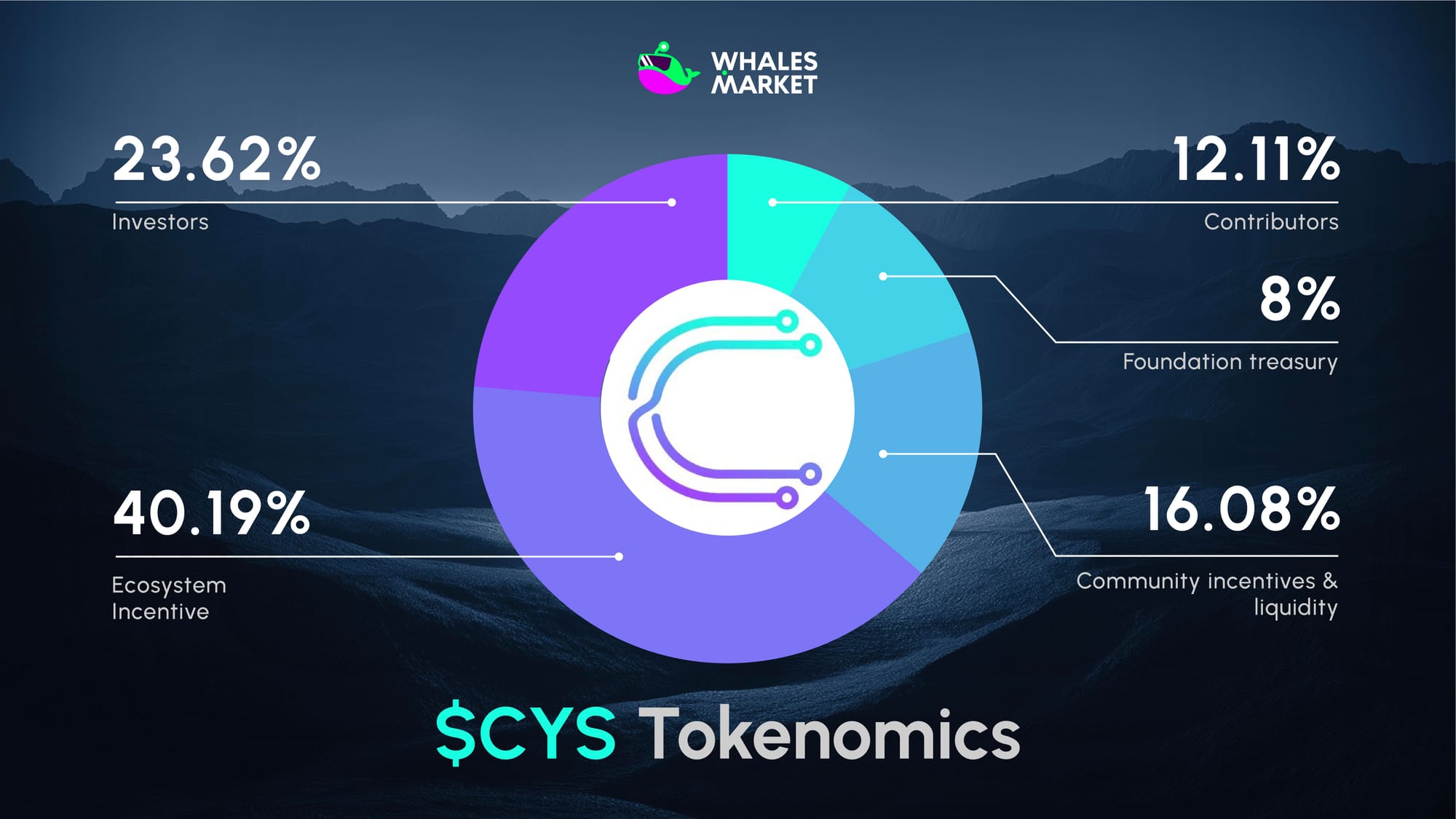
$CYS Allocation:
- Ecosystem Incentive (40.19%)
- Investors (23.62%)
- Community Incentives & Liquidity (16.08%)
- Foundation Treasury (8%)
- Contributors (12.11%)
Fundraising
According to CryptoRank, Cysic has raised $21.85M from many prominent names such as OKX Ventures, Hashkey, Polychain Capital, ABCDE...
Cysic Roadmap & Team
Roadmap
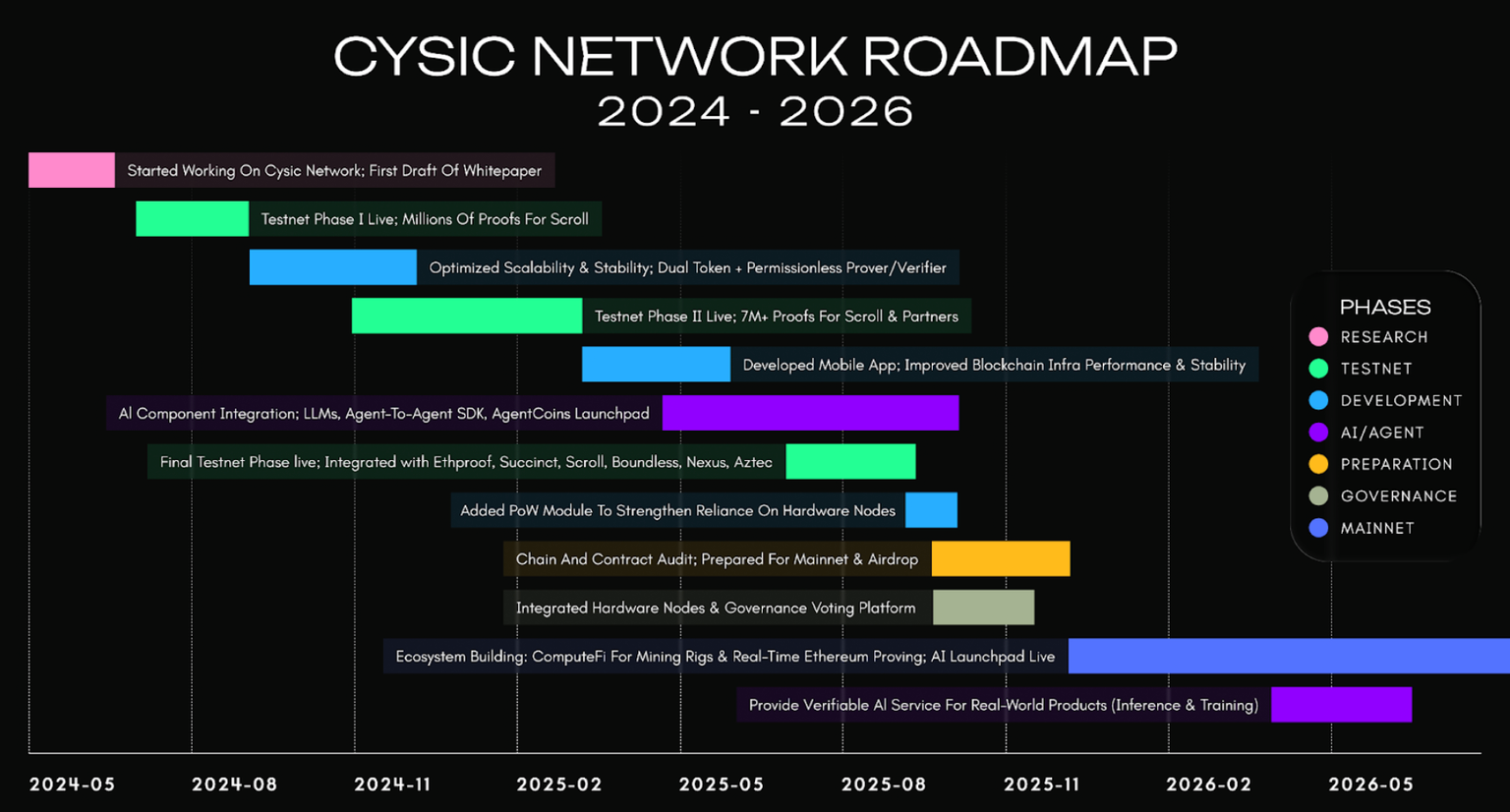
Cysic’s roadmap outlines a shift from dedicated ZK hardware toward a more decentralized compute economy, where physical machines, cryptographic proofs, and AI workloads are coordinated on-chain.
Its central goal is to make verifiable computation as accessible and liquid as other digital assets.
Team
Conclusion
Cysic combines hardware, a purpose-built Layer-1, and a token design to form a marketplace for verifiable compute across ZK and AI workloads. By standardizing heterogeneous computing resources and settling usage on-chain, the project aims to make compute a more transparent and programmable asset class.
At the same time, Cysic remains an early ComputerFi experiment. Long-term relevance will depend on sustained demand from ZK and AI projects, the economics of contributing hardware, and execution against the published roadmap.
FAQs
Q1. What problem is Cysic trying to address?
Cysic targets the shortage of transparent, verifiable compute for ZK proofs and AI workloads. The network’s design attempts to match on-chain demand with distributed hardware while keeping pricing, allocation, and settlement visible on-chain.
Q2. How does Cysic fit into the ComputerFi narrative?
Within ComputerFi, computing power is treated as a financialized resource. Cysic follows this approach by expressing workloads in standardized units (FLOPs, hashes, zkVM cycles) and turning those units into assets that can be allocated, paid for, and accounted for on-chain.
Q3. What makes Cysic different from a conventional cloud provider?
Traditional cloud services focus on renting virtual machines and are mostly off-chain. Cysic instead emphasizes verifiable execution, tokenized incentives, and a consensus mechanism that factors in both stake and contributed compute. The goal is less about generic hosting and more about trust-minimized proof generation and AI jobs.
Q4: What is $CYSIC token pre-market price?
Currently, CYSIC token is listed on Whales Market. Whales Market is the leading pre-market DEX platform to trade pre-TGE tokens and allocations, with over $300 million in volume, no middlemen, trustless and on-chain.
Q5: What is the price of $CYSIC token today?
While CYSIC hasn't been listed yet, users can trade CYSIC token pre-market on Whales Market before the TGE. Here you can trade CYSIC token before the asset gets listed on leading CEXes like Binance, Bybit or OKX.