


The $300M threshold on the USD.AI FDV prediction market holds $562,500 in trading volume, 44% of the entire event, while sitting at a near-coin-flip 52% probability. That gap between volume concentration and uncertain odds is the most important signal in this market.
Three independent valuation methods, applied using TVL multiples, fee multiples, and fundraising comparables, all converge on a $270M to $320M range. The real question before TGE is not whether $CHIP moons. It is whether it holds ICO price at all.
Disclaimer: This article is for informational purposes only. Always do your own research before making investment decisions.
USD.AI Overview
The Protocol & Its Dual-Token Model
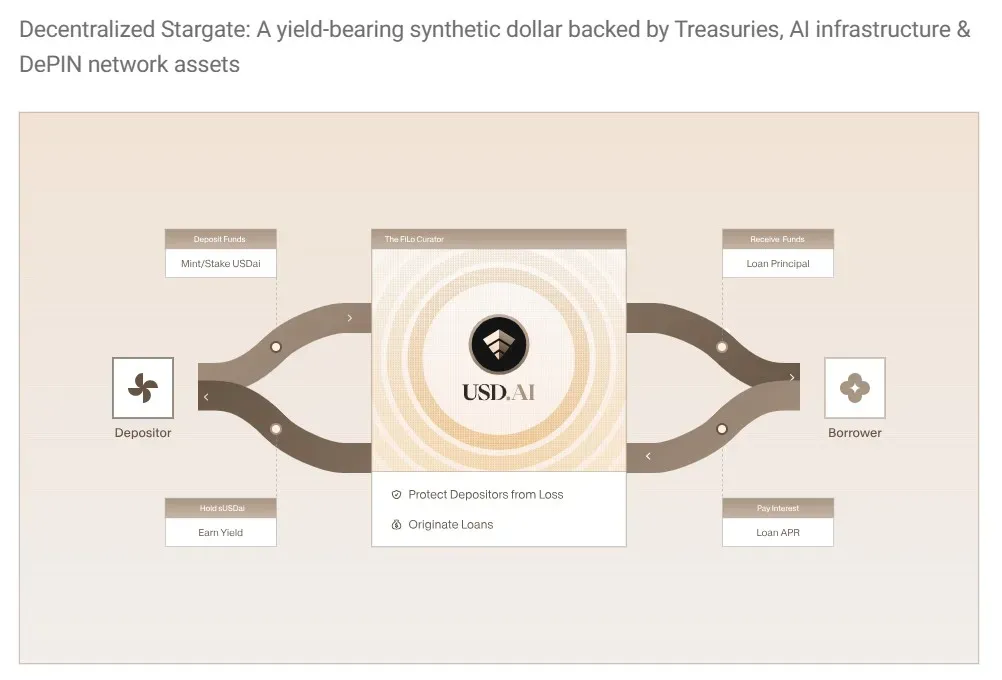
USD.AI is a permissionless lending protocol built to finance AI infrastructure. GPU operators tokenize their hardware as collateral using the CALIBER system, a legal and technical bridge that documents each GPU under U.S. commercial law and represents it as an on-chain NFT. Against that collateral, borrowers access stablecoin financing without selling their hardware or diluting equity.
The protocol issues two tokens:
- USDai is a fully backed synthetic dollar, overcollateralized by PayPal's PYUSD, and redeemable for liquidity at any time.
- sUSDai is its yield-bearing counterpart, currently offering 6.65% APY sourced from interest payments made by GPU borrowers. Idle capital not deployed in loans is held in Treasury Bills, providing a base yield floor.
Credit origination is decentralized through FiLo Curators, who underwrite and manage individual loan books while posting their own first-loss capital. Curators absorb initial defaults before lenders are affected, aligning incentives without centralizing risk in the protocol itself.
Funding & Backing
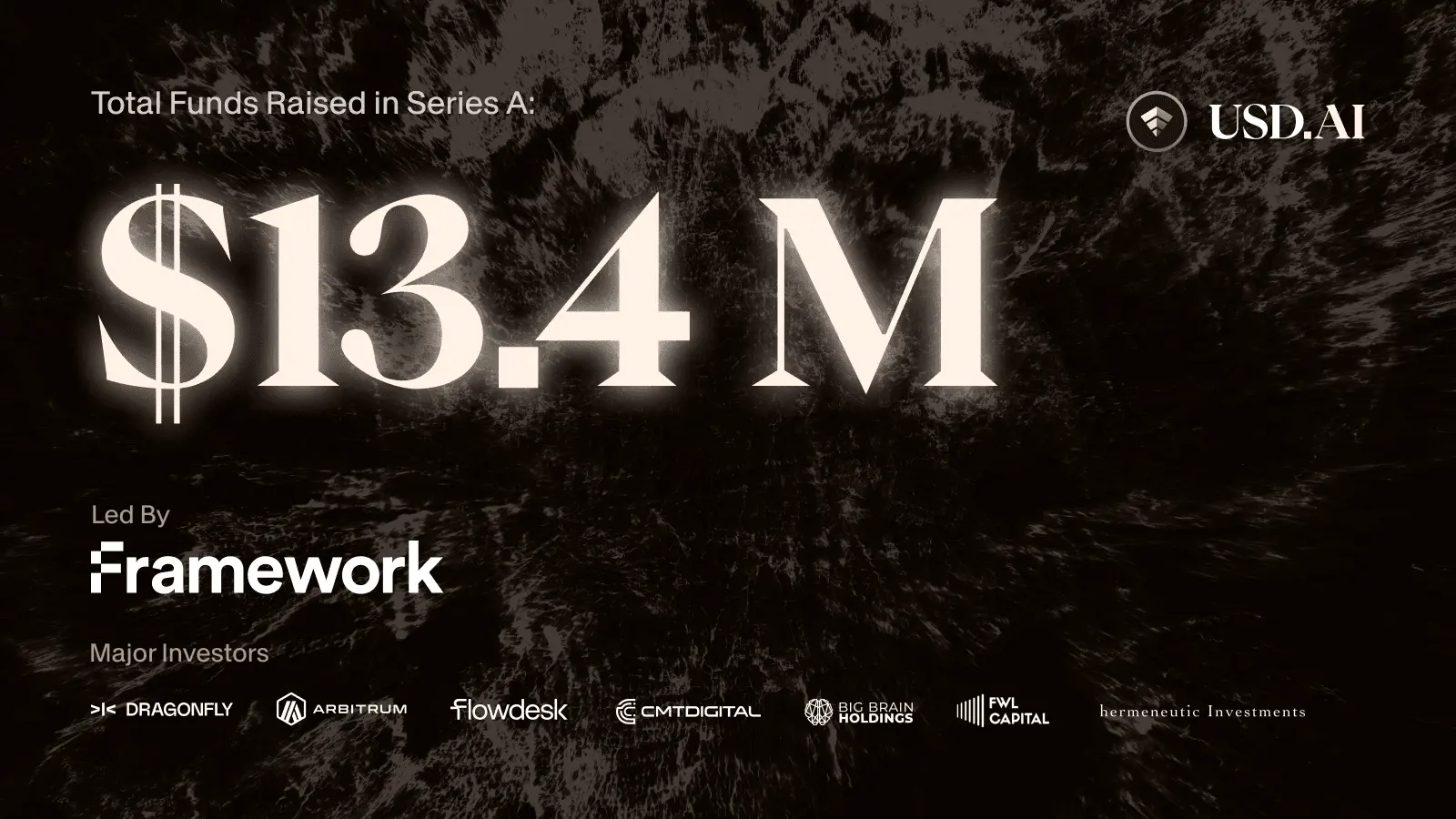
USD.AI has raised $17.4 million across four rounds, according to CoinLaunch and CryptoRank data.
- The Series A of $13 million, closed in August 2025, was led by YZi Labs (formerly Binance Labs), with participation from Dragonfly and Framework Ventures.
- Coinbase Ventures joined in a strategic round in November 2025, and Bullish contributed a separate $4 million round in September 2025.
$CHIP is the governance token of the USD.AI DAO. Holders vote on protocol parameters, approve or remove curators, and direct DAO treasury allocations. The insurance module allows CHIP stakers to backstop sUSDai holders against bad debt in exchange for yield. No fee distribution or buyback mechanism has been formally announced ahead of TGE.
USD.AI Protocol Fundamentals
TVL, Revenue & the Loan Pipeline
As of March 05, 2026, USD.AI holds approximately $450 million in TVL, according to DefiLlama, after briefly peaking at $701 million in November 2025. That drawdown from peak reflects broader DeFi market conditions and is a relevant input when applying TVL-based valuation multiples.
On the revenue side, the numbers are more modest than early narratives suggested. Protocol fees annualize at $18.25 million, capturing gross activity across the lending system. Net revenue annualizes at $3.11 million, reflecting the split between lenders, curators, and the DAO. Cumulative revenue since launch stands at $1.23 million, and current borrowed volume sits at $17.62 million, according to DefiLlama.
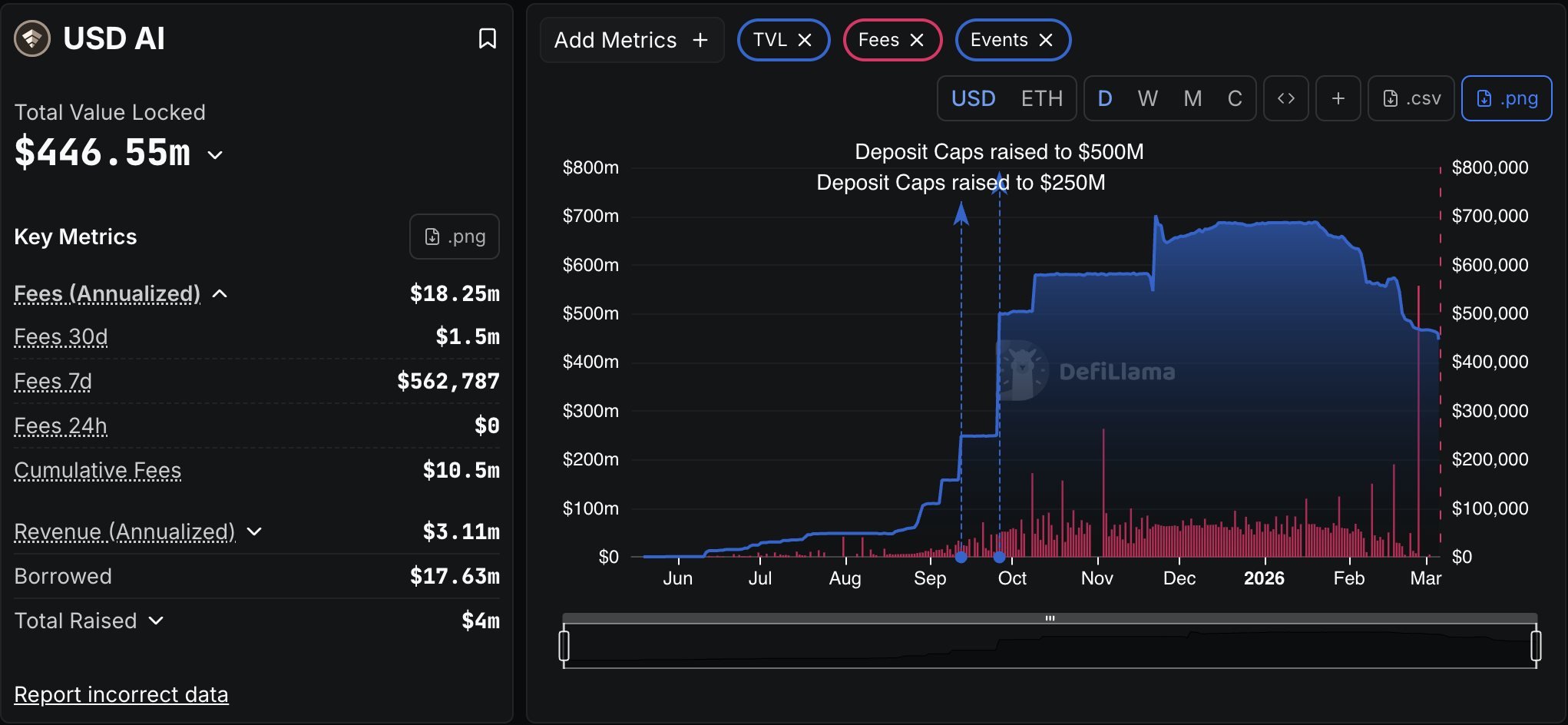
These are early-stage numbers on a protocol still ramping originations. They reflect a real but nascent lending market, and they set the ceiling for what fee-based valuation can justify at TGE.
The PayPal Partnership
In December 2025, Permian Labs announced a partnership with PayPal to back USDai with PYUSD. Loans are denominated in PYUSD, and proceeds can be received directly into PayPal accounts. A one-year incentive program launched in January 2026 to bootstrap deposit growth.
The partnership provides institutional credibility and a real distribution channel for GPU-backed lending. On day one of trading, this is a growth signal, not a revenue signal. Markets price what exists today, not what could exist in twelve months.
What Is a Reasonable FDV for $CHIP?
Each method below was applied independently. All three landed in the same range.
Method 1: FDV/TVL Multiple vs. Peers
The two closest comparable protocols are Ondo Finance and Maple Finance, both operating at the intersection of real-world assets, institutional credit, and DeFi.
The spread between Ondo and Maple is wide.
- Ondo commands a near-1x FDV/TVL ratio as the established RWA market leader.
- Maple, the more directly comparable institutional lending protocol, trades at 0.147x.
- USD.AI sits between the two: newer, well-backed, but without Ondo's market position or track record.
Reaching $300M on TVL alone requires a 0.67x ratio, above Maple but well below Ondo. That is a reasonable outcome only if the market assigns a meaningful AI narrative premium on day one, which is not guaranteed.
Method 2: P/F Ratio (Price-to-Fees)
The P/F ratio measures how much the market pays for each dollar of annualized protocol fees. It works like a P/E ratio in equities, but uses gross fees instead of net earnings, since DeFi protocols rarely report clean profit figures. A high P/F means the market is pricing future growth, not just current output.
Ondo's 51.2x P/F reflects its dominant market position and institutional user base. Applying that multiple to USD.AI's $18.25 million in annualized fees produces an implied FDV of $934 million, a number that imports Ondo's brand premium wholesale into a protocol with $1.23 million in cumulative revenue.
A conservative 15x to 20x range is the appropriate entry point for early-stage.
The base case of $274M to $365M brackets the ICO price, with the midpoint near $320M.
Method 3: Fundraising-Based Valuation
Maple Finance raised $17.7 million and holds an FDV of $292 million, implying a fundraising multiple of 16.5x. Applied to USD.AI's $17.4 million raised, the same multiple implies a FDV of approximately $287 million, just below ICO price.
This method is the most grounded anchor in this analysis. It reflects what the market has historically paid for institutional DeFi lending protocols at a comparable fundraising scale, before any narrative premium is layered on top.
$CHIP FDV Range at Launch:
Three methods. One range: $270M to $320M.
Central estimate: approximately $290M, which sits below ICO price.
Factors that will move FDV on Day One
Sell Pressure: Who Will Sell and How Much?
The 100% unlock at TGE is the dominant factor in this launch. Both the airdrop allocation (300 million CHIP, 3% of total supply) and the ICO allocation (700 million CHIP, 7% of supply) become fully liquid the moment trading begins. That is 10% of total supply entering the market on day one with zero vesting friction.
ICO participants break even at exactly $300M FDV, the $0.03 per CHIP entry price. Pendle YT farmers, who acquired Allo points by purchasing yield tokens at elevated premiums during the farming period, need FDV considerably above $300M to recover their cost. Many will sell well before that level, concentrating sell pressure at the exact threshold where 44% of Polymarket volume has positioned.
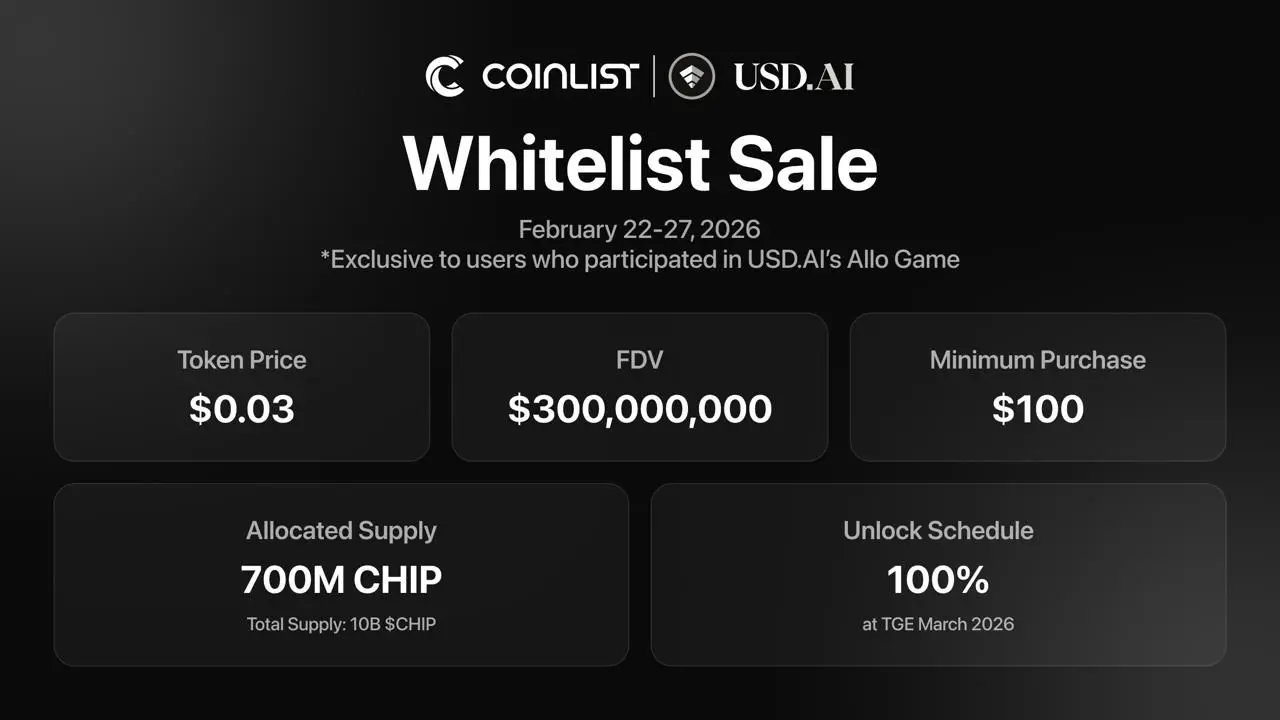
The buyout guarantee offers CoinList participants a cash exit at $350M or $420M FDV at TGE. It provides a floor for that specific cohort. It does not protect anyone who buys $CHIP on the open market after listing.
The Governance Token Discount
$CHIP has no confirmed fee distribution mechanism and no announced buyback program as of TGE. The insurance module provides staking utility, but the yield source is not formally documented before launch. Markets that have repriced pure-governance tokens through 2025 and into 2026 have consistently valued them at a discount to protocols with confirmed revenue sharing.
Until a fee switch or buyback announcement is made, $CHIP trades as a governance option on potential future value accrual. That option has real value. It is not the same instrument as a token with documented cash flows, and day-one pricing will reflect that difference.
The AI Narrative Premium
USD.AI sits at the intersection of yield-bearing stablecoins, RWA lending, and AI infrastructure financing. The PayPal partnership and YZi Labs backing carry more institutional credibility than most AI-branded DeFi projects can claim. In a risk-on market environment at TGE, that premium could push FDV toward or above the $300M ICO floor. In a neutral environment, fundamentals dominate and the range sits below it.
The premium is real. It is also not measurable in advance. The on-chain data, TVL, fees, borrowed volume, brackets rather than clears the ICO price. That gap is where the premium lives, if it shows up at all.
Analyzing the Polymarket Odds
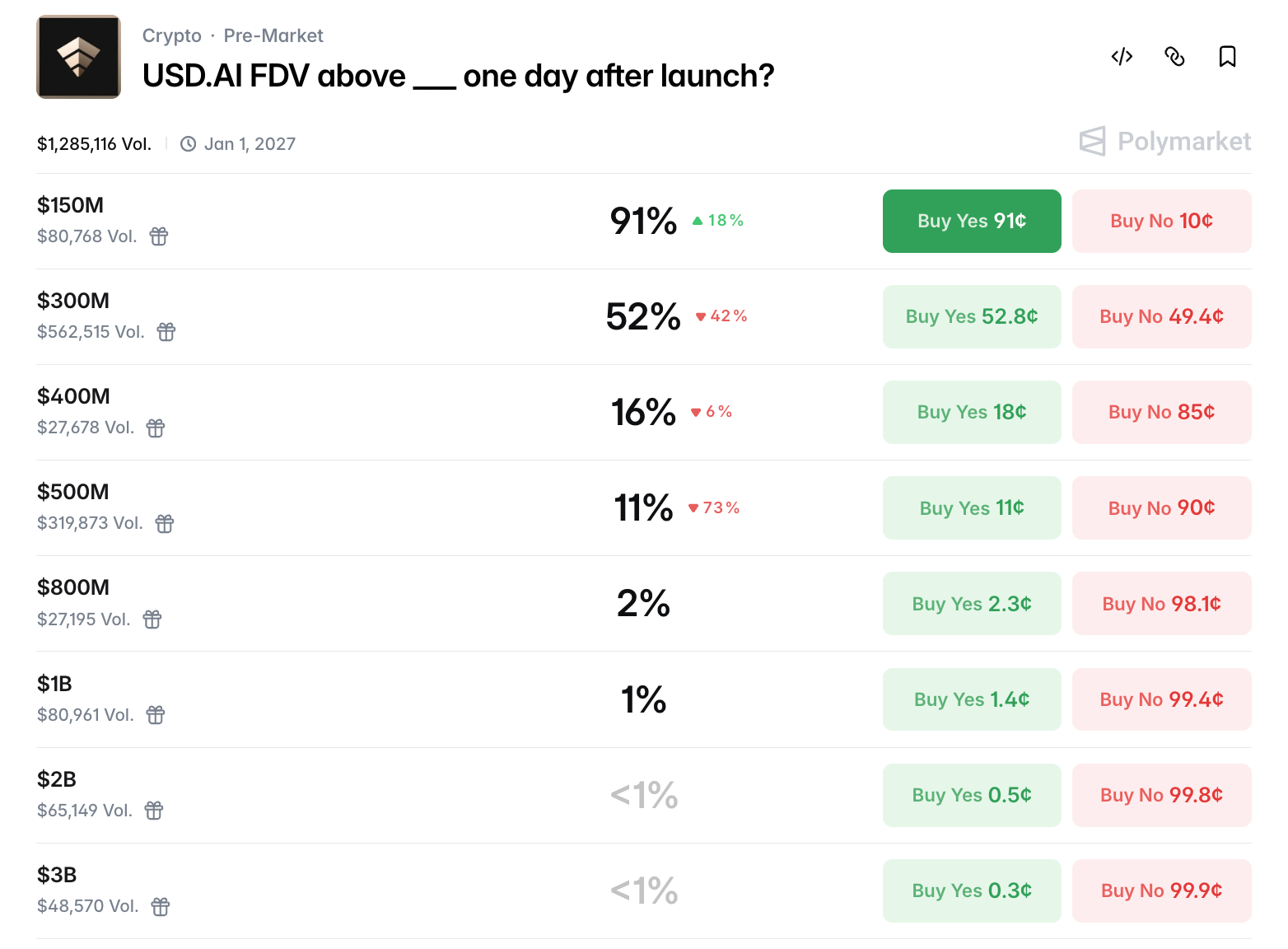
The USD.AI FDV prediction market on Polymarket shows the following probabilities as of March 5, 2026, with $1.28 million in total volume:
Why $300M Is the Real Battleground?
The $300M threshold concentrates $562,500 in volume at 52% probability. The market is not debating whether $CHIP clears $150M. It is debating whether the AI premium, the PayPal signal, and the institutional backing are worth enough to absorb the 100% unlock and governance discount simultaneously. That is not an easy bet in either direction, which is why the probability sits at a coin-flip.
One number worth examining separately: the $500M threshold holds $319,500 in volume at only 11% probability. That is the second-highest volume in the entire event, placed on a near-longshot outcome. It reflects a meaningful cohort that believes the AI narrative premium could run significantly above fundamentals. The market is pricing them as likely wrong, but the size of that bet suggests they are not a fringe view.
The drop to 16% at $400M and 2% at $800M confirms what the valuation methods show: no natural resting point exists between $300M and $500M in the fundamental data, and anything above $500M requires assumptions the market is not currently willing to make.
Trading Strategies for the USD.AI FDV Market
Buy YES "$150M" (91% probability): Near-certainty play with approximately 10% upside. A bet that $CHIP does not collapse to half ICO price on day one. The buyout guarantee and institutional backing make this almost certain absent a catastrophic listing failure.
Buy NO "$300M" (52% probability): The position most aligned with the valuation analysis. All three methods place the fundamental range at or slightly below $300M. The governance discount, 100% unlock, and early-stage revenue numbers all apply downward pressure. Main risk: a value accrual announcement at TGE that immediately reprices the governance discount.
Buy YES "$300M" (52% probability): The contrarian case. If the AI narrative premium and PayPal/YZi Labs signal drive buying above ICO price, this pays approximately 1.9x. Risk-reward is symmetric, which is exactly what a genuine battleground looks like.
Buy NO "$500M" (11% probability): High-conviction bearish position. All three valuation methods put $500M at 55% to 85% above the fundamental base case with no confirmed catalyst. Approximately 1.1x upside at current pricing.
Avoid $800M and above: At 2% probability and below, these reflect tail risk. Poor risk-reward in both directions.
Conclusion
Three independent valuation methods applied to USD.AI's actual on-chain data, $450M TVL, $18.25M in annualized fees, $17.4M raised, converge on a FDV range of $270M to $320M, with $290M as the central estimate. That sits below the $300M ICO price.
One catalyst changes the calculus entirely: a fee switch or buyback announcement at TGE. If the team reveals a confirmed revenue-sharing mechanism before markets open, the governance discount compresses immediately and the $300M floor holds with far higher confidence. Without it, the fundamental range governs.
Disclaimer: This article is for informational purposes only and does not constitute investment advice. Whales Market is not responsible for any investment decisions.
Frequently Asked Questions (FAQs)
What is USD.AI's $CHIP token?
$CHIP is the governance token of the USD.AI DAO. Holders vote on protocol parameters, approve or remove curators, and direct DAO treasury allocations. The insurance module allows staked CHIP to backstop sUSDai holders against bad debt. No fee distribution or buyback mechanism tied to $CHIP has been formally announced as of the TGE date.
When is the USD.AI TGE date?
The TGE is expected in March 2026, following the CoinList token sale that ran from February 22 to 27, 2026. The exact listing date has not been formally confirmed by the project as of early March 2026.
Why does 100% unlock at TGE matter for FDV?
A 100% unlock means all airdrop recipients (300 million CHIP) and all ICO participants (700 million CHIP) can sell immediately on day one. This is 10% of total supply entering the market with zero vesting friction. Protocols with vesting schedules spread this sell pressure over months. USD.AI concentrates it into a single trading session, which is the primary reason the $300M threshold is a coin-flip rather than a near-certainty.
What does the buyout guarantee mean for CHIP price?
The buyout guarantee offers ICO participants the option to exit at $350 million or $420 million FDV, paid in cash at TGE, according to Tekedia. This creates a partial price floor for CoinList buyers specifically. It does not protect open-market buyers who purchase CHIP after listing.
Where can I trade the USD.AI FDV prediction market?
The USD.AI FDV prediction market is live on Polymarket and on Whales Prediction (whales.market/prediction), which aggregates prediction market data and lets traders monitor probabilities, volume, and positioning across all FDV thresholds in real time.