

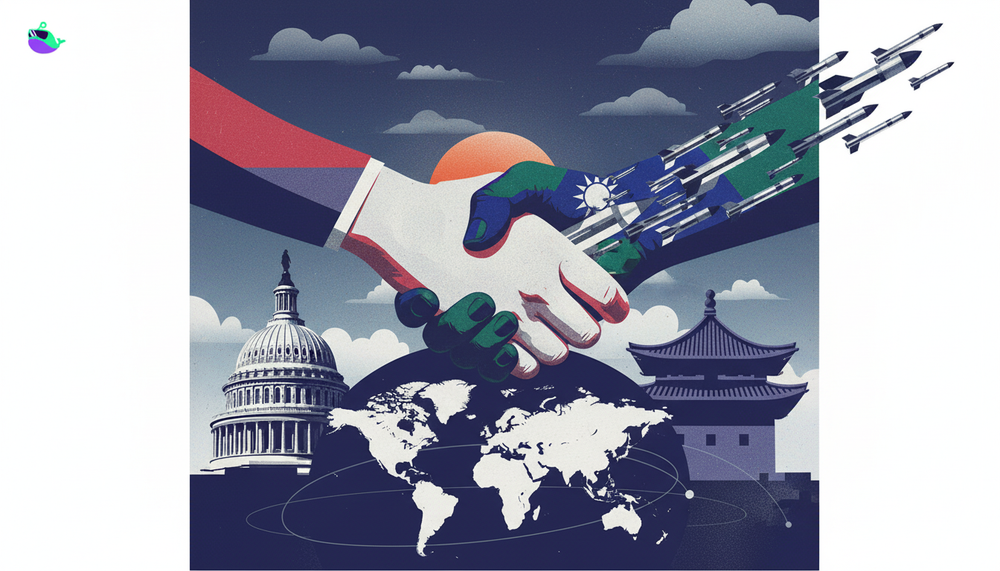
The United States has introduced its most substantial arms package ever for Taiwan, a move designed to bolster Taipei's defense capabilities against China. This development arrives amidst ongoing efforts to stabilize relations between the U.S. and China.
Details of the Arms Deal
The $11.1 billion deal encompasses a range of advanced weaponry, including:
- Over $4 billion for High Mobility Artillery Rocket Systems (HIMARS)
- Over $4 billion for M109 self-propelled howitzers
- Over $700 million for Javelin and TOW anti-tank missiles
- Altius loitering munitions
This marks the second arms sale to Taiwan during President Trump's second term. If approved by the U.S. Congress, this package will surpass the $8.4 billion in weapons sold to Taiwan during the previous administration.
Strategic Implications and Taiwan's Response
The U.S. National Security Strategy emphasizes the importance of maintaining a military advantage over China in the region to deter conflict regarding Taiwan. This strategy involves encouraging Taiwan to increase its defense spending and focus on developing asymmetric warfare capabilities, utilizing smaller, more mobile, and cost-effective weapons systems, similar to the tactics employed in the Russia-Ukraine conflict.
Taiwanese President Lai Ching-te has responded by proposing a $40 billion supplementary defense budget, prioritizing these smaller, asymmetric weapons. He has emphasized that there is "no room for compromise on national security." Following this announcement, Foreign Minister Lin Chia-lung made an unscheduled visit to Washington to meet with U.S. officials. Taiwan's defense ministry has stated that the U.S. continues to assist Taiwan in maintaining sufficient self-defense capabilities, rapidly building strong deterrent power, and leveraging asymmetric warfare advantages, which form the foundation for maintaining regional peace and stability.
China's Reaction
Predictably, Beijing has strongly condemned the arms deal, asserting that it "severely undermines peace and stability in the Taiwan Strait." A Chinese foreign ministry spokesperson stated that the U.S. is "bringing fire upon itself" by aiding "Taiwan independence" with weapons and that "using Taiwan to contain China is absolutely doomed to fail." China has significantly increased its military presence in the Taiwan Strait in recent weeks.
Other Global Developments
Frozen Russian Funds
European Union leaders are considering utilizing approximately $247 billion in frozen Russian assets held in Europe to fund Ukraine's war efforts. The proposal involves using these funds to support Ukraine's reconstruction and to back a $105 billion loan to Kyiv. Ukrainian President Zelensky has warned that without this loan, Ukraine could face funding shortages by spring, potentially forcing cuts in drone production and weakening its bargaining position with Russia. Some European nations view financing Ukraine's defense as crucial for protecting their own borders from potential future Russian aggression. However, Belgium, which holds the majority of the frozen Russian funds, is seeking sufficient guarantees to protect itself from legal and financial risks before agreeing to the plan.
Penalties for Hate Speech
Australia is introducing new measures to penalize those who spread hate, division, and radicalization, including antisemitism. The proposed legislation is a response to a recent mass shooting in Sydney. The measures include penalties for preachers and organizations that promote violence and racial hatred, a new federal offense of "aggravated hate speech," and making "hate" an aggravating factor in sentencing crimes for online threats and harassment.
FAQs
What weapons are included in the US arms deal with Taiwan?
The $11.1 billion arms package includes HIMARS, M109 self-propelled howitzers, Javelin and TOW anti-tank missiles, and Altius loitering munitions. This deal aims to bolster Taiwan's defense capabilities against potential threats.
How has China responded to the U.S. arms deal with Taiwan?
China has strongly condemned the arms deal, stating that it undermines peace and stability in the Taiwan Strait. They view the U.S. action as supporting "Taiwan independence" and have increased their military presence in the area.
What is Taiwan's plan to strengthen its defenses?
President Lai Ching-te has proposed a $40 billion supplementary defense budget, prioritizing smaller, asymmetric weapons. Taiwan aims to build strong deterrent power and leverage asymmetric warfare advantages to maintain regional peace and stability.
You've got the context, now make it count. Use your knowledge to potentially profit from market movements and Explore Whales Market for pre market trading crypto.