

Whales Market is pleased to introduce Cross-Chain Settlement, a new mechanism for Pre-market. It removes one of the most persistent friction points in multi-chain trading: the mismatch between where a token is traded and where it actually lives.
The problem we're solving
Pre-market trading has always carried an implicit assumption, that the chain where you trade a token allocation is the same chain where that token will eventually be issued.
That assumption no longer holds.
As the ecosystem has grown across Solana, EVM networks, and beyond, the reality is that a token's native chain and the chain with the most active trading community are often two different things.
Under the old model, this created a rigid constraint: sellers had to operate within the chain where the orderbook existed, regardless of where their actual tokens were held, and liquidity was siloed by chain rather than by market demand.
Cross-Chain Settlement is how we address this directly.
Two concepts to understand first
Before walking through how the mechanism works, two terms are worth defining clearly:
- Listing Chain: The blockchain where the orderbook exists, orders are created, and settlement transactions are executed. This is the chain users directly interact with when trading.
- TGE Chain: The blockchain where the token's original supply lives. This is where the project issued its tokens and where sellers initially hold their real allocations.
With Cross-Chain Settlement, these two chains no longer need to be the same.
How the Cross-Chain Settlement works
The core of the system is a 1:1 collateralized wrapped token model. Here is the flow:
- When a seller needs to fulfill an order on the Listing Chain but holds their tokens on the TGE Chain, the system initiates a bridge process.
- The original tokens are locked in a secure smart contract on the TGE Chain, they remain owned by the seller but cannot be reused or withdrawn once the bridge is confirmed.
- In exchange, an equivalent amount of wrapped tokens is issued on the Listing Chain to complete the settlement.
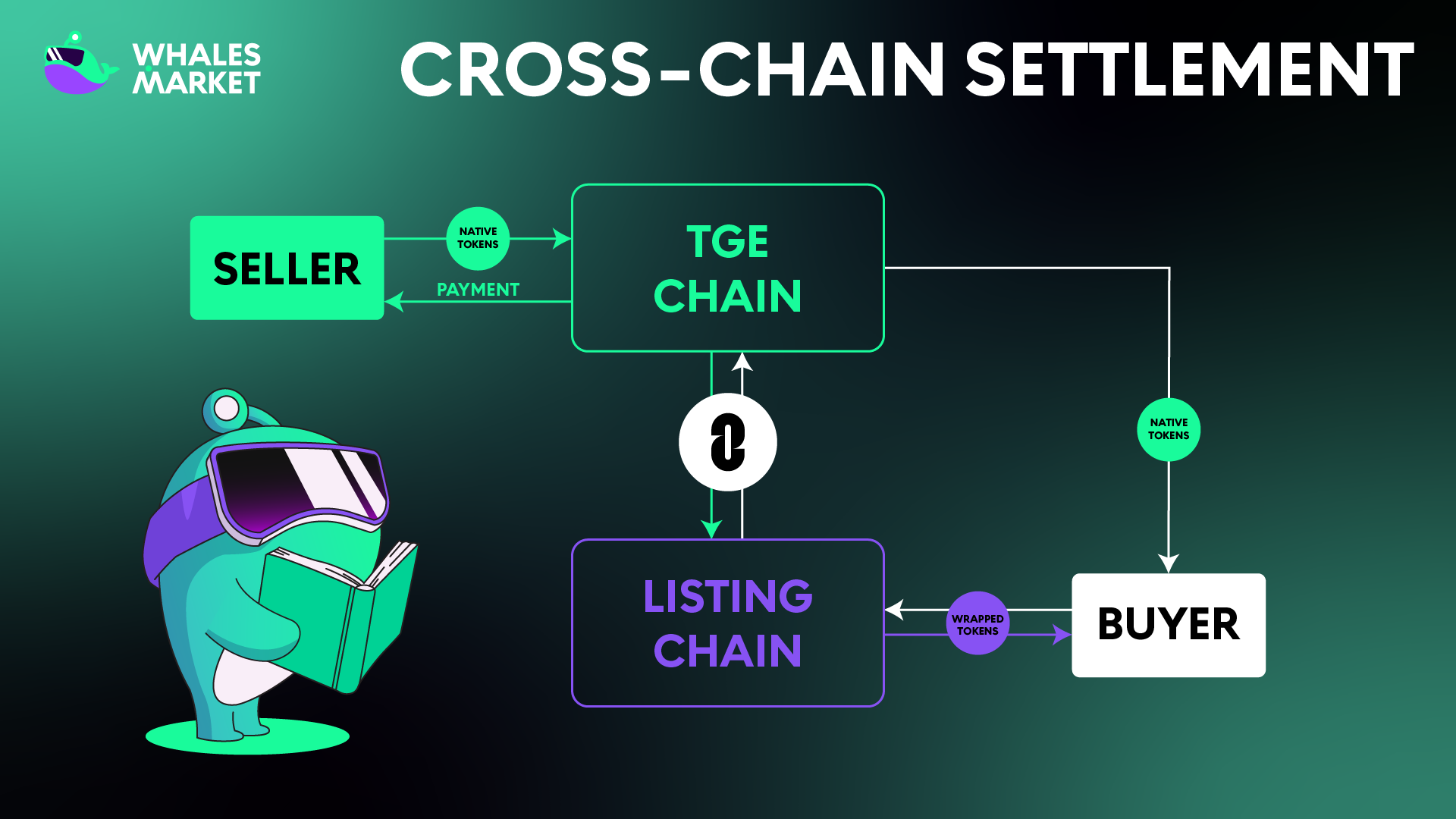
The ratio is always 1:1. There is no synthetic minting, no over-issuance, and no value duplication.
All cross-chain communication is handled by LayerZero protocol, which is responsible for secure message passing and delivery confirmation between networks. Critically, settlement will not proceed unless the cross-chain message has been fully confirmed through LayerZero. There is no shortcut around this step.
It is also worth noting that the system operates on a non-custodial design. No centralized party holds assets during any stage of the process, and every transfer requires an explicit signature from the user.
When does bridging actually happen?
The bridge step is only triggered when the system detects that the available wrapped token balance on the Listing Chain is insufficient to fulfill the specific order. If enough wrapped tokens already exist on the Listing Chain, the bridge is skipped entirely, making the process faster for orders that don't require it.
What this means for Buyers and Sellers
For buyers, the experience is largely unchanged. Settlement continues to happen on the Listing Chain as it always has.
For sellers, the key shift is that holding tokens on a different chain from the orderbook is no longer a blocker. The bridge process, when needed, is handled within the settlement flow rather than requiring a separate manual operation before trading.
For the platform overall, liquidity is no longer constrained by chain alignment. A token launching natively on one network can be listed and traded on another without requiring everyone to operate on the same infrastructure.
Security model of Cross-chain Settlement
A few properties of the security design are worth stating explicitly:
- Every wrapped token is backed 1:1 by an original token locked on the TGE Chain, verified on-chain, no exceptions.
- Settlement cannot proceed without a confirmed cross-chain message from LayerZero.
- Assets are never held in a centralized vault during the bridge process.
- All transfers require a direct user signature to execute.
Understanding your options at Settlement
Sellers on Whales Market retain the option to default rather than settle, choosing not to deliver tokens and forfeiting their collateral to the buyer instead. This is not a system failure; it reflects the nature of pre-market as price discovery trading, where TGE prices can move significantly from where an order was originally filled.
For buyers, if a seller does not settle within the designated window, the right to cancel the order is granted automatically. Cancellation is a right, not an obligation. It means if the buyer chooses to wait, the seller can still settle at any point until the order is either fulfilled or canceled.
One more thing worth noting: the bridge step only triggers when the wrapped token balance on the Listing Chain is insufficient to fulfill a specific order. If enough already exists, it is skipped. Once a bridge is confirmed, the original tokens on the TGE Chain are locked in the smart contract and cannot be reused or withdrawn until settlement completes.
When the unexpected happens
The protocol has structured fallbacks for infrastructure disruptions:
- Claim portal or bridge outage: Whales Market activates Extended Settlement, pausing the timer and extending the window by up to 48 hours.
- No viable bridge route at settlement time: Whales Market may deploy a temporary cross-chain settlement smart contract to escrow the seller's tokens and execute the transfer through a supported path.
- No resolution within the allowed timeframe: Whales Market will cancel the market for the affected pair, and all escrows are returned to their respective owners.
Users participating in pre-market trading are expected to understand and accept the risks that come with early-stage, cross-chain settlement environments.
What's Next
Cross-Chain Settlement expands what is possible on Whales Market, particularly for tokens launching on ecosystems with active pre-market communities spread across different chains. We will continue to expand supported chain pairs and routing options as the mechanism matures.