

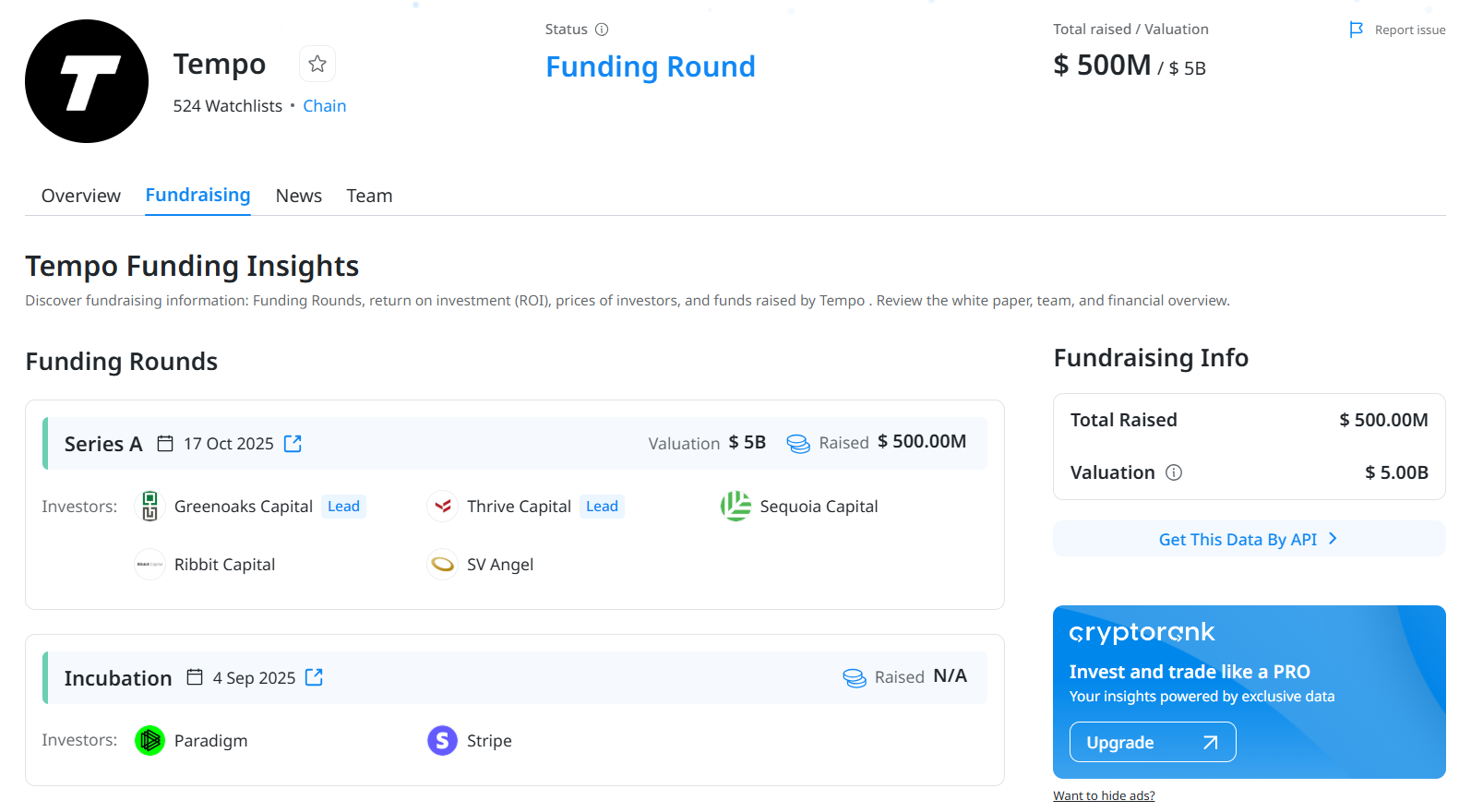
Backed by Stripe and Paradigm, Tempo positioned itself as a payments focused Layer 1 built around native stablecoin transfers and settlement. In October 2025, the project reportedly raised $500M at a $5B valuation and has since opened a public testnet.
Tempo Overview
Tempo is a payments-first Layer 1, built as the “Tempo Chain” with stablecoins at the center. It’s designed to make USDT and USDC work better for real transactions by reducing network fragmentation, cutting fees, speeding up transfers, and lowering compliance-related risk.
With support from major names such as Stripe & Paradigm, Tempo is positioning itself to drive stablecoins deeper into everyday spending and enterprise integrations.
Core highlights of Tempo:
- EVM compatible, so existing Ethereum tooling and apps can port over smoothly
- Gas paid in major stablecoins, not just a native token
- Zero-fee P2P transfers for everyday payments
- Finality in under 1 second, reducing settlement uncertainty
- Throughput above 100,000 TPS, built for large-scale payment flow
- Compliance-forward design with enterprise-grade security standards
Net effect: Companies can plug in global stablecoin payments more easily, without getting exposed to unpredictable gas costs.
Why should users pay attention to Tempo’s airdrop?
Below are the main reasons users should not ignore an airdrop from Tempo:
- Strong backing from leading institutions: Tempo is not a small project. It is built by Stripe. The involvement of Visa and Mastercard also suggests the project may integrate with traditional finance systems, increasing the chance of success and potential long-term token value.
- Potential for a large airdrop: Although there is no official confirmation of an airdrop, joining the testnet, launched on December 9, 2025, is viewed as a way to hunt retroactive rewards, similar to other Layer 1 projects such as Celestia, Aptos, and Sui…
- Low risk, near zero cost: Participation only requires a wallet such as MetaMask, claiming free faucet fund, and executing testnet transactions without investing real money. The main cost is time, usually 15 to 30 minutes to get started, then a few minutes per day to stay active.
How to Get the Tempo Airdrop?
To hunt the Tempo airdrop, users can follow the steps below.
Step 1: Connect a wallet and add Tempo Testnet
First, users need to add the Tempo Testnet network to use the chain:
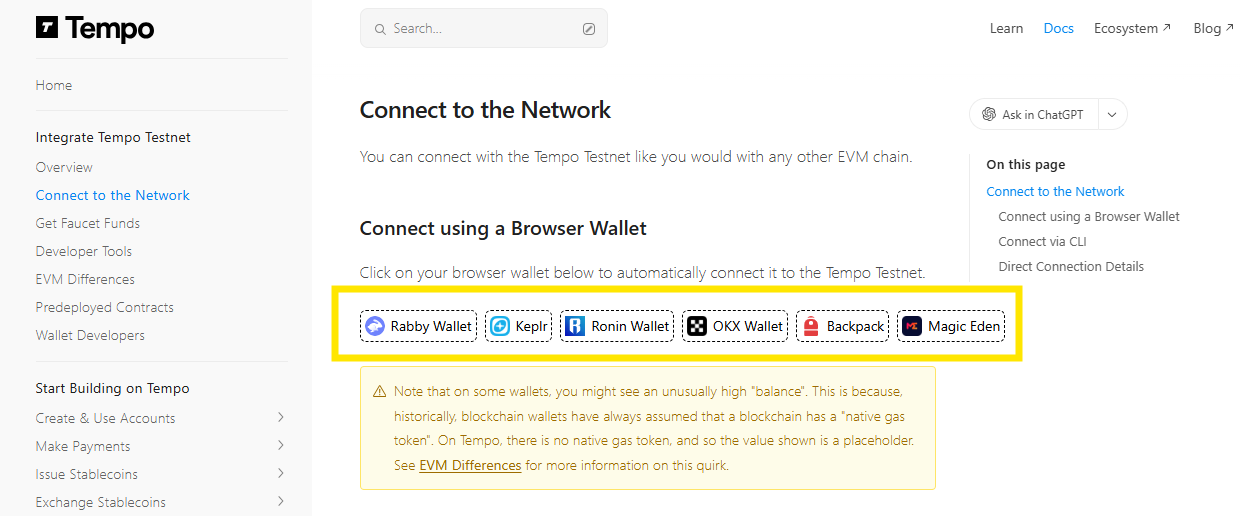
- Go to the Tempo Docs page.
- Choose to connect with any Web3 wallet the user is using.
- Connect the wallet and select Add Tempo Testnet to automatically add the network.
If manual setup is required, here are the Tempo Testnet details:
- Network Name: Tempo Testnet (Andantino)
- Currency: USD
- Chain ID: 42429
- HTTP URL (RPC): https://rpc.testnet.tempo.xyz
- Block Explorer: https://explore.tempo.xyz
Step 2: Faucet testnet tokens
After adding the network, users need to faucet tokens on the testnet to pay gas and use the chain.
- Go to the Faucet page.
- Select Add Fund to receive testnet tokens. Users will receive 1M of each token: AlphaUSD, BetaUSD, ThetaUSD, and PathUSD.

- Next, select “Add for each token” so they appear in the wallet. The token status in the wallet will change to “Added”.
- Then choose which token to pay network fees with. In the example, the selected token is AlphaUSD, then select “Set fee token”.

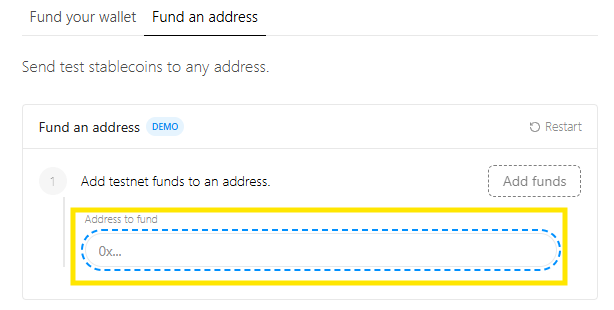
Users can also paste a wallet address directly into the faucet section (Funding an address), then paste the address and select Add Fund to faucet.
Step 3: Send transactions (Send Payments or GM)
After the network is added and fee tokens are available, users should generate onchain activity:
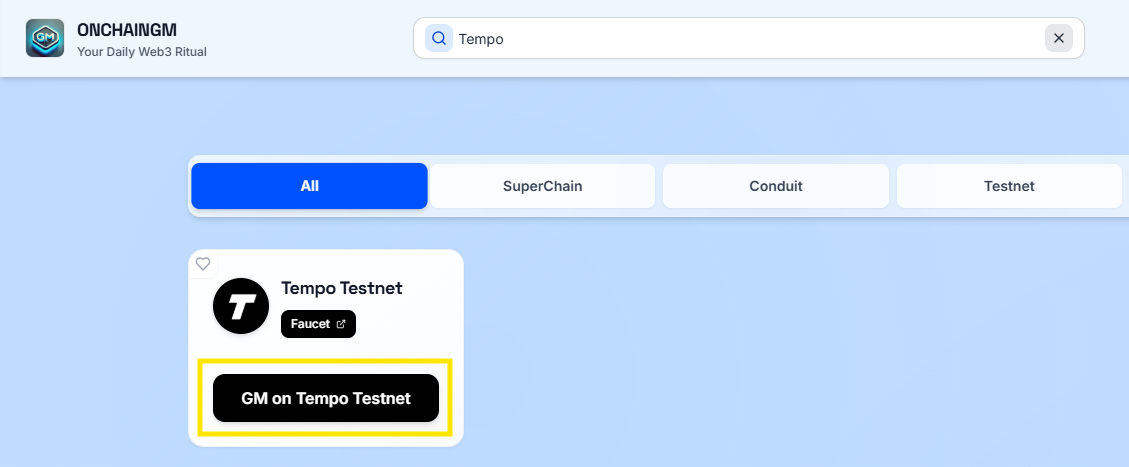
- Go to the onchaingm website. Select Tempo Testnet, then select GM on Tempo Testnet to create a transaction on the network. This is similar to sending tokens and helps generate the first onchain activity on the chain.
- Users can also send the tokens in the wallet on Tempo to any EVM wallet address.
Step 4: Buy a domain (Mint ID)
Beyond sending tokens, users can also buy a domain name on Tempo Testnet.
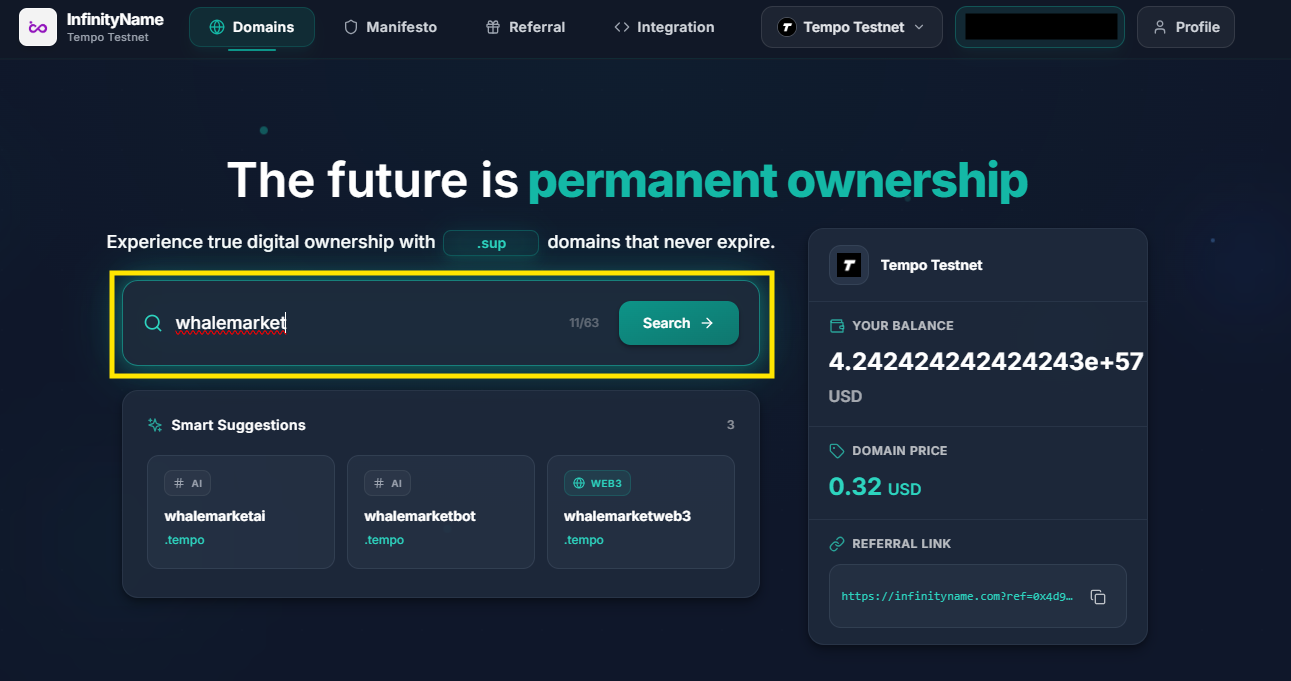
- Go to the InfinityName website.
- Type the desired domain into the search box, then select “Search”.
- Then select “Approved” and “Register” to complete the process.
Step 5: Complete the Superboard campaign (third-party)
If users want extra activity beyond basic testnet actions, you can also join the Superboard Tempo campaign.
- Go to Superboard Website.
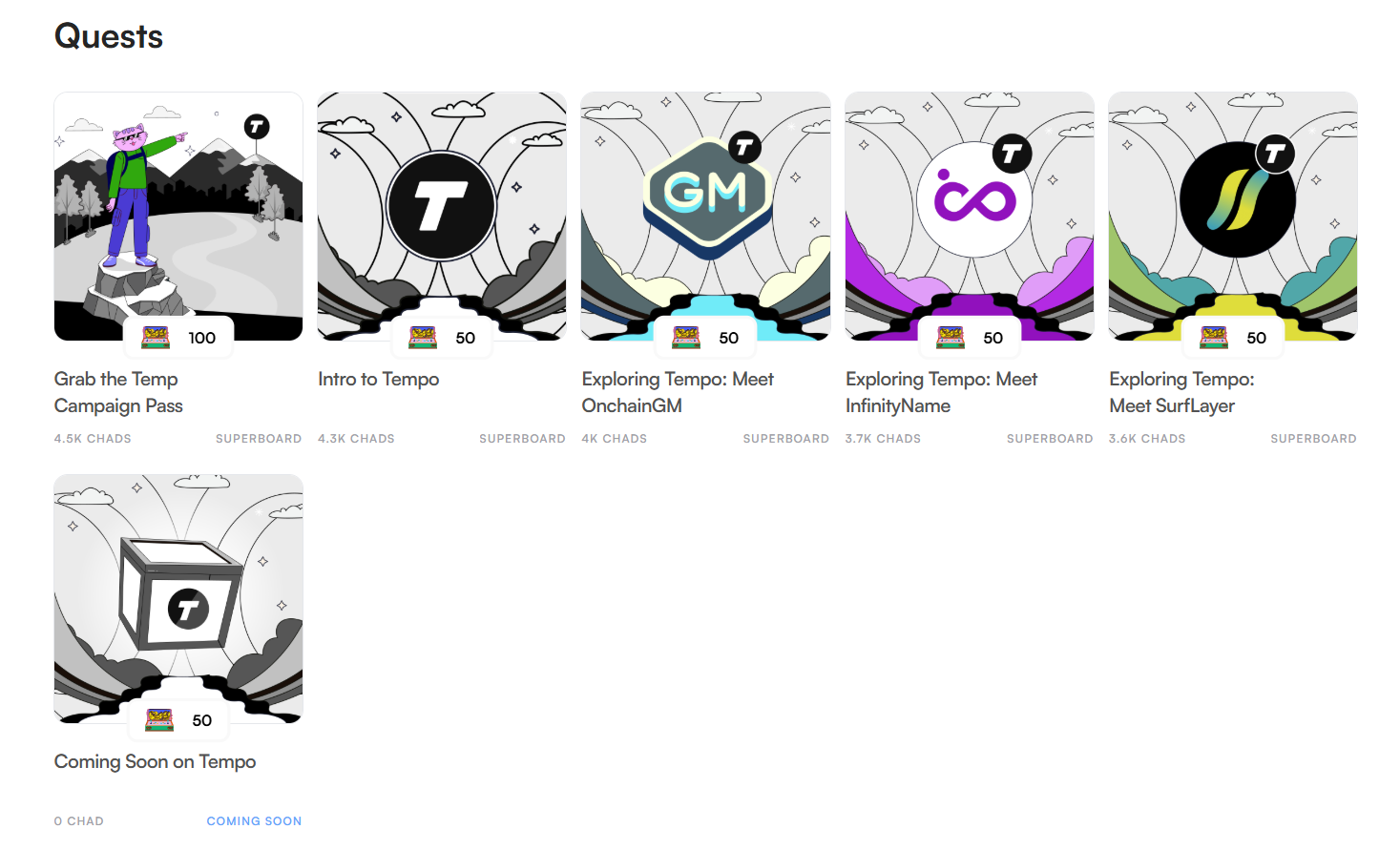
- Mint the Tempo Campaign Pass to unlock the quest list.
- Then complete each task one by one. Most quests are lightweight and usually involve basic actions like social interactions (follow/like/join), plus a few simple onchain check-ins (OnchainGM, InfinityName, SurfLayer) to collect campaign points.
Note: This is run by a separate platform and does not guarantee any Tempo airdrop, but it can help users stay active in the ecosystem.
In addition to testnet activity, users can also write posts on X to contribute to the project and potentially receive an airdrop.
Note: Because this is a testnet, users should only use fresh wallets or wallets with minimal assets to reduce risk.
Conclusion
Right now, farming Tempo mainly means basic testnet steps: add the network, claim faucet tokens, send a few transactions, and optionally mint an onchain ID or domain. It costs little beyond time, but there is no guarantee this activity will lead to any future distribution.
Disclaimer: This article is for informational purposes only, not investment advice, and Whales Market is not responsible for any of your investment decisions.
FAQs
Q1. Has Tempo officially confirmed an airdrop?
Tempo has not officially confirmed an airdrop at the time of writing, so testnet participation should not be treated as a guarantee of future rewards.
Q2. What is Tempo Testnet used for?
Tempo Testnet is a testing environment where users can try basic network actions using free test tokens without risking real funds.
Q3. Which wallet can I use to access Tempo Testnet?
You can use any EVM-compatible wallet that supports adding a custom network, such as MetaMask.
Q4. What do I need to do before I can send transactions on Tempo Testnet?
You need to add the Tempo Testnet network to your wallet and receive test tokens from the faucet to pay transaction fees.
Q5. What tokens does the faucet provide, and what are they used for?
The faucet provides several test stablecoins (such as AlphaUSD, BetaUSD, ThetaUSD, and others), and you use them to pay gas and perform test transactions on the network.