

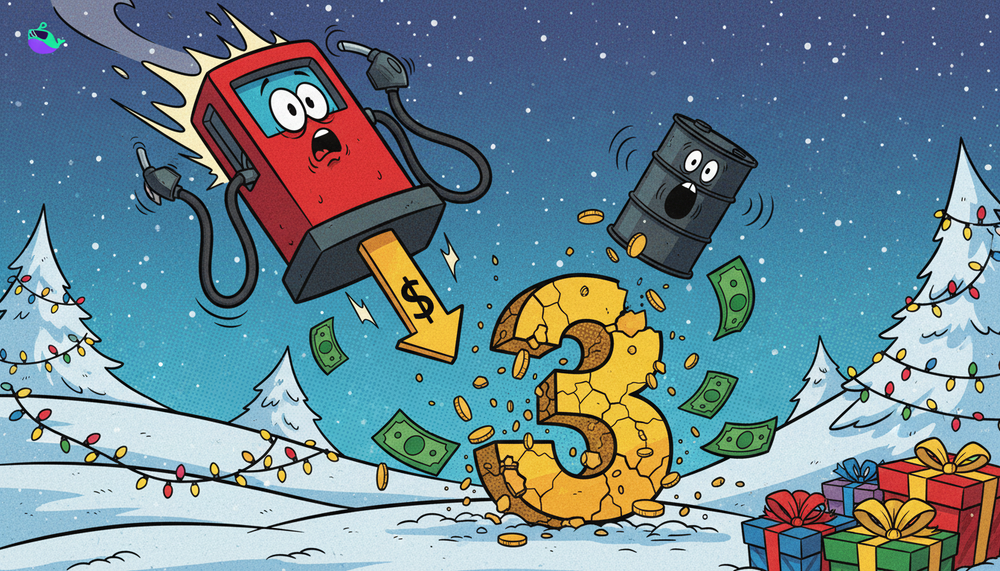
Gas prices are continuing their downward trend, falling below $3 per gallon nationwide and reaching their lowest point in four years, just ahead of the Christmas holiday travel period.
Factors Driving the Price Drop
The national average price of gasoline at the pump currently sits at $2.90 per gallon, approximately $0.12 lower than the same time last year, according to AAA data. This marks the third consecutive week of price declines. Several factors are contributing to this decrease:
- Increased Refinery Output: US refineries have completed scheduled maintenance and are now operating at higher production levels.
- Falling Crude Oil Prices: The cost of crude oil, the primary raw material for gasoline, has also been decreasing.
- OPEC Production: Increased oil production by the Organization of the Petroleum Exporting Countries (OPEC) has further exerted downward pressure on crude oil prices.
Expert Opinions and Predictions
According to GasBuddy, the current national average is the lowest it has been since March 12, 2021, resulting in weekly savings of almost $400 million compared to last year. GasBuddy data indicates that some gas stations in states like Texas, Colorado, and Oklahoma are already offering gasoline for $1.99 per gallon, and this trend is expected to expand to other areas.
Tom Kloza, an analyst for Gulf Oil, anticipates that these sub-$2 prices will become more common in the coming weeks, potentially spreading to stations in an additional 6 to 12 states. He believes the market will likely find a bottom within the next 60 days.
Weather conditions will play a crucial role; colder temperatures will incentivize refiners to produce diesel, heating oil, and kerosene, which yield gasoline as a byproduct, potentially offsetting any decrease in demand due to the weather. Furthermore, Kloza predicts a gasoline futures rally as the days lengthen, a common occurrence between the fourth and second quarters of the year.
Impact on Crude Oil Markets
The decline in gasoline prices is closely linked to the performance of crude oil markets.
West Texas Intermediate (WTI) futures recently reached their lowest level since 2021, touching $55 per barrel. Year-to-date, WTI prices have fallen by 22%. Brent crude, the international benchmark, has experienced a similar decline, dropping by 20% during the same period.
| Benchmark | Current Price (Approx.) | Year-to-Date Change |
|---|---|---|
| West Texas Intermediate (WTI) | $55 per barrel | -22% |
| Brent Crude | *Data Not Provided* | -20% |
Political Commentary
President Trump recently highlighted the lower energy prices, suggesting they would help reduce the cost of living for Americans. He emphasized the importance of affordability and noted that $1.99 gasoline would be equivalent to a significant tax cut.
FAQs
Why are gas prices dropping so significantly right before Christmas?
Gas prices are falling due to increased refinery output, declining crude oil prices, and higher oil production from OPEC, leading to the lowest prices in four years. The national average is currently $2.90 per gallon.
How low could gas prices potentially go in the coming weeks?
Some states are already seeing gas prices as low as $1.99 per gallon, and experts predict this trend will expand to more states soon. The market is expected to find a bottom within the next 60 days.
What impact are lower gas prices having on the crude oil market?
Lower gas prices are linked to falling crude oil prices, with West Texas Intermediate (WTI) futures reaching their lowest level since 2021 at around $55 per barrel, down 22% year-to-date. Brent crude has also experienced a similar decline.
You've got the context, now make it count. Capitalize on this financial knowledge and explore opportunities in crypto premarket on Whales Market.